Meshchersky's equation is the basic equation in the mechanics of bodies of variable mass, obtained by I. V. Meshchersky in 1897 [1] for a material point of variable mass (composition) .
The equation is usually written as follows:

Where:
- - the mass of the material point , changing due to the exchange of particles with the environment, at an arbitrary time t;
- - the velocity of the material point of variable mass ;
- - the result of external forces acting on a material point of variable mass from the side of its external environment (including, if this takes place, and from the side of the medium with which it exchanges particles, for example electromagnetic forces - in the case of mass transfer with a magnetic medium, the resistance of the medium movement, etc.);
- - the relative velocity of the attached particles;
- - the relative speed of the separated particles;
- and - the rate of increase in the total mass of adhering particles and the rate of increase in the total mass of separated particles, respectively.






The Tsiolkovsky formula can be obtained as a result of solving this equation.
Value:
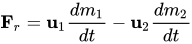
called "reactive power . "
Usually [2] [3] [4] the Meshchersky equation is obtained based on the equation for the rate of change of momentum of a system of material points, having the form:

Where - the momentum of the system, equal to the sum of the momenta of all the material points that make up the system, and - the resultant of all external forces acting on the bodies of the system. The following is the derivation of the equation using just such an approach.


Consider a body of variable mass . Let for a period of time a small mass is attached to the body speed before joining , and a small mass is separated whose speed after separation becomes equal . As the system of interest to us, we will consider all three of the mentioned bodies.


In accordance with the law of conservation of momentum, the momentum of the system at the beginning and end of the process in question is the same:

Where - a change in the momentum of the main body, due to both a change in its speed and a change in its mass.

Given that , from (1) we obtain:


Change in body weight associated with and the ratio , therefore, from (2) it follows:



After the transition from differentials to derivatives and rearrangement of the terms (3) takes the form:

By entering the relative particle velocities and equal respectively and , and adding the resultant of external forces , we obtain the Meshchersky equation in its final form.


Meshchersky's Relativistic Equation
The first papers [5] devoted to the study of rocket motion taking into account relativistic effects were the papers of Akkeret [6] and Senger [7] .
In deriving the Meshchersky equation, suitable for the case of velocities comparable to the speed of light, the expression for the relativistic momentum is used . As a result, the equation takes the form:
In this equation, in the general case, relative velocities are not introduced and , since in the relativistic case the addition of velocities is performed differently.
For the case of only particles separated with the speed of the collinear velocity of the rocket, this equation reduces to the following form:
Where - particle velocity relative to the rocket.
Discovery History
The equation of motion of a material point of variable mass for the case of attachment (or separation) of particles was obtained and thoroughly studied in the master's thesis of I. V. Meshchersky, defended at St. Petersburg University on December 10, 1897 [8] . The first report on the equation of motion of a material point of variable mass in the general case of simultaneous attachment and separation of particles was made by I.V. Meshchersky on August 24, 1898 at a meeting of the section of mathematics and astronomy of the X Congress of Russian naturalists and doctors in Kiev , it became widely known later, after the work "Equations of motion of a point of variable mass in the general case", published in the "News of the Petersburg Polytechnic Institute" in 1904 [9] .
It should be noted that according to the research of G. K. Mikhailov set forth in his doctoral dissertation [10] and the work “Georg Buqua and the beginning of the dynamics of systems with variable masses” [11] , a similar equation was established by the Czech amateur scientist Georg Buqua (1781— 1851) back in the works of 1812-1814.
See also
- Tsiolkovsky's equation
- Rocket dynamics
Notes
- ↑ Kosmodemyansky A. A. “The Scientific Activities of Ivan Vsevolodovich Meshchersky” pp. 9-25 in the book of I. V. Meshchersky. Work on the mechanics of bodies of variable mass. Ed. 1st. - M.: GITTL, 1949.p.13.
- ↑ Sivukhin D.V. General course of physics. - M .: Fizmatlit; MIPT Publishing House, 2005. - T. I. Mechanics. - S. 119-120. - 560 s. - ISBN 5-9221-0225-7 .
- ↑ Targ S. M. A short course in theoretical mechanics. - M .: Higher School, 1986. - S. 287-288. - 416 p.
- ↑ I. Herodov. Basic laws of mechanics. - M .: Higher school, 1985. - S. 41. - 248 p.
- ↑ Sedov L.I. , Tsypkin A.G. Fundamentals of macroscopic theories of gravity and electromagnetism. - M .: Nauka, 1989. Pp. 153.
- ↑ Aekeret I. Zur Theorie der Raketen // Helv-Physica. Acta. — 1946. - T. 19, N 2-P. 103-112.
- ↑ Sanger E. Zur Mechanik der Photonen-Strahlantriebe. - Munchen, 1956 (Russian transl.: M .: IL, 1958).
- ↑ Meshchersky I.V. Work on the mechanics of bodies of variable mass. - M .: State Publishing House of technical and theoretical literature, 1952. - S. 37.
- ↑ Meshchersky I.V. Work on the mechanics of bodies of variable mass. - M .: State Publishing House of technical and theoretical literature, 1952. - S. 222.
- ↑ Development of the fundamentals of the dynamics of a variable composition system and the theory of jet propulsion. - M .: 1977
- ↑ "Studies in the history of physics and mechanics." Moscow: Science, 1986, p. 191—238
Literature
- Meshchersky I. V. "Dynamics of a point of variable mass" // In the book. I.V. Meshchersky. Work on the mechanics of bodies of variable mass. Ed. 2nd. - M .: GITTL, 1952. - 280 p. pg. 37-188.
- Meshchersky IV , “Equations of motion of a point of variable mass in the general case” // In the book. I.V. Meshchersky. Work on the mechanics of bodies of variable mass. Ed. 2nd. - M .: GITTL, 1952. - 280 p. pg. 222-264.
- Mikhailov G. K. "On the history of the dynamics of systems of variable composition" Izvestiya AN SSSR: Solid Mechanics, 1975, No. 5, p. 41-51.
- Mikhailov G. K. On the history of the dynamics of variable composition systems and the theory of jet propulsion. M .: Institute of Problems of Mechanics, USSR Academy of Sciences, 1974.
- Karagodin V. M. Theoretical foundations of body mechanics of variable composition. M .: Oborongiz, 1963.178s.
- Mechanics of bodies of variable mass - an article from the Physical Encyclopedia
- Kilchevsky N.A. Course in Theoretical Mechanics. Volume 1. M .: Nauka, 1977. Chapter IV “Dynamics of a point of variable mass” Paragraph 221. - Derivation of the Meshchersky equation (pp. 433-435).
- Aizerman M.A. Classical mechanics. 2nd ed. M .: Nauka, 1980 .-- 368 p. Chapter 3. Paragraph 9. Application of the basic theorems of mechanics to the motion of a system of variable composition. pg. 107-120.
- Veretennikov V.G. , Sinitsyn V.A. Theoretical mechanics (additions to general sections). - M .: FIZMATLIT, 2006 .-- 416 p. - ISBN 5-9221-0703-8 (Sections 2.5. Kinematics of a system of variable composition. P. 71-77; 3.4. The main dynamic values of a system of variable composition. P. 91-94; 6.2. The problem of the motion of the center of mass during the interaction of a body with external continuous medium p. 170-172; 6.3. Theorem on the change in the quantity of motion of a system of variable composition. p. 172-180; 6.6. Application of the theorem on the change in kinetic energy to a system of variable composition. p. 200-207; 7.2. General equation analytical dynamics for a system of points of variable mass. p. 215-227.)
- Sedov L. I. To the relativistic theory of rocket flight // Applied Mathematics and Mechanics - 1986. - V. 50, no. 6.
- Sedov L.I. , Tsypkin A.G. Fundamentals of macroscopic theories of gravity and electromagnetism. - M .: Nauka, 1989 .-- 272 p. - ISBN 5-02-013805-3 . Chapter III. paragraph 4. Relativistic theory of rocket flight.
Links
- Borodovsky V.N. Domestic rockets. History and future