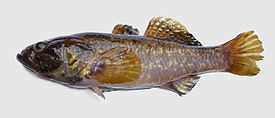
Rota-rotana [3] , or rotan [3] , or charcoal , or grass ( Latin Perccottus glenii ) is a species of ray-finned fish from the Golenshkov family, the only member of the genus of Robe ( Perccottus ).
| Rotan | |||||||||||||||||||||||||||||||||||||||||||
 | |||||||||||||||||||||||||||||||||||||||||||
| Scientific classification | |||||||||||||||||||||||||||||||||||||||||||
|---|---|---|---|---|---|---|---|---|---|---|---|---|---|---|---|---|---|---|---|---|---|---|---|---|---|---|---|---|---|---|---|---|---|---|---|---|---|---|---|---|---|---|---|
| |||||||||||||||||||||||||||||||||||||||||||
| International Scientific Name | |||||||||||||||||||||||||||||||||||||||||||
Perccottus glenii Dybowski , 1877 | |||||||||||||||||||||||||||||||||||||||||||
| Synonyms | |||||||||||||||||||||||||||||||||||||||||||
| |||||||||||||||||||||||||||||||||||||||||||
| Area [2] | |||||||||||||||||||||||||||||||||||||||||||
| |||||||||||||||||||||||||||||||||||||||||||

Erroneous Latin species names in the literature ( orth. Var. ): Glehni , glenhi . The erroneous name of the genus Percottus is also used.
In the second half of the 20th century, among aquarists, rotan was often called the Amur bull .
Content
Description
The body is dense, short, covered with dull scales of medium size. The color is changeable, gray-green and dirty-brown tones prevail, with small spots and strips of irregular shape. The color of the belly is usually grayish. In the mating season, rotan becomes black. The head is large, the large mouth is seated with small sharp teeth in several rows. Gill covers have a characteristic backward-facing spine-like spike, however, in rotan it is soft. The fins are soft, without sharp thorns. There are two dorsal fins, the rear one being longer. Anal fin short. Pectoral fins large, rounded. The tail fin is rounded. In general, rotan resembles representatives of goby fish. The characteristic difference is the ventral fins: in Rotan, they are paired, are close to the head and disproportionately small, while in the goby, the abdominal fins coalesce into one and resemble a sucker.
In length, rotan can reach 10–35 cm, depending on the habitat conditions, but fish of record sizes are rare. Maximum weight 500 gr. Life expectancy is up to 15 years, usually 7–10 years.
Sexual maturity comes at the age of two. Spawning occurs in May and July. Fertility is about 1 thousand eggs. Rotan caviar lays on plants and on various objects, after which the male protects the clutch. It feels best in stagnant waters with well-developed higher aquatic vegetation.
Rotan withstands partial drying of the reservoir and complete freezing to the bottom in winter. Survives in polluted water.
Rotan is a predator. Initially, the fry feed on zooplankton , then on small invertebrates, benthos .
Adult rotan eat small fish, leeches, newts , amphibian larvae ( tadpoles ). Rotan feed on caviar and sometimes carrion.
Cannibalism is widespread in Rotan - eating smaller individuals of its own species. During fishing, rotan often swallows the bait deeply.
In a small reservoir, rotan becomes numerous and is able to completely exterminate representatives of other species of fish.
In large bodies of water, other predatory fish regulate the abundance of rotan: pike , catfish, and especially perch . At home in the Far East - if in a lake or in a pond, where only rotan previously lived, miners are found, they will regulate the number of rotan, actively eating their juveniles.
Rotan is not able to survive, being completely frozen; nevertheless, when a water body freezes, glycerin and glucose released inside the fish bind free water, thereby increasing the specific salt concentration in the tissues and the surrounding water, which very significantly lowers the crystallization temperature. [4] After thawing the pond, rotan returns to normal life.
Area
Hitting rotan in the XX century in the basin of Lake Baikal, many scientists consider as biological pollution.
In 1916, rotan was released into the reservoirs of St. Petersburg. Subsequently, it spread throughout Northern Eurasia, over most of the territory of Russia and many European countries.
At present, rotan has been recorded in the basins of the Volga , Dnieper , Don , Dniester , Danube , Irtysh , Ural , Styr , Ob rivers. It lives in stagnant reservoirs, where there are no conditions for the existence of other predators. It spreads in flood between floodplains and is also settled by humans.
In large reservoirs, natural enemies of rotan are salmon ( grayling , trout , and char ), eel , pike , zander , asp, and especially perch . The number of people in such conditions is usually very small, and most often it reaches its size of up to 200 grams.
Biological and economic value
Rotan is not a weed fish, but an active predator.
In pond farming, rotan harms fish farming by eating fry of valuable species of fish.
Large rotan is an object of amateur fishing , it bites well on earthworm and pieces of raw meat or lard, as well as on various mormyshki and medium sized locks, it is enough to tie a bunch of red threads to the hook. Being caught in a pond, rotan not bad withstands transportation in a bucket of water to another reservoir, where it can be used as live fish for catching predatory fish, which, however, can contribute to its settlement. Rotan is indispensable when fishing in circles , especially when fishing for perch, perch, catfish and pike. Resilient, as live fish works all day, at home, contained in a barrel or bath in the country. Fishing does not require special gear, just a meter of fishing line with a hook to catch rotan in sufficient quantities.
From rotan you can cook a lot of various dishes - ranging from ordinary fried or dried fish to more complex dishes, such as burgers or baze. Its meat is dense, tender, white-pink in color, with a small number of large bones. Skillfully cooked rotan can compete in its taste with the most exquisite dishes.
Notes
- ↑ FishBase: Synonyms Perccottus glenii Dybowski, 1877
- ↑ Reshetnikov AN, 2010. The current range of Amur sleeper Perccottus glenii Dybowski, 1877 (Odontobutidae, Pisces) in Eurasia. Russian Journal of Biological Invasions. 1 (2): 119-126.
- ↑ 1 2 Reshetnikov Yu. S. , Kotlyar A. N. , Russ T. S. , Shatunovsky M. I. Pyatiazychny dictionary of animal names. Fish. Latin, Russian, English, German, French. / edited by Acad. V.E. Sokolova . - M .: Rus. laz., 1989. - p. 346. - 12 500 copies. - ISBN 5-200-00237-0 .
- ↑ V.N. Elovenko, “Why does not freeze rotan”, Chemistry and Life, 1981, No. 1, p. 30
Links
- All about rotan in the article with the video: description, gear, tips
- Rotan 100 years of expansion (inaccessible link)
- Catching rotan float fishing tackle, video
- Vertebrates of Russia: rotan goloshenka
- Rotan in the Catalog of Freshwater Fish in Russia
- rotan on rybalka.tv
- Rotan (Chinese sleeper) in Fishbase
- Description of rotan (pdf document)