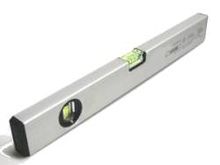
Level , or waterpas ( eng. Waterpass , net . Waterpas from water “water” + pas “adjust”) - a rectangular measuring instrument made of plastic, wood or metal with transparent flasks (eyes) installed in it filled with liquid. The level was designed to assess the correspondence of surfaces to a vertical or horizontal plane, as well as to measure the degree of deviation of a surface from a horizontal plane.
Content
- 1 History
- 2 Design
- 3 Common Level Types
- 4 Other level designs
- 5 spirit level
- 6 Checking and leveling
- 7 See also
Appearance History
The alcohol level was invented by the French scientist, traveler and cartographer Melchizedek Theveno . His invention was first used on his expedition to Madagascar in 1666.
Design
The main working element of this tool is measuring flasks (level eye), most often barrel-shaped with risks applied to their body. The flasks are usually filled with a colored alcohol-containing liquid with a small air bubble. Filling with alcohol, for example ethanol, is explained by the fact that such a liquid does not freeze at a negative temperature, and also has a low viscosity for the rapid movement of an air bubble. Measurement and adjustment of surfaces relative to horizontal and vertical planes occurs due to the movement of an air bubble along the bulb, and it is necessary to achieve its position exactly in the middle between the two risks on the bulb. In modern instruments for measuring a more accurate deflection angle, more than two scans are applied to the eye.
The most common type of level is a level with two eyes: vertical (90 degrees) and horizontal (180 degrees). For more complex work, a tool with three eyes is used. The third of the flasks fixedly measures 45 degrees from the horizontal plane or is rotary to measure any angle of the surface. Less commonly used are levels with a large number of eyes that duplicate horizontal or vertical flasks for a more accurate measurement. Today, there are many types of levels designed for various needs. First of all, the tool is used by carpenters, masons, installers for various installation and mounting works, as well as to verify the results of already completed work.
The level enclosure may include the following modifications:
- Stiffeners - for greater strength of the tool body
- Marking on one of the sides of the level - to use the tool as a ruler
- The milled surface of one of the sides - to prevent the level from slipping off the work surface, as well as to facilitate the applied efforts while holding the level with one hand
- Impact pad - for the possibility of striking with a hammer in order to adjust the surface with which the master works
- Groove for pipes - to prevent slipping level from rounded surfaces
The most common types of levels
Profile Level
It is made of a rectangular aluminum shape. Suitable for all types of work. Main advantage: body strength.
Rail level
Lightweight rail-shaped housing. Suitable for all types of work. The main advantage: low weight.
Dashboard level
A small plastic case, most often 225 mm. One of the sides is magnetic for installation on a metal surface. Suitable for domestic work. Main advantage: small sizes
Shock level
Level with an additional platform for the possibility of striking with a hammer. Suitable for tile laying. The main advantage: a robust housing, the ability to strike.
Other level designs
- Laser level (Also see the Level subject to accuracy according to GOST 10528-90)
- Water Level ( Hydro Level )
Spirit Level
Often, in contrast to the liquid level described above, a device is called a device, which consists of two strictly perpendicular wooden planks connected in the form of an inverted letter T, on the "leg" of which a plumb line is fixed. The spirit level performs the same functions as the horizontal level, but is easier to manufacture.
Check and adjust level
To check the level (that is, to evaluate the accuracy of his measurements), it is necessary to install it on a flat horizontal surface and measure the position of the air bubble relative to two marks in the center of the bulb. Then the level must be turned in the horizontal plane 180 degrees and re-measure the position of the bubble. If the level is good, then the air bubble will be in exactly the same position as in the first measurement. To adjust the instrument (if provided, the flask will be fixed with the adjusting screws on the level body), it is necessary to alternately rotate the level 180 degrees in the horizontal plane and adjust the position of the eye until its readings are identical when the instrument rotates. For such adjustment, a perfectly horizontal or vertical surface is not required.
See also
- Plumb
- Malka