Lactobacillus acidophilus (lat.) - a species of bacteria of the genus Lactobacillus , used in industry together with Streptococcus salivarius and Lactobacillus delbrueckii subsp. bulgaricus for the manufacture of acidophilus and other acidophilus drinks.
| Lactobacillus acidophilus |
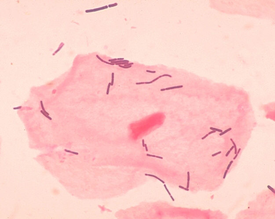
L. acidophilus near vaginal epithelial cells |
| Scientific classification |
|---|
| View: | Lactobacillus acidophilus |
|
| International scientific name |
|---|
Lactobacillus acidophilus (Moro 1900) Hansen and Mocquot 1970 |
|
Lactobacillus acidophilus got its generic name from lat. lacto- - “milk” and bacillus - “stick”, and the species name from acidum - “acid” and “philus” - “to love”.
L. acidophilus survives in more acidic environments than other species ( pH 4-5 or less) and grows optimally at temperatures around 30 ° C . L. acidophilus is naturally found in the digestive tract and vagina of humans and some other mammals . The bacterium ferments lactose and other saccharides [1] to lactic acid , like many other (although not all) lactic acid bacteria . Some related species produce ethanol , carbon dioxide and acetic acid , but L. acidophilus is a homoenzymatic organism that produces only lactic acid. Like most bacteria, L. acidophilus can be destroyed by heat or direct sunlight.
Acidophilic lactobacilli can be used as probiotics. In Russia, several brands of drugs are registered , the main active ingredient of which is the culture of these bacteria: “Acylact”, “Vitaflor”, “ Acipol ”, “LIVEO”, “Linex”, “Biobacton”, “Lactobacterin”, “Normobact”, “ Ecofemin. "
The pharmacological effect of these drugs is caused, among other things, by lactic acid produced by living lactobacilli, which provides a high acidity of the medium and creates adverse conditions for the life of acid-sensitive pathogenic and conditionally pathogenic bacteria (staphylococci, protea, enteropathogenic Escherichia coli).
