Vladimir Alexandrovich Kislitsyn (January 9, 1883, Bila Tserkva - May 18, 1944, Harbin ) - Russian officer, colonel (1919), major general (1928, produced by Grand Duke Kirill Vladimirovich). He was an officer of the Russian Imperial Army , and then commander of the White Army at a later stage of the Civil War .
| Kislitsyn Vladimir Alexandrovich | |||||||
|---|---|---|---|---|---|---|---|
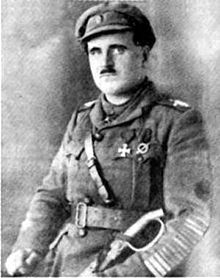 Photo taken after the Great Siberian Ice Campaign | |||||||
| Date of Birth | |||||||
| Place of Birth | |||||||
| Date of death | |||||||
| Place of death | |||||||
| Affiliation |  Russian empire Russian empire Republic of China Republic of China Manzhou guo Manzhou guo | ||||||
| Rank | major general | ||||||
| Battles / wars | |||||||
| Awards and prizes |
| ||||||


Biography
Born on January 9, 1883 in the White Church of the Russian Empire, now Ukraine.
Start of Service
The son of Admiral Alexander Kislitsyn. Vladimir was educated at the Odessa Military School in 1900 . He was sent to serve in the Separate Border Guard Corps on the western border of the Russian Empire . He participated in the Russo-Japanese War .
He participated in the Great War in the ranks of the 23rd Odessa Border Brigade. On August 6, 1916, being seconded to the 11th Dragoon Regiment of Riga, he was promoted to colonel with seniority on January 10, 1916. He was repeatedly wounded, including his head.
According to Kislitsyn’s memoirs, at the end of 1917 he commanded a brigade in the 11th cavalry division, and in November 1917, when dividing the division into Great Russians and Ukrainians, he headed the Ukrainian formations in the division.
In Ukraine
In 1918 he served in the hetman army of Ukraine. He was appointed brigade commander and then head of the 3rd Ukrainian Cavalry Division, then commander of the Ukrainian corps in Zhytomyr. These Ukrainian units were not formed and existed only on paper.
He participated in the defense of Kiev from the Petliurites and the Bolsheviks in December 1918. After the occupation of Kiev, the Petliurites were captured in Darnitsa , and was arrested in the Kiev museum. At the insistence of the German authorities, he was released and went to Germany.
He lived in a camp in Neustadt .
Service in the White Army
In 1919, Kislitsyn with a small group of officers, passing through Denmark, Norway and Murmansk, in June 1919 arrived in Arkhangelsk on the Northern Front of General Eugene Miller . Upon arrival in Arkhangelsk he was appointed to the post of General for errands under the Commander-in-Chief General Miller.
Not believing in the success of actions on the Northern Front, Kislitsyn asked Miller for permission to go to Siberia to Kolchak. By boat on the Arctic Ocean and the Pechora River I got to Ust-Tsilma , from where on horseback along the taiga and boats on the Sosva River I got to Berezov , and from there on the boat to Tobolsk and the capital of White Siberia Omsk .
In July 1919, Vladimir Kislitsyn was appointed brigade commander of the 2nd Ufa cavalry division in the army of Admiral Kolchak . In September 1919 he participated in the Tobolsk operation . On October 12, 1919, he was wounded in a battle near the village of Krutikha, Yalutorovsk district, Tobolsk Province. In December 1919, he was appointed commander of the 2nd Ufa cavalry division.
After the defeat of Kolchak’s army in the Urals and Western Siberia , Vladimir Kislitsyn took part in the Great Siberian Ice Campaign . After arriving in Chita , Ataman Semenov entrusted him with a Manchu detachment until the White Guards retreated from Russia ( 1921 - 1922 ).
In exile
Vladimir Kislitsyn emigrated to Harbin in November 1922 , where he became a dentist, and also served in the police. In Manchuria, he led the local club of " Legitimists " who supported Kirill Vladimirovich as the legitimate heir to the Russian throne. In 1928, he was promoted by Grand Duke Kirill Vladimirovich to the rank of general. The commander of the detachment of Russian volunteers during the conflict on the CER . In 1935 he created the Far Eastern Military Union under the slogan " For Faith, Tsar and Fatherland ", which by 1939 totaled 11,500 people. In 1936, Kislitsyn’s memoirs “In the Flames of Civil War” were published in the publishing house “ Our Way ”.
From 1938 to 1944, Kislitsyn served as chairman of the Bureau for Russian Emigrants in Manchuria , created by the Japanese . On his initiative, on November 7, 1940, the monument to the fighters against the Comintern was unveiled in Harbin on Cathedral Square on November 7, 1940.
He died in Harbin in 1944 , where he was buried.
Rewards
Vladimir Kislitsyn was awarded the Order of St. George of the fourth class in 1915 , the Order of St. Stanislav of the 3rd and 2nd class , the Order of St. Anne of the 4th and 1st class and received the St. George arms .
Works
- In the fire of the Great World War (personal memories). Harbin, 1938.49 p.
- On fire Civil war: memoirs. Harbin, Our Way, 1936. 113 c.
- Pantheon of military valor and honor. Harbin, 1941.488 s.
- Ways of Russian youth. Harbin, "Dawn", 1944. 248 p.