The Ministry of the Navy of Imperial Japan ( Jap. 海軍 省 Kaigunshё ) [1] - the civilian executive authority of Imperial Japan on military policy and public administration of the Navy in 1872-1945.
| Ministry of the Navy Imperial Japan 大 日本 帝国 海軍 省 Dai Nippon Teikoku Kaigunsyo | |
|---|---|
 The building of the Ministry and the General Staff Imperial Japan Navy | |
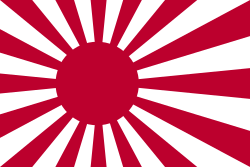 Imperial Japan Navy Flag | |
| general information | |
| A country |  Imperial japan Imperial japan |
| date of creation | 1872 |
| Previous Office | Ministry of War 1868-72 |
| Leads activities | Minister of the Navy |
| Parent agency | Imperial Headquarters |
| Headquarters | Tokyo Kojimati-ku , Kasumigaseki |
| Minister (1872) | C. Saigo |
| Minister (1945) | S. Kabayama |
| Key document | Decree of the Ministry of Imperial Japan |
Content
History
The Ministry of the Navy was created in April 1872 simultaneously with the Ministry of the Army , to replace the former Ministry of Military Affairs.
Initially, the Ministry of the Fleet was responsible for both administrative affairs and the operational activities of the Imperial Fleet of Japan , but after the creation of the General Staff in May 1893, the Ministry retained only administrative functions. Its main tasks were responsibility for the fleet budget, providing the fleet with weapons, personnel issues, relations with parliament and the Cabinet of Ministers , as well as a wide range of issues of naval policy.
The head of the Fleet Ministry was the Minister, who was assisted by senior and junior deputies, as well as senior and junior clerks. According to the structure of 1872, the Ministry included the Secretariat of the Minister and three departments.
Ministry of the Navy ( Dayjokan , 1872) | |||
| The Minister 卿 | Seniors alternates 大 輔 | Junior alternates 少 輔 |
|
| Seniors clerks 大 丞 | Junior clerks 少 丞 | ||
In 1876, the Ministry was replenished with 2 departments and one service. It took full responsibility for the maintenance of warships.
In 1884, the Ministry established the Department of the General Staff of the Navy of Japan . For two years he was reassigned to the General Staff of the Army , turning it into a Fleet Division ( п 部 ) . In 1889, this department was again transferred to the Ministry of the Navy, and in 1893 it was assigned to an independent military structure - the General Staff of the Navy of Japan , which was subordinate only to the Emperor of Japan .
In 1885, in connection with the replacement of Daidzekan by the Cabinet of Ministers , the Ministry was reorganized. Since 1900, only professional active service men had the right to head it. Advisers to the Minister of the Navy were exclusively appointed from the same category. In 1913, an amendment was adopted, according to which civilians could become a minister, but after the coup on February 26, 1936 it was canceled.
After the Sino-Japanese War of 1894–1895 and the Russo-Japanese War of 1904–1905. the status of the Imperial Navy equaled the status of the Imperial Army of Japan . Unlike army generals, who saw Japan and Russia as the main danger, the fleet's top leadership considered the North American United States a potential adversary for the country in the Pacific. It began to increase the combat effectiveness of the Japanese naval forces and expanded the structure of the Ministry of the Navy. For 1916 it consisted of the Secretariat of the Minister, the Military, Medical, Legal and Organizational Departments, as well as the Departments of Personnel, Finance and Ship Management.
Ministry of the Navy ( Cabinet of Ministers , 1916) | |
| The Minister 大臣 |
|
Until the 1920s, the Fleet General Staff played a subordinate role to the Fleet Ministry, but during the Washington Conference , General Staff officers saw a chance to make a difference. At the Conference, the United States and Great Britain wanted to establish the proportions between the number of ships in the fleets of various powers, and asked Japan to agree that it had fewer ships than Western countries. The naval minister wanted to agree to this in order to preserve the Anglo-Japanese alliance , but the Naval General Staff opposed, as a result, the Imperial Fleet of Japan split into warring "fleet faction" and "contract faction". As a result, Japan signed the agreement, but withdrew from it in 1934.
In the 1930s, as Japanese militarism grew, the "fleet fraction" gradually gained the upper hand over the "contract fraction", and as a result, the prevailing influence of the General Staff led to the decision to attack Pearl Harbor contrary to the opinion of the Ministry of the Fleet, which preferred diplomatic methods.
Since 1937, both the Minister of the Navy and the chief of the Naval General Staff became members of the Imperial Headquarters.
Ministry of the Navy ( Cabinet of Ministers , 1940) | |
| The Minister 大臣 |
|
Chapters
Sea Lords of the Ministry of Military Affairs
Ministry of the Navy ( Dayjokan ) | ||||
| No. | Name | Period | Affiliation | |
|---|---|---|---|---|
| one | Katsu Kaisu | October 25, 1873 - April 25, 1875 | former Tokugawa Shogunate official | |
| 2 | May 24, 1878 - February 28, 1880 | Satsuma Faction | ||
| 3 | Enomoto Takeaki | April 28, 1875 - April 7, 1881 | former Tokugawa Shogunate official | |
| four | April 7, 1881 - December 22, 1885 | Satsuma Faction | ||
Fleet Ministers
According to the law, the Fleet Minister was appointed from among the current admirals and vice admirals. His primary task was to organize interaction between the Fleet General Staff , the Fleet , the Cabinet of Ministers and the Parliament .
| Period of office | Name | |
|---|---|---|
| one | December 22, 1885 - May 17, 1890 | Saigo Zugumichi |
| 2 | May 17, 1890 - August 8, 1892 | Kabayama Sukanori |
| 3 | August 8, 1892 - March 11, 1893 | |
| four | March 11, 1893 - November 8, 1898 | Saigo Zugumichi |
| five | November 8, 1898 - January 7, 1906 | Yamamoto Gombay |
| 6 | January 7, 1906 - April 16, 1914 | Saito Makoto |
| 7 | April 16, 1914 - October 8, 1915 | |
| eight | October 8, 1915 - May 15, 1923 | Kato Tomosaburo |
| 9 | May 15, 1923 - January 7, 1924 | |
| ten | January 7 - June 11, 1924 | |
| eleven | June 11, 1924 - April 30, 1927 | |
| 12 | April 30, 1927 - July 2, 1929 | Okada Kaisuke |
| 13 | July 2, 1929 - October 3, 1930 | |
| 14 | October 3, 1930 - December 13, 1931 | |
| 15 | December 13, 1931 - May 26, 1932 | |
| sixteen | May 26, 1932 - January 9, 1933 | Okada Kaisuke |
| 17 | January 9, 1933 - March 9, 1936 | |
| 18 | March 9, 1936 - February 2, 1937 | Osami Nagano |
| nineteen | February 2, 1937 - August 30, 1939 | Yonai Mitsumasa |
| 20 | August 30, 1939 - September 5, 1940 | Yoshida Zengo |
| 21 | September 5, 1940 - October 18, 1941 | Oikawa, Koshiro |
| 22 | October 18, 1941 - July 17, 1944 | Shimada Shigetaro |
| 23 | July 17 - 22, 1944 | |
| 24 | July 22, 1944 - December 1, 1945 | Yonai Mitsumasa |
Notes
- ↑ Ministry of the Navy