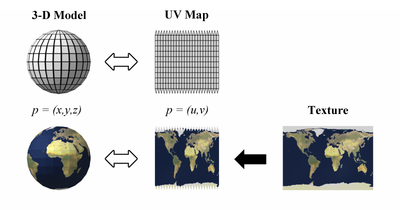


UV conversion or development in a three-dimensional graph ( English UV map ) - the correspondence between the coordinates on the surface of a three-dimensional object ( X , Y , Z ) and the coordinates on the texture ( U , V ). The values of U and V usually vary from 0 to 1 [1] . The scan can be built either manually or automatically - for example, in 3D Studio MAX there are several algorithms for the automatic deployment of the model.
Modern three-dimensional hardware considers that UV-conversion within the limits of one triangle is affine - therefore it is enough to set U and V for each vertex of each of the triangles. However, the 3D modeler chooses exactly how to join the triangles with each other, and the ability to build a successful scan is one of the indicators of his class. There are several conflicting scan quality indicators:
- Maximum use of the texture area. However, depending on the gap between the "minimum" and "maximum" system requirements, the edges of the scan texture need a certain "allowance" for generating smaller textures . [2]
- Lack of areas with insufficient or excessive texture detail.
- Lack of areas with excessive geometric distortion.
- The similarity with the standard angles from which an object is usually drawn or photographed simplifies the artist’s work on textures .
- Successfully located “seams” are lines corresponding to one edge, but located in different places of the texture. Seams are desirable if there is a natural “gap” in the surface (seams of clothing, edges, joints, etc.), and undesirable if there are none. Amateurs from all over the world participated in the modeling of Dota 2 characters, and the modeling guide required that the eyes be a separate “island” of development. [2]
- For partially symmetrical objects: a successful combination of symmetric and asymmetric scan areas. Symmetry increases the detail of the texture and simplifies the work of the artist on the textures; asymmetric details “enliven” the object.
Example: Equidistant Projection
In cartography, a cylindrical projection is a family of projections that transform meridians in the vertical ( U = const) and parallels in the horizontal ( V = const). One of the cylindrical projections, the so-called equidistant projection (φ - latitude , [−π; π]; λ - longitude , [−½π; ½π]):
A similar transformation can be applied in computer graphics to superimpose the texture of the earth's surface on a three-dimensional ball. By these metrics:
- Use of texture area : excellent. Used the entire area of the texture.
- Lack of areas with insufficient / excessive detail : medium. The poles have an excess of detail.
- Similarities to standard angles : good. Such a projection is similar to ordinary cartographic, although it does not coincide with them.
- Lack of seams : excellent. There is one seam along the meridian (between U = 0 and U = 1). The seam can be made as invisible as possible by placing the ocean in its place; also, cyclically shifting the texture, you can accurately draw a seam, and then shift it back.
- Geometric distortion : bad. At the poles, the Earth's surface is severely distorted.
- Symmetry : not applicable. The globe is asymmetrical.
UVW Conversion
Painted and photographic textures use only two coordinates: U and V. In the case of auto-generated textures or multitexturing, a third coordinate is possible - W , depth in the “continuum of textures” [3] . For example, W = 0 can be sand, W = 1 can be stones, intermediate values can be sand from which stones peep.
The fourth, fifth, etc. coordinates are theoretically possible - however, the graphic hardware, imposing textures, carries out the transformation [4] and discards the third coordinate. The UVW transform uses the discarded coordinate to transition from one texture to another: it animates the “screen world” without seriously changing the design of the video card.
Notes
- ↑ There is also a mode where U and V are arbitrary, and the video card takes a fractional part , this allows you to cover the surface with a repeating texture. However, in this mode, the scan is prepared algorithmically, and not manually.
- ↑ 1 2 DOTA 2 item UV mapping
- ↑ 3ds Max UVW Mapping - CGWiki unopened (inaccessible link) . Date of treatment July 29, 2013. Archived September 21, 2013.
- ↑ To be precise, the graphics accelerator operates with 4-dimensional vectors, which are the uniform coordinates of a point in R³