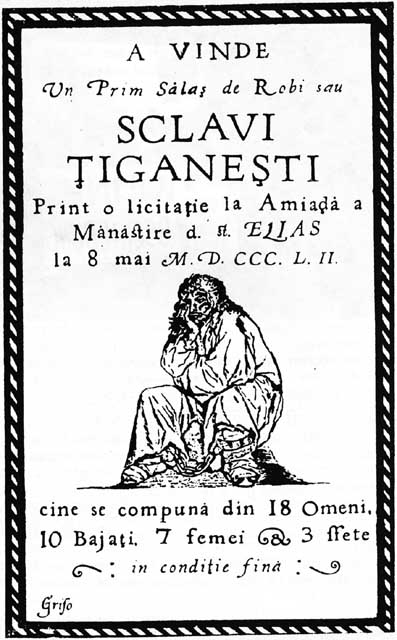
Slavery in Romania ( 1385 - 1856 ) and the Romanian lands (Robie, rum. Robie ) had a peculiar character and lasted until 1864 . Historically, slaves in the Danubian principalities were mainly Gypsies ( Wallachia , Transylvanian Principality , Bukovina ) and, to a lesser extent, the Bujak Tatars and Nogais ( Moldavian Principality ). Slavery in Romania, which at that time was a vassal of the Ottoman Empire , was prohibited by law only in February 1856, but in fact it disappeared only in the mid-1860s. At the same time, along with slaves in the Romanian lands there were serfs - Romanians (known as tsars , epochs , serfs ); and in Transylvania - “ Romanians ”, Yobags , etc.) The basis of the local ruling class ( boyars ) was ethnic Romanians (in Wallachia and Moldova), and in Transylvania - ethnic Hungarians .
History
Despite all the difficulties of statistical accounting, as well as socio-political contradictions in the country, Romania is the largest and most famous region of the gypsy culture in the world. This circumstance is not accidental. Gypsies settled in medieval Romanian lands in unusually large numbers. They were undoubtedly attracted to this by the greater tolerance of the Romanesque population, which has been preserved here since antiquity. Indeed, in comparison with the Wallachians, who were also partially involved in nomadic cattle breeding, the later peoples settled in the Balkans were much less tolerant of the nomadic way of life of Gypsies, their language and culture.
Romanian gypsies currently number at least two million people. The first Gypsies entered the Romanian lands in the 12th century from the south. Starting from the 13th century, the Gypsies found themselves in the position of slaves of the local Romanian and Hungarian boyars. It was then that their gradual enslavement by the local Slavic-Roman elite in a very peculiar form, resembling slavery in Brazil, began . The first written mention of Roma slaves in Romania appeared on the third of October 1385 . At different times, hypotheses were also put forward that the Gypsies in Romania were supplied by the Mongols or Turks , who drove them from Asia. After the transformation of Romania into a vassal of the Ottoman Empire, the country became part of the Mediterranean slave trade with the Maghreb countries.
Gypsy estates

Of particular note is the complex classification of Romanian gypsies that has developed over more than 5 centuries of slavery in Romania.
According to their belonging to a certain class of owners, gypsy slaves were divided into three categories. The most “elite” and the smallest part were the master gypsies (also “god gypsies”, in the old Romanian terminology “gypsy domnesti”), which belonged to the Wallachian rulers and Moldavian rulers ( princes ). They were followed, also not particularly numerous, by a group of monastic or church Gypsies (“Gypsy Menestiresti”), but the most numerous were the boyar Gypsies of the Romanian and Hungarian landowner landowners.
Within each of the three categories there were sedentary (vetrash) and semi-nomadic (leiashi) groups of gypsies, the latter being allowed to roam the country for several months, but once or twice a year they were obliged to return to the boyar to pay the rent. In this regard, they are similar to the Mexican day-laborers-hornalers.
It is interesting that the gypsy castes brought from India continued to persist at the insistence of the Romanian boyars in a somewhat modified “semi-professional” form throughout the entire period of the existence of slavery, and even after its abolition. At the time of the maximum flowering of slavery in the Danube principalities, as it once was in the Roman Empire, the Gypsies lived under every, even the most seedy, manor court. Among them were musicians who celebrated all life events (holidays, weddings, funerals), blacksmiths, cooks and others.
In Romania, the following professional classes of gypsies were formed:
- calderashi (letters. "copper craftsman"),
- Lautars ("musicians"),
- Boyars or Lingurars ("Spoons")
- Ursars ( Bear Bears),
- fierara ("blacksmiths"), as well as "horseshoes".
From the very beginning of the history of slavery in Romania, many slaves, as in Roman Dacia , worked in salt and ore mines. The gypsy women who belonged to the boyars were maidservants, often the concubines of their masters. Formal marriages between Romanians and Gypsies were not encouraged, but illegitimate children from such unions filled the streets of Romanian cities, exacerbating the problem of child neglect, which continues to this day. A similar problem was acute in Brazil and other Latin American countries, which for a long time cultivated the institute of plazage .
After the abolition of slavery in the Danube principalities , at least 250 thousand Gypsies, or about 10% of the population, received freedom. In the Russian Bessarabia of 1858, the census also took into account 11,074 gypsy slaves. The release of the gypsies did not improve their economic situation. As in Brazil, the liberated slaves did not receive land, which means they were forced to join the ranks of the urban poor or to modify the scope of their activities. For example, the fierara combined horseshoeing with horse-stealing .