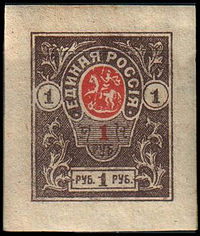
Marks of the South of Russia during the Civil War period include the issuance of postage stamps of local and military administrations in the territory of the South of Russia in 1918 - 1922 .
Content
Issues of the Administration of the Don Don Region
In May 1918, Decree No. 121 of the Council of Departments of the Great Don Army (VVD) Department of Departments was approved, approved by the Don Ataman on May 26, on the issue of exchange marks - a 20- kopeck currency substitute, replacing the exchange coin [1] . The stamp was printed on white paper by the Rostov office of the State Bank , on its front side there is a portrait of Ermak in a helmet and chain mail, on the reverse side of the miniature, the emblem of the Russian Republic is shown at the top, and there is also the text: “An issued stamp was issued by the Rostov n / a office of states. Bank " . In addition to its main purpose - replacing the bargaining chip, this stamp was occasionally used as a postage, as met stamps with the cancellation of Rostov-on-Don testify to this.
There are counterfeits of this brand printed on yellow-brown paper and differing from the true details of the picture. There are also fakes with the propaganda text on the back: “A change of stamp issued by the Rostov n / a CONTROL ATAMAN BAND” [2] .
On September 26, 1918, the Council of Managing Departments of the Ministry of Internal Affairs decided: “To re-stamp the stamps 1, 2, 3, 4, and 7 kopeks, available in postal and telegraph institutions, into stamps of 25 kopeks by stamping“ 25 ” and postcards of 3 kopecks worth 10 kopecks . "
On November 20, 1918, eight postage stamps were issued ( Mi # 1A — 3B; Yt # 7-14) by overprinting a new value on stamps of the Russian Empire of the 17th and 21st issues. Overprints were made in Rostov-on-Don . Stamps were circulated within the Don Region before their official seizure on July 15, 1919. There are known letters and postcards franked with these stamps and sent to Germany , whose ally was the Don Don Region, soldiers and officers of the German troops there [3] .
By the same decree of the Novocherkassk expedition, it was prescribed to print with a circulation of 1 million stamps of the Ermak type, of reduced size, 25 kopecks. However, this release did not take place [4] .
Kuban Oblast Administration Editions
Soon after the occupation of Yekaterinodar and the Kuban region by the troops of the Volunteer Army in August 1918, the Post and Telegraph Department of the Ministry of Internal Affairs of the Kuban Regional Government drew attention to the need to re-evaluate the stocks of postage stamps at its disposal. In the period from 1918 to 1920, three issues of postage stamps were issued. The first issue of eight stamps took place in September 1918, according to the order of the Department of Internal Affairs. A printing overprint of the value figure or the figure of value and the letter “ p ” in black ink was made on stamps of the Russian Empire of the 17th and 21st issues. Stamps were in use on the territory of the Kuban and in the areas occupied by the troops of the Volunteer Army [5] [6] .
The second issue, carried out in 1919, was a typographic overprint on postage stamps of Russia of the 17th and 21st issues and savings stamps in black ink in one line of the value figure and the letter “ k ” or in two lines of the value figure and the word “ ruble ” ( "Rubles" ). The third - in 1920, was a typographic overprint in black ink in two lines of the value figures and the words “cop.” ( “Rubles” ) on Russian stamps of the 17th and 21st issues [6] .
Dono-Kuban
In the fall of 1918, a postal and telegraph agreement was signed between the Kuban and Don regarding the circulation of the Kuban stamps on the Don and vice versa. It was also planned to publish a series of eight stamps for the territory of the Don and the Kuban, symbolizing the unity of the two Cossack troops. Four projects were prepared, approved by the chairman of the Kuban regional government L. L. Bych . The draft of the brand in denominations of 25 kopecks depicted the hands of the Don and Kuban Cossacks stretching to each other; 50 kopecks stamp project - portraits of Taras Bulba and Ermak Timofeevich and the territory of the Don and Kuban rivers. The author of these projects was S. Yuryev. Two more projects were made by another artist [5] .
Trial stamps ( essays ) with the inscription “ Dono - Kuban ” , face value of 25 kopecks, are also known in format and drawing resembling the penny dignity of the High Command of the Armed Forces of the South of Russia (SC VSYUR). The stamps are serrated, printed in Novocherkassk in a printing way with bright emerald green ink on very thick glossy paper.
The brand image, in general, repeating the figure of the penny marks of the SC VSUR group, has differences. So, the branches on the sides of the inner oval are more “neat”, with detailed leaves, they surround the entire oval to the top ribbon. There is no ornament in the upper part of the oval, which is on the marks of the All-Union Sports Union School, on the Dono-Kuban brand; instead, two small ornamental curls appeared at the bottom of the oval. The oval itself is slightly larger, its inner part is shaded with frequent horizontal strokes, on this background are depicted in the middle - large mail horns and intersecting zippers, and above and below them - a small six-pointed asterisk from two triangles with a white middle. On the ribbon oval there is an inscription in large white letters on a colored background: "Dono-Kuban" , at the bottom of the ribbon are three white dots. On the ribbon, placed in the upper part of the figure (above the oval) the inscription “MAIL” , the letters are made in the same font as on the stamps of the VSYUR Group of Companies, however, they are thicker and shaded with thin lines. On the bottom of the plate (under the oval) with a circle in the middle the inscription: "25 kopecks." Two curls under the circle with a number on the Dono-Kuban brand on the marks of the VSYUR Group of Companies are missing. The size of the pattern is 16 × 30 mm .
In 1929, a quartlock of Dono-Kuban stamps with teeth glued in the album “[Samples of the work of the Expedition for the Harvesting of Valuable Forms of the Great Don Army]. Novocherkassk, 1919 ”, was in the collection of A. Belyavsky [7] .
General Denikin's United Russia Edition
On January 8, 1919, the troops of the High Command of the Armed Forces of the South of Russia (SC VSYUR) were created, led by General A. Denikin [8] .
Even earlier, on August 31, 1918, a “ Special Meeting under the Supreme Commander of the Supreme Council of the All-Union Socialist Republic of South Africa ” was formed, which, in fact, became the government of General Denikin. As part of the government, a postal department was created, which in the first steps of its activity was faced with a lack of stamps, the stocks of which in the post offices came to an end. A decision was made, approved by the government, to print stamps of their own sample. An order for printing was given to the created “Expedition for the Harvesting of Valuable Forms of the Great Don Army” [9] in Novocherkassk [8] .
At the end of April (old style) in 1919, the first issue of the VSYUR Group stamps took place (the Novorossiysk stamp from the Myaskovsky collection was dated 24.4.19). Eleven toothless stamps with the image of George the Victorious and the inscription "United Russia" were printed on plain gray paper with rough glue applied by hand. Denominations in kopecks were made by printed sheets of 400 pieces, consisting of 16 25-stamp blocks, which for sale were cut into 4100 stamp sheets (2 × 2 × 25). The next issue was printed with 500 vintage sheets, cut into 5100 vintage strips (4 × 1 × 25). The 120-branded ruble denomination printed sheet consisted of four 30-branded (5 × 6) sheets. The latest issue was printed on white gummed paper. Denominations in kopeks are preserved in scanty numbers, because after the capture of the Reds Novocherkassk they were burned. Ruble denominations of 3, 5 and 10 rubles are known much better, but as perforated, although toothless brands are known, including 1-ruble ones. These stamps were printed in 60-branded blocks (10 × 6), which, judging by the found gatter-pairs, could be 8 pieces on a sheet when printing on a large lithographic machine [8] .
Initially, stamps were put into circulation in the Black Sea province and only from July 15 (28) in the Don region in order to enable the population to use up Don stamps on hand. In June 1920, the issue stamps were put into circulation in the parts of the Yekaterinoslav province that were liberated from the red and in the Terek region. As the South of Russia was liberated , stamps were used in other areas, so they were used throughout the territory under the control of the Supreme Soviet Union [8] .
After the occupation by the Reds of the South of Russia, the issue marks continued to remain in circulation in the RSFSR and the Ukrainian SSR for quite some time due to the lack of all-Russian stamps, for which permission was given to the corresponding people's commissariats. Extinguishing dates prior to January 1921 are not too rare. There is even a registered letter franked with stamps of the issue and of the Russian Empire in the amount of 1.250 rubles, that is, paid strictly according to the tariff, which was sent from Berdyansk to the Tauride province on 12.23.21 and received in Moscow on 9.1.22. It is also known to use the stamps of United Russia as the food stores of the RSFSR (Zheleznovodsk and Canova of the Tersky region) and the Ukrainian SSR (Olshana and Talnoe of the Kiev province) [8] .
Fake stamps are quite rare. Forgeries of ruble denominations are determined quite easily, since they were printed on paper with interspersed colored threads. With denominations in cents, the situation is somewhat more complicated. In the vast majority of cases, the situation is saved by the fact that they were printed on cellular paper without glue. Hacked fakes are found only with a fake Millerovo stamp [8] .
Issues of the Crimean Regional Government
On June 25, 1918, the First Crimean regional government was created in Simferopol under the chairmanship of General M. Sulkevich . In 1918, this government issued a postage stamp - a typographic overprint of the new face value “35 kopecks” with black ink on Russian stamps of the twenty-first issue . The need for this issue was explained by the need for a large number of stamps of this dignity, corresponding to the cost of simple nonresident letters in Crimea. The overprint was made in Simferopol in the former provincial printing house.
On March 19, 1919, a stamp of 50 kopecks was issued, depicting the coat of arms of the Tauride province , printed in a lithograph by Wilhelm Kreve in Berlin on thick paper without prongs . On the front side is indicated its postal and fiscal nature, on the back - circulation as a banknote . The brand was planned as a multi-purpose , but it was never sold at the post office and its use as a postal or official stamp was prohibited. In essence, this mark is a monetary symbol . All extinguished copies of this brand, including those on envelopes, are fictitious [6] [10] or philatelic. The exception is a letter sent from the Tauride Provincial Zemsky Council (TGZU) to the factory inspector of the province Viktor Ivanovich Demikeli, whose envelope is in the collection of G. G. Verbitsky (USA). Naturally, the postman could not refuse to take this letter. It is possible that over time other envelopes of letters sent from TGZU will be found.
General Wrangel Administration Editions
In 1919, the troops of the All-Union Union of Youth League (generals A. Denikin and P. Wrangel ) occupied the Left-Bank Ukraine and the Crimea .
In August - October 1920, the administration of General P. Wrangel in the Crimea carried out the fourth issue of stamps of the SC VSYUR Group. It was a typographic overprint in black ink in three lines of the value figures and the words “five rubles ” (the tariff of a simple nonresident letter) on the stamps of the Russian Empire of the seventeenth and twenty-first issues, as well as stamps of the All-Union Union of Judicial Forces. Overprints were made in Simferopol in the former provincial printing house. Stamps were in circulation until the beginning of the evacuation of the remnants of white parts from the Crimea on November 11, 1920 [10] .
In early October 1920, the question was raised about raising postal rates and revaluing the remaining stocks of stamps. At the same time, several test prints of a new four-line printing overprint were made in black ink of the words “Yug Rossii” , the cost figures and the words “rubles” on Russian stamps of the seventeenth and twenty-first issues. Two stamps of the fifth issue of the VSYuR Group of Companies with an overprint of 100 rubles per 1 kopeck with and without teeth came out after the evacuation of the white parts from the Crimea [6] [11] .
Mariupol issue
In May 1919, the administration of the VSSYUR Group of Companies in Mariupol overprinted in black line the value figures and the letters “ K. ” on the UNR ( Central Rada ) stamps - “35 K.” on the 10- step mark and “70 K.” on 50-paced.
Sochi Administration Editions
On July 5, 1918, Georgia captured the area of the city of Sochi (Sochi District). At the same time, postal rates changed, a simple letter began to cost 60 kopecks, and a registered one - 1 ruble 20 kopecks. The administration of Sochi was forced to issue two issues of stamps. The first issue ( Mi # 1–2; Yt # 7–9) was intended for payment of postal items and represented a typographic overprint with the black ink of the number “60” and a line under it on the Russian stamps of the 17th and 21st issues. On 15 marks, the line under the number is missing. Overprints were made in a local printing house with a cash of a different type, therefore there are 11 different types of overprints. There are also two errors: "09" (the number is inverted) and "90" (6 is inverted). Three letters are known - two with the cancellation of Sochi and one of Adler . In addition, stamps with the cancellation of the city of Sochi are quite common.
In early 2010, a unique parcel wrapper was found with a report from the Adler Agricultural Society for October-November 1918 sent to the Board of the Agricultural Society in Sochi, which removes all doubts about the actual postal use of the issue. [12]
The second issue - stamps of original drawings to pay for official correspondence ( packages ). Stamps were printed lithographically on yellowish paper. The stamps depict a seaside landscape with a palm tree in the center, crossed shovel and pickax beneath it. Inscriptions - “Mark Sochi - City College” and face value.
See also
- Stamps of Russia during the Civil War
- Stamps of Ukraine during the Civil War
- Postage stamps of Russia
- South of Russia (1919-1920)
Notes
- ↑ Highlanders (1929).
- ↑ Lyashenko (2006).
- ↑ Magnificent (2000).
- ↑ Belyavsky (1929).
- ↑ 1 2 Yuriev S. (1935)
- ↑ 1 2 3 4 “Directory-directory of domestic signs of postal payment” (1990, T.1)
- ↑ Highlanders (1928, 1929); Belyavsky (1929).
- ↑ 1 2 3 4 5 6 I.F. Myaskovsky, Graduation of General Denikin (2010)
- ↑ The name of the printing house is printed on the margins of the vintage sheets.
- ↑ 1 2 Manzhelei S. (1935)
- ↑ Manzheley S. (1936)
- ↑ Myaskovsky I. Issue of the city of Sochi // Myaskovsky I. F. Pages of the postal history of the Civil War: reference book / Comp. and ed. B.A. Krasnov. - M .: ITC "Marka" , 2009. - S. 55-66. - (Addendum to the journal. Philately, No. 7, 2009).
Literature
General section
- Hybrik Seymour Polish consular post in Odessa in 1919-20 . // Rossika. - 1956. - No. 49-50. - S. 5-6.
- Directory of domestic signs of postage . - M., 1990. - T. 1. - S. 155-183; T. 3. - S. 325—337 (Appendix to the journal. “ Philately of the USSR ” and “ Philately ”: Collection of 3 vols.)
- Tyukov V. M. Russian stamps and signs of postage. Big Encyclopedia. - M .: EXMO, Our Word, 2011 .-- S. 154-164. - ISBN 978-5-699-47412-7 .
- Rosselevich A. M. Overprints and vintage issues of the South of Russia 1918-20 // Rossika. - 1959. - No. 57. - S. 8-15.
- Scott 2007. Standard Postage Stamp Catalog. - New York: Scott, 2006. (Eng.) (See scan of catalog page .)
Mail of Don, Kuban and All
- Gortsev P. Marks “Dono-Kuban” // North Caucasian collector. - Rostov-on-Don, 1928. - No. 4. - S. 1. (Retrieved September 1, 2009)
- Ivakhno A. I. “Dono-Kuban” and “United Russia”: Questions and Answers // Ukrainian and Russian Philately. - 1992. - No. 1. - S. 22.
- V. Kutilin On the history of vintage emissions in the S. Caucasus (documents of the Don and Kuban) // North Caucasian collector . - Rostov-on-Don, 1932. - No. 7-9.
- Myaskovsky I.F. Postal history of the Civil War: issue of General Denikin: a reference book / Ans. ed. E. A. Obukhov . - M .: ITC "Marka", 2010. - 79 p. - (Addendum to the journal. Philately, No. 9, 2010).
- Myaskovsky I.F. Use of the Kuban and United Russia brands in the North Caucasus // Mir Markov. - 2011. - No. 6. - S. 68-82.
- Myaskovsky I. F. Comments on Pavlov's additions published in the journal RUS // Information Center “WHITE and RED”. - 2013 .-- February 27.
- Myaskovsky I. F. Solution of “duplicate” stamps according to P. Pavlov // Information Center “WHITE and RED”. - 2014 .-- February 10.
- Epstein A. The Postal History of South Russia 1917-1920: Issues and Rates // The Post-Rider. - 2000. - No. 47. - S. 32-41.
Don
- Belyavsky A. Towards the History of Don Stamps // North Caucasian Collector . - Rostov-on-Don, 1929. - No. 1. - P. 10. (Retrieved September 1, 2009)
- Gortsev P. Towards the History of Don Stamps (supplement) // North Caucasian Collector. - Rostov-on-Don, 1929. - No. 2. - P. 7. (Retrieved September 1, 2009)
- V. Kutilin Materials for the history of Don banknotes ("Ermak") . // North Caucasian collector . - Rostov-on-Don, 1929. - No. 2.
- Lyashenko L. Rostovsky Ermak // Philately. - 2006. - No. 10. - S. 45.
- Myaskovsky I. Donskoy issue (postal use) // World of stamps. - 2009. - No. 3. - S. 72-79.
Kuban
- Borisov and Konstantinov. On the stamps of the Kuban // Soviet philatelist. - 1924. - No. 2, 3, 4 and 6.
- Krivtsov B. Stamps of Kuban // Soviet philatelist. - 1923. - No. 5-6. - S. 5-10.
- Krivtsov B. Typos in Kuban pharmacies // Soviet philatelist ". - 1923. - No. 7-8. - S. 16-18.
- Yuryev S. Projects of the Kuban brands // Rossika. - 1935. - No. 22. - S. 193-195.
VSYUR (United Russia issue)
- Adler K. [1] // Rossika. - 1963. - No. 65. - S. 52-53.
- Great A. with the stamps of the "white" cities. Postal service and stamps of the Armed Forces of the South of Russia // Rodina. - 2000. - No. 12.
- Gortsev P. Trial stamps of "United Russia" // North Caucasian collector. - Rostov-on-Don, 1928. - No. 9.
- Kutilin V. About the stamps of "United Russia" // North Caucasian collector. - Rostov-on-Don, 1929. - No. 2.
- Myaskovsky I. F. Pages of the postal history of the Civil War: a guide / Comp. and ed. B.A. Krasnov. - M .: ITC "Marka" , 2009. - 79 p. - (Addendum to the journal. Philately, No. 7, 2009). (Retrieved May 5, 2011)
- Counterfeit Gene Release. Denikin. - S. 41-54.
- Myaskovsky I. Trial stamps issued by General Denikin // Information Center “WHITE and RED”. - 2013, December 21.
- Myaskovsky I. Design of stamps of the issue "United Russia" // Mir Markov. - 2010. - No. 3. - S. 76-79.
- Myaskovsky I. Issue gene. Denikina - A Variety of Printed Sheets // Information Center “WHITE and RED”. - 2013, December 18.
- Myaskovsky I.F. Postal history of the Civil War: issue of General Denikin: a reference book / Ans. ed. E. A. Obukhov. - M .: ITC "Marka", 2010. - 79 p. - (Addendum to the journal. Philately, No. 9, 2010).
- Graduation of General Denikin (last option) - S. 2–47.
- Myaskovsky I. About the article by P. Pavlov of the general “Postage stamps of United Russia” // Information Center “WHITE and RED”. - 2013, December 21.
- Sokolov Vl. and Kutilin V. On the issue of the issue of stamps of United Russia . // Soviet collector. - 1928. - No. 2. - S. 11-12.
- Stepanov V. About overprints of "YUG RUSSIA" // Philately. - 2009. - No. 10. - S. 45–46.
- Yudkin V. How “White Guard” Stamps Bailed Out Soviet Mail // Philately. - 2005. - No. 2. - S. 38-39.
- Ceresa RJ The Postage Stamps of Russia, 1917-1923. - Vol. 3. - Pts. 6-12. - P. 117-123 (Edinaya Rossiya Issue: Government of General Denikin).
- Rayhak M. South Russia Essays? // Rossica Journal. - 1979. - No. 96/97. - S. 115-117.
Crimea Post
- Bailey V. L. G. Crimean overprint “SOUTH RUSSIA - 100 rubles” for 1 kopeck. // Rossika. - 1959. - No. 57. - S. 32-34.
- Manzheley S. Stamps issued in Crimea // Rossika. - 1935. - No. 2. - S. 189—192; 1936. - No. 23. - S. 213-216.
- Myaskovsky I. F. Pages of the postal history of the Civil War: a guide / Comp. and ed. B.A. Krasnov. - M .: ITC "Marka" , 2009. - 79 p. - (Addendum to the journal. Philately, No. 7, 2009). (Retrieved May 5, 2011)
- Crimean issue gene. Wrangel. Test overprints. - S. 3-10.
- Myaskovsky I.F. Overprint “South of Russia. 100 rubles. ”Response to Pavlov’s article published in the journal“ RUS ” // Information Center“ WHITE and RED ”. - 2013. - August 20.
- Myaskovsky I.F. Stamp-money of the Crimean regional government // World of stamps. - 2012. - No. 1, 2, 4.
- Rosselevich A. Overprints gene. Wrangel in Crimea // Rossika. - 1958. - No. 55. - S. 1-12.
Other issues of the South of Russia
- Bessonov V. Sochi pharmacies // Soviet collector. - 1925. - No. 22. - S. 3-6.
- Myaskovsky I. F. Pages of the postal history of the Civil War: a guide / Comp. and ed. B.A. Krasnov. - M .: ITC "Marka" , 2009. - 79 p. - (Addendum to the journal. Philately, No. 7, 2009). (Retrieved May 5, 2011)
- Issue of the city of Sochi - S. 55-66.