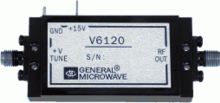
A voltage controlled oscillator (VCO; English VCO ) is an electronic generator whose oscillation frequency depends on the control voltage supplied to the generator [1] . VCOs are widely used in various electronic systems - radio communication equipment, automatic control, electric musical instruments , etc.
Content
Types of VCOs
VCOs can be divided into two types depending on the output signal:
- Harmonic oscillators ;
- Relaxation generators .
Harmonic oscillators generate a sinusoidal waveform. They include an amplifier and a resonant circuit (the circuit is necessary in order to send the signal back to the input). Fluctuations occur at the tuning frequency, where a positive gain occurs around the loop.
Relaxation generators can generate sawtooth or triangular waveforms. They are often used in monolithic integrated circuits (MIS) and can provide a wide range of frequencies [2] . There are three methods for constructing a VCO, which are most often used for implementation in integrated performance:
- generators with a passive resonator, containing an oscillatory system, a quartz resonator , devices for SAWs, resonators of a different kind, which determine the nominal frequency of the generated signal and its quality;
- relaxation generators, in which there is an alternate charge exchange of a frequency-setting capacitor from a direct current source between two threshold values;
- A ring generator , consisting of an odd number of asymmetric inverters or an even / odd number of differential inverters with their connection in a ring circuit [3] .
Main parameters and characteristics of VCOs
For voltage-controlled generators, it is customary to distinguish the following parameters:
- VCO tuning range . It determines the frequency range from the minimum ( f min ) to the maximum ( f max ) signal at the output of the generator;
- The steepness of the tuning of the VCO in frequency. This is the steepness of the tuning characteristic in frequency from the tuning voltage (expressed in Hz / V), showing how much the output frequency will change when the control voltage changes by one;
- Frequency tuning characteristic of the VCO. This is a graphical representation of the frequency at the output of the VCO from the control voltage;
- Frequency tuning nonlinearity. This deviation from the linear nature of the characteristic changes in the frequency of the VCO from the tuning voltage [4] ;
- RF VCO output signal power . It depends on the frequency and is determined by the type of generator and element base used;
- Deviation from the nominal value of power at the output of the VCO. This is the difference between the maximum and minimum power level at the output of the VCO at a load of 50 Ohms at a given temperature (expressed in dB) of the frequency;A simple generator circuit built on two operational amplifiers. If R1 ≪ R2, then the frequency Ua is fairly accurately proportional to Ue
- Dependence of output power on temperature. This is the change in the power of the fundamental signal at the output of the VCO from temperature;
- Frequency versus temperature . Change in VCO frequency as a function of temperature at a constant tuning voltage;
- Frequency tuning rate (VCO transient time). This is the time it takes to set the output frequency of the VCO to 90% of its final value after the start of tuning the frequency of the VCO;
- Modulation bandwidth. This is the frequency of the modulating signal at which the frequency deviation decreases to 0.707 from its constant value. Usually it depends on the impedance of the source of the modulating signal, the typical value of which is 50 Ohms;
- The residual detuning of the VCO. With a jump-like change in the tuning voltage, the VCO will be tuned from the initial frequency f 1 to the final frequency f 2 . In this case, the frequency f 2 will be set to the desired value after some time. The residual detuning of the VCO is the deviation of the frequency from the final value for a certain time after an abrupt change in the tuning voltage;
- Care VCO frequency. This is the deviation of the frequency from the final value for a certain time after an abrupt change in the tuning voltage;
- VCO frequency drift when temperature changes. This is a change in the frequency of the VCO depending on the temperature at a constant tuning voltage;
- Frequency pulling. This is the deviation of the output frequency of the VCO from the nominal value caused by changes in its output load;
- Frequency offset. This is a change in the output frequency of the VCO during external influences, excluding a change in the magnitude of the generator load, at a constant voltage setting;
- VCO output voltage harmonic factor. This is the level of the harmonic components of the output signal. Measured in dB relative to the carrier (dBc);
- Side components, non-harmonic side components. Side components and non-harmonically dependent signals present in the spectrum of the output signal of the VCO;
- Phase noise It is measured in the 1 Hz band with respect to the power of the carrier frequency at a certain frequency shift or detuning from it [1] [5] .
See also
- Signal generator
- Auto generator
- Phase locked loop
- Ring generator
Notes
- ↑ 1 2 Voltage controlled oscillators .
- ↑ Voltage-controlled generators // LIT-FONON OJSC.
- ↑ Voltage controlled generators. Switched VCO // Radiodesign and RF Technology.
- ↑ This parameter is essential when using a VCO as a voltage-frequency converter.
- ↑ VCO - Radio Wiki .
Links
- Horowitz P., Hill W. Art of circuitry. - M., Mir, 1998 .-- 704 p. - ISBN 978-5-9518-0351-1
- Circuits of voltage controlled oscillators.
- Schemes