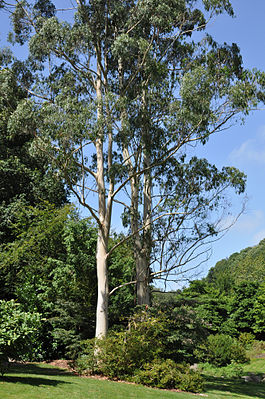
Eucalyptus Dalrymple ( Latin Eucalyptus dalrympleana ) is an evergreen tree , a species of the genus Eucalyptus ( Eucalyptus ) of the Myrtaceae family .
| Eucalyptus Dalrymple | |||||||||||||||||||||||||
 | |||||||||||||||||||||||||
| Scientific classification | |||||||||||||||||||||||||
|---|---|---|---|---|---|---|---|---|---|---|---|---|---|---|---|---|---|---|---|---|---|---|---|---|---|
| |||||||||||||||||||||||||
| International scientific name | |||||||||||||||||||||||||
Eucalyptus dalrympleana maiden | |||||||||||||||||||||||||
| Subsidiary taxa | |||||||||||||||||||||||||
See text | |||||||||||||||||||||||||
Named after George Elphinstone Dahlrimple (1826–1876), an Australian explorer.
Distribution and Ecology
In nature, the species range covers Tasmania and southeastern Australia . Widely distributed in cold and humid mountains at an altitude of 900 to 1200 m above sea level. m. in the central and southern parts of New South Wales , on Delegate Mountain in Victoria and Tasmania.
It forms pure plantings, but more often grows together with Eucalyptus delegatensis and Eucalyptus malifloriforum with undergrowth from Acacia blackwood and Acacia silvery .
Differs in high frost resistance; withstands short-term temperature drops of -12 ... -11 ° C without damage.
It grows rapidly, especially at a young age and on favorable soils. So, in 4.5 years, on deep, spread, moderately moist soil, it reaches an average height of 15.5 m (individual trees 18.5 m), with a trunk diameter of 13-15 cm. In 15 years, under the same conditions, it grows to 25–27 m, with a trunk diameter of 40–50 cm. It develops worse on clay slopes: over 4 years it grows on average here with trees 8.5 meters high, with a trunk diameter of 8 cm. It grows slowly on podzolized-carbonate soils: over 4 , 5 years reaches a height of only 3.5 m, with a trunk diameter of 3 cm.
Botanical Description
A tree up to 45 m high, with a trunk diameter of up to 1.5, less often up to 2.7 m.
The bark is smooth, falling, white, with age it turns pink with bluish stripes and spots, in the lower part of the trunk more or less rough and not falling.
Young leaves are opposite, in a large number of pairs, sessile, bluish, ovate, heart-shaped or rounded, 4-6 cm long, 4-5 cm wide or slightly larger. Intermediate leaves are also opposite, petiolate , ovate or ovate-lanceolate, vary in size and degree of blue color. Adults - alternating, long-grained, from narrowly lanceolate to widely lanceolate, 10-22 cm long, 1.5-2.5 (up to 4) cm wide, dark green, shiny.
Umbrellas are axillary , three-flowered ; legs are compressed or almost cylindrical, 4-7 mm long; buds on pedicels or sessile, from ovoid to cylindrical, 7-8 mm long, 3-5 mm in diameter; the cap is blunt-conical, equal in length to the receptacle tube; anthers open with longitudinal slots; small piece of iron on the back of the anther.
Fruits on legs or sessile, from ovoid-truncated to spherical, 7-8 mm long, 8-9 mm in diameter; the disk is convex or almost flat; valves deltoid, protruding.
Blossoms in the homeland in March - May; on the Black Sea coast of the Caucasus - in April - July.
Meaning and Application
The wood is pink, light, moderately hard, relatively durable and stable, with well-noticeable annual layers and straight fibers, but is prone to warping and cracking. It is used in paper production, on handles for tools, on poles, boxes, etc.
Leaves contain essential (eucalyptus) oil (0.48%), consisting of cineole (50%), pinene , esters and sesquiterpenes .
Classification
Representatives
Within the species, a number of subspecies are distinguished [2] :
- Eucalyptus dalrympleana subsp. dalrympleana
- Eucalyptus dalrympleana subsp. heptantha LASJohnson
Taxonomy
Species Eucalyptus Dalrympla is a member of the genus Eucalyptus ( Eucalyptus ) of the subfamily Myrtaceae of the family Myrtaceae of the order Myrtaceae .
| 13 more families (according to APG II System ) | 130 more births | |||||||||||||||
| Myrrhaceae order | subfamily Myrtle | View of Eucalyptus Dalrymple | ||||||||||||||
| Department of Flowering, or Angiosperms | Myrtov family | clan eucalyptus | ||||||||||||||
| 44 more order flowering plants (according to APG II System ) | 1 more subfamily (according to APG II System ) | more than 700 species | ||||||||||||||
Notes
- ↑ For the conventionality of specifying the class of dicotyledons as a superior taxon for the plant group described in this article, see the APG Systems section of the Dicotyledonous article .
- ↑ According to the APNI website (see the "Links" section).
Literature
- Trees and shrubs of the USSR. Wild, cultivated and promising for introduction. / Ed. volumes S. Ya. Sokolov . - M. - L .: Publishing House of the Academy of Sciences of the USSR , 1960. - T. V. Angiosperms. Families Myrtle - Olive. - S. 60-62. - 544 p. - 2200 copies.