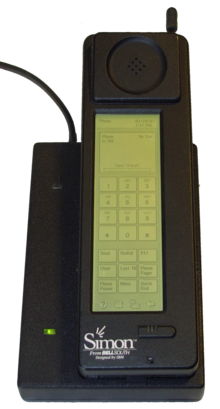
IBM Simon ("Simon") is a personal mobile communication device in which the functions of a cell phone and a PDA were first combined, which in a few years became known as a smartphone . Developed by the American corporation IBM in conjunction with the telecommunications company [1] .
Content
- 1 History
- 2 Functions
- 3 Construction
- 4 Specifications
- 5 notes
- 6 References
History
Simon was first shown in November 1992 as a concept product [2] at , an exhibition of telecommunications industry achievements in Las Vegas . Created in 1993 [3], the device combined the features of a mobile phone, PDA , pager and fax . After some delay, in 1994 it was put on sale in 190 cities in 15 US states at a price of $ 899 with a BellSouth operator contract or $ 1,099 without a contract [4] .
Functions
In addition to the full range of communication capabilities, the device had the functions of an organizer (calendar, notepad, address book) and a calculator , displayed world time , allowed sending and receiving faxes, working with e-mail (without attached files), and also contained several games. He could act as a pager: if the incoming call remained unanswered, the caller could leave the phone number that was recorded in Simon's menu [4] .
Design
Simon became the first touch phone in the world . He did not have physical control keys - the choice of phone numbers, the creation of text notes and other actions were performed using the touch screen using a stylus . To enter text on the screen, either a small QWERTY keyboard or the unique “intelligent” PredictaKey keyboard was displayed - it offers the following six characters, which are most likely to be used, and allows you to scroll six more predictable letters alphabetically [4] .
Simon supported working with a PCMCIA memory card, and also could connect via a serial bus to a personal computer via a 33-pin connector. On top of the apparatus had a retractable antenna. A regular battery provided about 1 hour of work (talking or data transfer) and from 8 to 12 hours in standby mode. For an additional $ 78, a larger battery was offered [4] .
Specifications
- Supported Cellular Standard: AMPS
- Processor: Vadem 16 MHz, 16 bit.
- Display: 4.7 inches; 160x293 pixels.
- Dimensions: 200x64x38 mm.
- Weight: 623 g (without charging station).
- RAM: 1 MB.
- Internal memory: 1 MB, PCMCIA slot.
- OS: ROM-DOS.
- Communications: 2400 bps modem.
- Power supply: main nickel-cadmium battery (7.5 volts) and a backup lithium battery (to save data when the main battery is discharged or removed) [4] .
Notes
- ↑ This day in the history of business: the world's first smartphone . Forbes (November 23, 2012). Archived November 24, 2012.
- ↑ Schneidawind, J: “Big Blue unveiling”, USA Today , November 23, 1992, page 2B
- ↑ Associated Press: “Keep it simple, Simon says,” Florida Times-Union newspaper , November 3, 1993
- ↑ 1 2 3 4 5 O'Malley, C: Simonizing the PDA , Byte Magazine , December 1994, page 145
Links
- IBM Simon PDA cellphone
- Simon Says "Here's How!" - Users Manual . IBM (1994). Archived July 29, 2013.
- Video review of the device