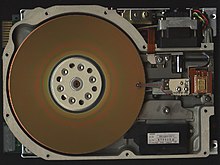
The ST-506 is the first 5.25-inch form factor hard drive .
Content
ST-506
The ST-506 was the first 5.25-inch hard drive , albeit a full-height . Introduced by Seagate Technology in 1980 [1] , the disk drive had a capacity of 6 (after formatting - 5) MB. To encode the information recorded on the disk, the modified frequency modulation method of the MFM was used, which has already been widely used in floppy disk drives . The ST-506 was connected to the computer system using the SA1000 interface [2] which used the hard disk controller ( en ). The ST-506 interface developed by Shugart Associates , in turn, was the basis for developing the interface of floppy drives, [3] thus forcing the design of a hard disk controller to be relatively simple [1] . A feature of the ST-506 interface is the connection of a disk using several cables:
- the first - for transmitting control signals (with two connectors in the case of one drive in the system, and three - in the case of two drives);
- second (third) - to transfer data to the first (second) drive;
- Each drive has traditionally been powered by a separate cable.
The disks were simple and called at the same time, because the control board broadcast requests to the track and sector required by the operating system in a sequence of commands that position the read heads on the cable simultaneously to all drives, then read the signal from them and send the read data. The 34-pin “control cable” only controlled the mechanical movements of the disk using one line, for example, signals from “HD SLCT 0” to “HD SLCT 3” and a step to move the read head to the corresponding track were used to select one of the 16 heads, transmitted over the wire with the “STEP” / “DIRECTION IN” signal. Data could then be sequentially read or written using the corresponding two pins of the 20-pin “data cable”. This led to a fundamentally low performance in the hard disk, due to the limited bandwidth of the "data cable", although at that time it was not a fundamental task. Drives of modern hard drives have significant data processing capabilities inside, and thus, the operating system only needs to request a data block, and the hard disk itself takes all the steps that are required to find the requested data block.
ST-412
In 1981, more expensive and capacious (10 MB formatted capacity, 12 unformatted) drives with the ST-412 interface were introduced. The interface update appeared in them - the ability of "buffered search" was added. [4] In the buffered search mode, the disk controller sent the “STEP” signal to the disk as fast as it could get a response without having to wait for the stepper motor to move. Then, the built-in microcontroller sent the signal to the stepper motor at the speed with which it could work, or reprogrammed the servo system on the head drive to move to the desired track. Buffered search significantly improved the search time index and in the late 1980s provided disks using this ability with an average search time of 15-30 milliseconds (old disks like the ST-506 had an average search time of 100-200 milliseconds on average, like floppy drives or modern optical drives ).
ST-412 used the RLL recording method, which added up to 50% to the drive in capacity and data transfer speed (see also ESDI ).
Historical Importance
A number of other companies quickly began production of hard drives using the same connectors and signals, taking ST-506-based hard drives as standard. IBM chose it by purchasing adapter cards for IBM PC / XT (released by Xebec) [5] and for IBM PC / AT (released by Western Digital ). In addition to the Seagate ST-412, the IBM PC / XT IBM Model 5012 also used the Miniscribe 1012 adapter from International Memories [6] . As a result of IBM approval, most of the hard drives in the 1980s were based on the ST-506. The complexity of the controller and cabling has led to new solutions like ESDI , SCSI, and later the IDE . A few early SCSI drives were actually ST-506 drives with a SCSI-> ST-506 controller inside the drive. However, most SCSI and all ATA had a built-in controller as part of the disk, and thus, the ST-506 interface was excluded in such models.
The real level of compatibility with the disk interface is the level of support in the BIOS , provided by the motherboard . When the IBM PC innovation was introduced in 1983 by the computer industry, support for the hard drive interface was provided by the BIOS chip on the hard disk controller. It is most likely that the BIOS of the IBM PC and IBM PC / XT motherboards does not have any native hard drive interface support. When the IBM PC / AT system was introduced, IBM placed support for the ST-506/412 interface in the BIOS of the motherboard, eliminating the task of this support from the controller. Since then, any IBM PC / AT compatible system also has an extended version and also provides support for the hard disk interface in the BIOS of the motherboard. Since this support was partially limited, especially in older BIOS versions, many disk controller manufacturers placed additional BIOS support directly on their hard disk controllers. In some cases, it is possible to use both the BIOS-controller of the hard disk and the BIOS of the motherboard; in other cases, you can disable the BIOS of one of the controllers (either on the hard drive or on the motherboard), and then use the remaining one.
Description of connectors
The following table is from OEM Manual ST506 / ST412 [4]
In this table, the “~” sign indicates a signal whose active level is low. The direction of the IN / OUT signal relative to the drive to the controller.
| Earth | one | 2 | ~ HD SLCT 3 (Or ~ Decrease recording current) | in |
| Earth | 3 | four | ~ HD SLCT 2 | in |
| Earth | 5 | 6 | ~ WRITE GATE | in |
| Earth | 7 | 8 | ~ SEEK CMPLT | out |
| Earth | 9 | 10 | ~ TRACK 0 | out |
| Earth | eleven | 12 | ~ WRITE FAULT | out |
| Earth | 13 | fourteen | ~ HD SLCT 0 | in |
| Key (no contact) | fifteen | 16 | Reserve | - |
| Earth | 17 | eighteen | ~ HD SLCT 1 | in |
| Earth | 19 | twenty | ~ INDEX | out |
| Earth | 21 | 22 | ~ READY | out |
| Earth | 23 | 24 | ~ STEP | in |
| Earth | 25 | 26 | ~ DRV SLCT 0 | in |
| Earth | 27 | 28 | ~ DRV SLCT 1 | in |
| Earth | 29th | thirty | ~ DRV SLCT 2 | in |
| Earth | 31 | 32 | ~ DRV SLCT 3 | in |
| Earth | 33 | 34 | ~ DIRECTION IN | in |
| ~ DRV SLCTD | one | out | 2 | Earth | - |
| Not connected | 3 | - | four | Earth | - |
| Not connected | 5 | - | 6 | Earth | - |
| Not connected | 7 | - | 8 | Key (No contact) | - |
| Not connected | 9 | - | 10 | Not connected | - |
| Earth | eleven | - | 12 | Earth | - |
| + MFM WRITE | 13 | in | fourteen | -MFM WRITE | in |
| Earth | fifteen | - | 16 | Earth | - |
| + MFM READ | 17 | out | eighteen | -MFM READ | out |
| Earth | 19 | - | twenty | Earth | - |
| Conclusion 1 | + 12V = |
| Conclusion 2 | + 12V return |
| Conclusion 3 | + 5V return |
| Conclusion 4 | + 5V = |
Links
- ↑ 1 2 "Disc-storage innovations keep coming while manufacturers ponder user needs," EDN, May 20, 1980, pg 59
- ↑ The main difference was an increase in data transfer rates from 4.34 to 5.00 Mbps
- ↑ “Simplified system design with a single combined hard disk / floppy disk controller” Electronic Design, October 25, 1979, pg 76-80.
- ↑ 1 2 http://www.bitsavers.org/pdf/seagate/ST412_OEMmanual_Apr82.pdf
- ↑ “Xebec Lands Key IBM Controller Pact,” Computer System News, November 29, 1982, pg. 1, 29.
- ↑ Hard Disk Interfaces