The comb-pottery culture , or the pit-comb pottery culture is a cultural-historical community that existed in the Stone Age in northeastern Europe ( Scandinavia , Russian North-West, Belarus , Baltic ), from about 5 millennium BC. er until 2000 BC. er The name was given by the method of decorating ceramic finds characteristic of this culture, which looks like prints of ridges.
| Pit-and-comb culture Neolithic | ||||
|---|---|---|---|---|
 | ||||
| Geographical region | Eastern Europe | |||
| Dating | 4200 BC er until 2000 BC. er | |||
| Carriers | controversially: either the Urals or the Paleo-Europeans ( Dauphine-Ugric substrate ) | |||
| Continuity | ||||
| ||||
Content
Spread
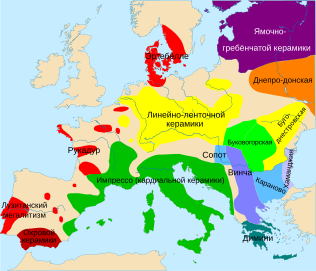
The distribution of artifacts of this community is approximately the following: Finnmark ( Norway ) in the north, the Kalikselven river ( Sweden ) and the Gulf of Bothnia ( Finland ) in the west and the Vistula river ( Poland ) in the south. In the east, comb pottery with some variations of styles was extended to the Ural Mountains . Perhaps, among others, included the Narva culture in Lithuania . The bearers of this culture were allegedly hunters and gatherers, although the so-called Narva culture in Lithuania has signs of farming. For the later horizons of some of these regions, the culture of corded stoneware is characteristic.
The initial focus of this culture was the Dnieper region ( Dnieper-Donetsk culture ), from there it spread through Valdai to Finland [1] .
Local Options
Currently, at least 8 related cultures stand out in the cultural community of pit-comb ceramics:
Comb and Pit Ceramic Zone
- Kargopol culture
- Karelian culture
- White Sea Culture
- Asbestos Ceramics Culture
Comb Ceramics Area
Comb ceramics was common in the Kama, Urals and Trans-Urals.
This zone includes, for example, the Kokui culture with backward-comb-dividing ornamentation of ceramics (from the second half of the V to the first third of the 4th century BC) and the Sostovo-Istov culture with dishes ornamented in the comb tradition (from the second to the last third of the IV th BC) [2] Findings of ceramics with comb ornamentation are known and much east of - in particular, among the artifacts of the Sinlunwa culture [3] , which existed in the northeast of modern China in the 7th – 6th millennium BC. e., as well as on the territory of modern Korea and in the upper Yenisei and the Angara. [four]
Zone of typical splay-pottery
- Balakhna culture
- Lyalovskaya culture → Volosovo culture
- Ryazan culture
Culture
Ceramics
Ceramics is a large pots with a capacity of 40-60 l, rounded or pointed at the bottom. The shape of the products for centuries remained unchanged, but the applied ornaments varied. According to the accepted dating, ceramics is traditionally divided into the following periods: early (from 4200 BC to 3300 BC ), typical (from 3300 BC to 2700 BC. ) And late (from 2800 BC to 2000 BC. ). Among the many styles of pit-comb ceramics, there is one that uses the properties of asbestos : a culture of asbestos ceramics . Other famous styles are Püheätsiltä, Yakärlä, Kierikki and Säriäsniemi with their respective sub-styles.
Tools
Stone tools changed slightly over time. Made from local materials such as slate and quartz . The findings confirm the existence of the exchange of goods: red slate from northern Scandinavia , asbestos from Lake Saimaa, green slate from Lake Onega , amber from the southern coast of the Baltic Sea and flint from the Valdai Upland .
Art
The culture is characterized by small figures of burnt clay and animal heads made of stone. The heads of animals usually depict an elk or a bear and derive from the Mesolithic art. Cave paintings are also known.
Habitats
Settlements were located on the coast or lakes. The way of existence was based on hunting, fishing and gathering plants. In Finland, this culture was a seaside one that specialized in seal hunting. Typical housing was, apparently, tipi area of about 30 m2, which could live up to 30 people. Burials were arranged inside the settlement, the dead were covered with red ocher. For comb-pottery culture , burial of the deceased is typical, along with objects made of flint and amber. Empty sandstone dolmens were used in the Äkärlä group.
Anthropological type
A population that is a carrier of a pin-pottery culture could have been formed on the basis of the same Mesolithic Europoid stratum, but with a greater weight of the Mongoloid component than the population of the Volovo, Dnieper-Donetsk and Narva cultures. [5] In particular, the creators of Lyalovskoy culture, belonging to the cultures of typical pit-comb ceramics, were Caucasoids with a strong admixture of Mongoloid (northern laponoid type ). [6] [7]
Paleogenetics
The representatives of the comb-pottery culture from the location of Kudruküla ( est. Kudruküla , estuary of the River Narva 5600 years ago) identified the archaic Y-chromosomal haplogroup R1a5 (R1a1b ~ -YP1272 ), which is now extremely rare, and the mitochondrial haplogroup U5b1d1, I4, I4, I4, I4 .
Language
Until about the beginning of the 1980s, historians did not question the Finno-Ugric origin of the tribal culture of pit-comb ceramics. A number of researchers of the Helsinki school (Prof. K. Viik and his followers) even claimed that the Pre-Uralic language had been spoken in Estonia and Finland since the last glaciation, although this point of view did not enjoy the support of the majority. Currently, archaeologists and linguists are more cautious about the links between languages and phenomena of material culture. According to one hypothesis, an increase in the number of settlements in the indicated period was associated with general warming of the climate, which caused the development of a productive economy.
A sufficiently large number of scientists believe that the tribes of pit-comb ceramics spoke an unknown extinct language (the Y-haplogroup R-YP1272 is autochthonous, almost extinct, having a common ancestor 15,000 years ago with the main Indo-European haplogroup) [9] , not related neither the Ural nor the Indo-European language families. The language of native speakers of the culture of pit-comb ceramics, these scientists are usually called " Paleo-European " [10] [11] (it is possible that its relics constitute a substrate of unknown origin, distinguished by linguists in the Sami language ; a non-Indo-European substrate of unknown origin is also present in the Finno-Volga languages, but in much smaller volumes [12] ). Numerous hydronyms in the European part of Russia can also testify to this (according to B. A. Serebrennikov - “Volga-Oka place names ” [13] ), the etymology of which remains unclear. At the same time, the majority of linguists (including Academician A.K. Matveev, whose point of view is set out in the unfinished work “Substrate Toponymy of the Russian North”) believe that these toponyms are still derived from the disappeared Finno-Ugric languages (in particular, from Meryan language).
A consistent supporter of the “Paleo-European” hypothesis of the origin of cultures of a typical YAGK is V. V. Napolskikh, who at the same time unambiguously associates Zauralie comb ceramics with the Pra-Ural linguistic community. [14] Among Finnish researchers, P. Kallio and J. Häkkinen [15] admit the pale-European character of part of the YGK cultures, while still linking the southeastern part of the range of these cultures with Pra-Urals. [16] V. A. Zakh considers the similarity of European and Trans-Ural comb ceramics to be the result of the presence of a common (possibly Finno-Ugric) origin in these cultures. [17] The authors of a genetic study of the remains from the burial of Sertei II’s late Neolithic Zizhitsky culture (Smolensk region, middle of the 3rd millennium BC, ceramics of “transitional” type), which revealed the presence of Y-haplogroups R1a1 and N1c, also believe that the distribution Finno-Ugric »Y-haplogroup N1c should be associated with patchy-comb pottery cultures, and that the maximum“ Finnish ”genetic markers correlate well with the spread of Finno-Ugric toponymy and hydronymy. [18]
Notes
- ↑ Ceramics: Northern culture of Finland and Karelia (Inaccessible link) . Date of treatment November 17, 2012. Archived January 17, 2012.
- ↑ Mosin Vadim Sergeevich (2015), Neolithic of the forest-steppe Trans-Urals and Irtysh: the latest research and periodization. Bulletin of the Kemerovo State University. - cyberleninka.ru
- ↑ S.V. Alkin. "The early Neolithic culture of Xinglong in Northeast China and its funeral rite ." Institute of Archeology and Ethnography SB RAS, Novosibirsk, 1998
- ↑ [1] (jap.)
- ↑ Alekseeva T. I., Denisova R. Ya., Kozlovskaya M.V., Kostyleva E.L., Krainov D.A., Lebedinskaya G.V., Utkin A.V., Fedosova V.N. Neolithic forest lanes of Eastern Europe (Anthropology of the Sakhtysh sites). M .: Scientific World, 1997.
- ↑ Spiridonova E. V. The most ancient past of the Yaroslavl Territory
- ↑ Archaeological Museum of IvSU: Age of the Neolithic / Eneolithic (Unavailable link) . Date of treatment March 4, 2009. Archived July 10, 2014.
- ↑ Lehti Saag et al. Estonia has been through a sex-biased migration from March 2, 2017
- ↑ ive Ind
- ↑ Tretyakov P.N. Volga-Oka place names and issues of ethnogenesis of Finno-Ugric peoples // Soviet Ethnography. 1958, No. 4. Moscow.
- ↑ Napolskikh V.V. On the reconstruction of the linguistic map of the Center of European Russia in the Early Iron Age Archival copy of November 7, 2017 on the Wayback Machine // Art Magazine No. 4, 2007
- ↑ MA Zhivlov Non- Indo- European Substrate in Finno-Volga Languages
- ↑ Serebrennikov B. A. Volga-Oka toponymy on the territory of the European part of the USSR // Questions of linguistics . 1955, No. 6.
- ↑ Napolskikh V.V. Prehistory of the peoples of the Uralic language family // History of the Tatars from ancient times in seven volumes. T. 1. The peoples of steppe Eurasia in antiquity. Ed. S. G. Klyashtorny. Kazan, 2002. pp. 195-203.
- ↑ “ Stratification of Y-haplogroup N1c ” (Jaakko Häkkinen, August 5th, 2010), p. 10
- ↑ Petri Kallio “ The Language Contact Situation in Prehistoric Northeastern Europe ” (p. 83)
- ↑ Zakh Viktor Alekseevich “ Ornamental traditions in Western Siberia ”. Bulletin of archeology, anthropology and ethnography, 2006.
- ↑ Chekunova E. M., Yartseva N. V., Chekunov M. K., Mazurkevich A. N. “First results of genotyping of indigenous people and human bone remains from archaeological monuments of the Upper Dvina”, p. 287-294. Table on p. 294. // Archeology of lake settlements of the 4th – 2nd millennium BC. e.: chronology of cultures and climatic rhythms. - St. Petersburg: LLC Periphery, 2014.