| M 94 | |
|---|---|
| Galaxy | |
 | |
| Research history | |
| Discoverer | Pierre Meshen |
| opening date | March 22, 1781 |
| Designations | M 94 , Messier 94 , Messier 94 , NGC 4736 , IRAS12485 + 4123 , UGC 7996 , ZWG 216.34 , MCG 7-26-58 , ZWG 217.1 , PGC 43495 |
| Observational data ( Age J2000.0 ) | |
| Constellation | Hounds Dogs |
| Right ascension | |
| Declination | |
| Visible dimensions | 14.4 '× 12.1' |
| Apparent magnitude m V | 8.1 |
| Photographic magnitude m B | 8.9 |
| Specifications | |
| Type of | Sab |
| Radial velocity | |
| Redshift | and |
| Distance | 16 million St. years [3] |
| Angular position | 117 ° |
| Surface brightness | 13.6 |
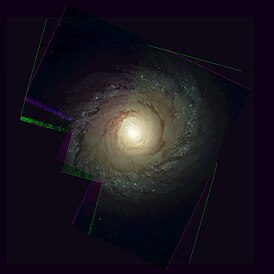
Messier 94 It is located at a distance of about 16 million light years from Earth [3] . It was discovered by Pierre Meschen in 1781 [6] and cataloged by Charles Messier two days later. Although some sources describe M94 as a spiral galaxy with a jumper , the jumper has a shape close to an oval [7] .
The galaxy is noteworthy in that it has two powerful ring-shaped structures [8] .
This object is one of those listed in the original edition of the New General Catalog .
Content
Kernel
M 94 is usually classified as a galaxy with a nucleus with a low degree of ionization [9] , that is, the spectral lines obtained in the images have bands of weakly ionized or neutral elements, such as O , O + , N + , S + .
Outer and Inner Rings
The structure of the galaxy includes two rings having sizes 70 "and 600" - internal and external, respectively. Presumably, the rings formed under the influence of the gravitational field of the galactic disk . The inner ring is a place of active star formation , it is fueled by interstellar gas, which dynamically flows into the ring from an oval jumper structure [10] .
A 2009 study [11] , conducted by an international team of astrophysicists, showed that the outer ring of the galaxy is not closed, as historically appears in the literature, but is a complex structure of spiral arms . The study showed that the external drive is active. It contains about 23% of the total mass of stars in the galaxy and about 10% of new stars are formed in it. In fact, per unit of stellar mass, the star formation rate of the external disk is approximately two times higher than that of the internal disk.
There are several possible external events that could lead to the appearance of an external disk, including accretion of a galaxy satellite or gravitational interaction with a neighboring star system. However, further studies have identified problems associated with each of these scenarios. Thus, the report concludes that the oval distortion of the internal disk led to the creation of the outer disk of this galaxy.
Pseudo Bulge
An article published in 2004 by John Cormendi and Robert Kennicutt claims that the M94 contains a pseudo- bulge [7] . A classic spiral galaxy consists of a central bulge (an almost spherical bulge or bulge) surrounded by a disk. In contrast, a galaxy with a pseudo-bulge does not have a large bulge, but instead contains a bright central structure with intense star formation, which looks like a bulge when the galaxy is viewed flat. In the case of M94, the pseudo-bulge takes the form of a ring around the central region.
Distance measurement
At least two methods have been used to measure the distance to the M94. The distance to M94 measured using the method of fluctuations in surface brightness is 17.0 ± 1.4 million St. years (5.2 ± 0.4 mpc ) [12] . At the same time, M94 is close enough for the possibility of using the Hubble Space Telescope to observe bright individual stars in the galaxy, to later compare them with observations of similar stars within the Milky Way. It is estimated that the distance to M94 measured using this technique is 15 ± 2 million sv. years (4.7 ± 0.6 mpc ) [13] . The averaged value of these measurements gives an estimate of the distance of 16.0 ± 1.3 million St. years (4.9 ± 0.4 mpc ).
Galaxy Group
M94 is one of the brightest galaxies within the M94 group, containing from 16 to 24 galaxies [14] [15] [16] . This group is one of many that lie within the Virgo supercluster [17] . Despite the large number of galaxies, it seems that only a few galaxies near M94 form a gravitationally bound system with it. Most other neighboring galaxies appear to be moving under the influence of the expansion of the Universe [13] [18] .
See also
- List of Messier objects
- New shared directory
Notes
- ↑ M 94
- ↑ The ROSAT AGN content of the 87GB 5 GHz survey: bulk properties of previously optically identified sources - 1995.
- ↑ 1 2 Starburst galaxy Messier 94 . Date of treatment October 19, 2015.
- ↑ Galaxy groups: a 2MASS catalog // Astron. J. / J. G. III - IOP Publishing , 2015 .-- ISSN 0004-6256 ; 1538-3881 - doi: 10.1088 / 0004-6256 / 149/5/171
- ↑ R. Brent Tully, Courtois H. M., Sorce J. G. COSMICFLOWS-3 // Astron. J. / J. G. III - IOP Publishing , 2016 .-- Vol. 152, Iss. 2. - P. 50. - ISSN 0004-6256 ; 1538-3881 - doi: 10.3847 / 0004-6256 / 152/2/50
- ↑ Kepple, George Robert. The Night Sky Observer's Guide. - Willmann-Bell , 1998 .-- Vol. Vol. 2. - P. 51. - ISBN 0-943396-60-3 .
- ↑ 1 2 J. Kormendy; RC Kennicutt Jr. Secular Evolution and the Formation of Pseudobulges in Disk Galaxies (Eng.) // Annual Review of Astronomy and Astrophysics : journal. - 2004. - Vol. 42 , no. 1 . - P. 603-683 . - DOI : 10.1146 / annurev.astro.42.053102.134024 . - . - arXiv : astro-ph / 0407343 .
- ↑ NASA / IPAC Extragalactic Database . Results for M94 . Date of treatment November 9, 2006.
- ↑ LC Ho, AV Filippenko, WLW Sargent. A Search for "Dwarf" Seyfert Nuclei. III. Spectroscopic Parameters and Properties of the Host Galaxies (Eng.) // The Astrophysical Journal : journal. - IOP Publishing 1997. - Vol. 112 . - P. 315-390 . - DOI : 10.1086 / 313041 .
- ↑ C. Muñoz-Tuñón, N. Caon, J. Aguerri, L. Alfonso. The Inner Ring of NGC 4736: Star Formation on a Resonant Pattern (Eng.) // The Astronomical Journal : journal. - IOP Publishing 2004. - Vol. 127 . - P. 58-74 . - DOI : 10.1086 / 380610 .
- ↑ I. Trujillo; I. Martinez-Valpuesta; D. Martinez-Delgado; J. Penarrubia; M. Pohlen; R. Jay GaBany. Unveiling the Nature of M94's (NGC4736) Outer Region: A Panchromatic Perspective (English) // The Astrophysical Journal : journal. - IOP Publishing 2009. - Vol. 704 , no. 1 . - P. 618-628 . - DOI : 10.1088 / 0004-637X / 704/1/618 . - . - arXiv : 0907.4884 .
- ↑ JL Tonry; A. Dressler; JP Blakeslee; EA Ajhar; AB Fletcher; GA Luppino; MR Metzger; CB Moore. The SBF Survey of Galaxy Distances. IV. SBF Magnitudes, Colors, and Distances (English) // The Astrophysical Journal : journal. - IOP Publishing , 2001. - Vol. 546 , no. 2 . - P. 681-693 . - DOI : 10.1086 / 318301 . - . - arXiv : astro-ph / 0011223 .
- ↑ 1 2 ID Karachentsev; ME Sharina; AE Dolphin; EK Grebel; D. Geisler; P. Guhathakurta; PW Hodge; VE Karachentseva; A. Sarajedini; P. Seitzer. Galaxy flow in the Canes Venatici I cloud // Astronomy and Astrophysics . - EDP Sciences 2003. - Vol. 398 , no. 2 . - P. 467-477 . - DOI : 10.1051 / 0004-6361: 20021598 . - . - arXiv : astro-ph / 0210414 .
- ↑ RB Tully. Nearby Galaxies Catalog. - Cambridge University Press , 1988 .-- ISBN 0-521-35299-1 .
- ↑ A. Garcia. General study of group membership. II - Determination of nearby groups (Eng.) // Astronomy and Astrophysics Supplement : journal. - 1993. - Vol. 100 . - P. 47-90 . - .
- ↑ G. Giuricin; C. Marinoni; L. Ceriani; A. Pisani. Nearby Optical Galaxies: Selection of the Sample and Identification of Groups // The Astrophysical Journal : journal. - IOP Publishing , 2000. - Vol. 543 , no. 1 . - P. 178-194 . - DOI : 10.1086 / 317070 . - . - arXiv : astro-ph / 0001140 .
- ↑ RB Tully. The Local Supercluster // The Astrophysical Journal . - IOP Publishing , 1982. - Vol. 257 . - P. 389-422 . - DOI : 10.1086 / 159999 . - .
- ↑ ID Karachentsev. The Local Group and Other Neighboring Galaxy Groups (Eng.) // The Astronomical Journal : journal. - IOP Publishing 2005. - Vol. 129 , no. 1 . - P. 178-188 . - DOI : 10.1086 / 426368 . - . - arXiv : astro-ph / 0410065 .
Literature
- Richard J. Rand and John F. Wallin. Pattern Speeds of BIMA SONG Galaxies with Molecule-dominated Interstellar Mediums Using the Tremaine-Weinberg Method (Eng.) // The Astrophysical Journal . - IOP Publishing , 2004. - DOI : 10.1086 / 423423 . - arXiv : astro-ph / 0406426 .
- ID Karachentsev. The Local Group and Other Neighboring Galaxy Groups (Eng.) // The Astronomical Journal . - IOP Publishing , 2005. - DOI : 10.1086 / 426368 . - arXiv : astro-ph / 0410065 .
- Michael W. Regan, Michele D. Thornley, Stuart N. Vogel, Kartik Sheth, Bruce T. Draine, David J. Hollenbach, Martin Meyer, Daniel A. Dale, Charles W. Engelbracht, Robert C. Kennicutt, Lee Armus, Brent Buckalew, Daniela Calzetti, Karl D. Gordon, George Helou, Claus Leitherer, Sangeeta Malhotra, Eric Murphy, George H. Rieke, Marcia J. Rieke, and JD Smith. The Radial Distribution of the Interstellar Medium in Disk Galaxies: Evidence for Secular Evolution // The Astrophysical Journal . - IOP Publishing , 2006. - DOI : 10.1086 / 505382 .
- Thomas G. Pannuti, Eric M. Schlegel, and Christina K. Lacey. A Search for Chandra-detected X-Ray Counterparts to Optically Identified and Candidate Radio Supernova Remnants in Five Nearby Face-on Spiral Galaxies // The Astronomical Journal . - IOP Publishing , 2007. - DOI : 10.1086 / 510718 .
- Krzysztof T. Chyży and Ronald J. Buta. Discovery of a Strong Spiral Magnetic Field Crossing the Inner Pseudoring of NGC 4736 (Eng.) // The Astrophysical Journal . - IOP Publishing 2008.- DOI : 10.1086 / 587958 . - arXiv : 0803.0555 .
- Joanna Jałocha, Łukasz Bratek, and Marek Kutschera. Is Dark Matter Present in NGC 4736? An Iterative Spectral Method for Finding Mass Distribution in Spiral Galaxies // The Astrophysical Journal . - IOP Publishing , 2008. - DOI : 10.1086 / 533511 . - arXiv : astro-ph / 0611113 .
- Fumi Egusa, Kotaro Kohno, Yoshiaki Sofue, Hiroyuki Nakanishi, and Shinya Komugi. Determining Star Formation Timescale and Pattern Speed in Nearby Spiral Galaxies (Eng.) // The Astrophysical Journal . - IOP Publishing , 2009. - DOI : 10.1088 / 0004-637X / 697/2/1870 . - arXiv : 0904.3121 .
- Kimberly A. Herrmann, Robin Ciardullo, and Steinn Sigurdsson. Kinematic Evidence for Halo Substructure in Spiral Galaxies (English) // The Astrophysical Journal . - IOP Publishing , 2009. - DOI : 10.1088 / 0004-637X / 693/1 / L19 . - arXiv : 0901.3798 .
- Kimberly A. Herrmann and Robin Ciardullo. Planetary Nebulae in Face-On Spiral Galaxies. II. Planetary Nebula Spectroscopy (Eng.) // The Astrophysical Journal . - IOP Publishing , 2009. - DOI : 10.1088 / 0004-637X / 703/1/894 . - arXiv : 0908.0531 .
- Kimberly A. Herrmann and Robin Ciardullo. Planetary Nebulae in Face-On Spiral Galaxies. III. Planetary Nebula Kinematics and Disk Mass // The Astrophysical Journal . - IOP Publishing , 2009. - DOI : 10.1088 / 0004-637X / 705/2/1686 . - arXiv : 0910.0266 .
Links
- Information in English and French from the original “ New General Catalog ”
- Information (Eng.) From the Revised New General Catalog
- SIMBAD
- VizieR (English)
- NASA / IPAC Extragalactic Database
- NGC 4736 Publication List
- M 94 on WikiSky