
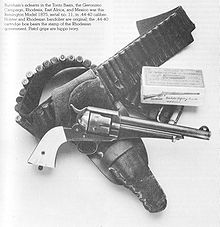

Bandolier ( it. Patronentasche - " cartridge bag ") - equipment for carrying cartridges with separate cells for each of them. The shooter is adapted to be worn on the belt or chest, that is, in a position convenient for the rapid extraction of cartridges.
Content
History
It is borrowed from the German language - the addition of the words Patron - "cartridge" and Tasche - "bag, pocket", in the XVII century with the advent (from 1616 [1] ) of foreign mercenaries in the Russian army of elected regiments .
Initially, the bandolier was part of military equipment ( ammunition ), used by arrows to store ammunition during the use of single-shot rifles and rifles: first paper unitary cartridges, then metal. At the beginning of the XX century in the armies of European countries was replaced by cartridge bags for magazine rifles .
20. To make changes to the equipment of ordinary and commanding personnel:
- g) instead of two cartridge and one spare bag, leave on the fighter one bag for 30 rounds and a bandoleer for carrying over the shoulder for 60 rounds;
- Protocol of the subcommittee, chaired by the Chief of Supply of the Red Army of the corps commissioner Comrade Khrulev, April 19–20, 1940.
Subcommission on the organization and system of military-economic supply of the Red Army
Modern Application
Bandoliers of various designs have traditionally been used as an object of hunting equipment, but, unlike military equipment, have not lost their relevance and are widely used at present. Hunters feel the need to wear cartridges distributed one at a time in the bandoleer, because the use of box-shaped weapons in hunting is very limited, and in the vast majority of cases, loading a weapon with one cartridge each. The cartridges are used of different types (bullet cartridges with different types of bullets, shot, container, with different sizes and quantities of shots, signal), which also necessitates their placement in bandoliers, in predetermined cells. Sometimes used by hunters in order to save, the storage and carrying of cartridges in clothing pockets is inconvenient, unsafe and can lead to damage and loss of cartridges.
Bandolier is a necessary accessory of every hunter. They have a lot of samples. It's a matter of taste. But the most common, and therefore favorite, are handbags with lids for 8-10 rounds and a double-row shoulder for 24-30 rounds. The Boer bandoleer belt for 24-30 rounds is inconvenient, since cartridges, especially folder cartridges, are not covered by anything from above. The bandoliers combined in the form of a small handbag are very practical.
- Ryabov V.V. Pen hunting. - 1965
Classification and types
A classic bandoleer is either a belt with cells, or one or more pouches with cells attached or worn on a belt. The most famous classic hunting bandoleer is a waist leather belt with an open arrangement of cartridges (" Boer belt"). Bandoliers vary in:
- Type of access to the cartridge: open, closed (with a valve closing the cartridges from above from the rain and protecting them from falling out), hidden (sewn into the pockets of clothes [2] , jagdtash [3] , gun case);
- Suspension structures: waist belts, pouches (worn on a belt), suspension systems (with shoulder straps), vests, clips, universal suspension systems;
- Place of wearing: on a belt, on a shoulder, on a chest, in a bag, in a pocket of clothes; on the butt, forend, weapon receiver, rifle belt, hand arrow [4] ;
- Cartridges arrangement: single-row, double-row, folding [5] ;
- Materials used: traditionally, bandoliers are made of leather of various grades and dressings, rarely of dense fabrics (tarpaulins), the popularity of modern synthetic fabrics ( cordura , oxford and others) with water-repellent treatment and combined leather and synthetics bandolers is growing, plastic bandoliers are used for high-speed shooting ;
- By type of cartridges: each bandoleer is designed for a certain type of cartridges, but they can be divided into three groups: for smooth-bore weapons, for rifled weapons and combined;
Due to the spread of bandoliers in many countries, there are their traditional species, often with their own names. A bandoleer worn over a shoulder strap may be called a bandolier . Sometimes homemade bandoliers were made from a piece of machine gun belt . [6] In Russia, the forerunner of the bandolier was the beredeyka .
The development of sports shooting in the XX-XXI centuries led to the appearance of new types of bandoliers, such as clips, speed strippers [7] and bandoliers, mounted as close as possible to the chamber of weapons. And the popularity of paramilitary outdoor activities made possible the widespread use of universal military equipment suspension systems (MOLLE [8] , PALS, MALICE, etc.), which allow the attachment of bandoliers to anywhere in the belt, vest, backpack, gun case, and so on.
Notes
- ↑ The etymological dictionary of the Russian language by Max Fasmer.
- ↑ Hunting suit with bandoliers built into pockets . www.hsn.ru. Date of treatment March 28, 2016.
- ↑ Jagdtash with a sewn-in bandoleer . hsn21.ru. Date of treatment March 28, 2016.
- ↑ Wrist bandolier
- ↑ Folding bandoleer . hsn.su. Date of treatment March 28, 2016.
- ↑ Sailor of the Marine Corps, World War II
- ↑ Speedstripper plastic for 4 rounds . www.stich.su. Date of treatment March 28, 2016.
- ↑ Hunter belt with universal MOLLE suspension system . www.hsn.ru. Date of treatment March 28, 2016.
Literature
- A. D. Michelson . An explanation of the 25,000 foreign words that have come into use in the Russian language, with the meaning of their roots. - 1865.
- Bandolier // Brockhaus and Efron Encyclopedic Dictionary : in 86 volumes (82 volumes and 4 additional). - SPb. , 1890-1907.
- F. Pavlenkov . Dictionary of foreign words included in the Russian language. - 1907.
- A.N. Chudinov . Dictionary of foreign words included in the Russian language. - 1910.
- The etymological dictionary of the Russian language by Max Fasmer.
- L.V. Belovinsky . Bandolier // Illustrated encyclopedic historical and everyday dictionary of the Russian people. XVIII - beginning of XIX century / ed. N. Ereminoy . - M .: Eksmo, 2007 .-- S. 471. - 784 p.: - Ill. with. - 5,000 copies. - ISBN 978-5-699-24458-4 .