| M 104 | |
|---|---|
| Galaxy | |
 | |
| Research history | |
| Discoverer | Pierre Meshen |
| opening date | May 11, 1781 |
| Designations | M 104 , Messier 104 , Messier 104 , NGC 4594 , MCG -2-32-20 , UGCA 293 , IRAS12373-1120 , PGC 42407 |
| Observational data ( Age J2000.0 ) | |
| Constellation | Virgo |
| Right ascension | |
| Declination | |
| Visible dimensions | 8.6 '× 4.2' |
| Apparent magnitude m V | 8.3 |
| Photographic magnitude m B | 9.2 |
| Characteristics | |
| Type of | Sa |
| Radial velocity | |
| Redshift | +0.003 |
| Distance | and |
| Angular position | 89 ° |
| Surface brightness | 12.0 |
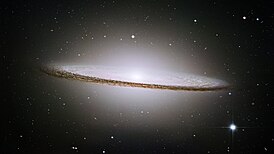
Sombrero Galaxy ( Messier 104 , English M 104 , NGC 4594 , Russian Messier 104 ) - a spiral galaxy in the constellation Virgo at a distance of 29.3 (± 1.6) million light-years from Earth (8.98 ± 0.49 million parsec). Diameter - about 50,000 light years (15329.74 pc) - about 30% of the diameter of the Milky Way. As shown by recent studies of this object by the Spitzer telescope, there are two galaxies: a flat spiral is inside an elliptical.
This object is one of those listed in the original edition of the New General Catalog .
Galaxy M104, better known as Sombrero, got its name due to the protruding central part (bulge) and a ridge of dark dusty matter (not to be confused with "dark matter" ), which gives the galaxy a resemblance to a sombrero hat. According to de Vaucouleurs , the object is observed almost from the edge, the plane of the galaxy is inclined to the line of sight at an angle of 6 ° to the south.
Due to its characteristic central bulge, the galaxy is classified as Edwin Hubble's Sa type.
Very strong x-ray radiation is due, according to many astronomers, the presence of a black hole with a mass of a billion solar masses in the center of this galaxy.
It was classified by Hubble as a sample of the Sa galaxy [3] .
Content
- 1 Discovery History
- 2 Membership
- 3 Galaxy structure
- 4 Black hole in the center of the galaxy
- 5 notes
- 6 Literature
- 7 References
Discovery History
Object M104 is the first of 7 objects of the Messier catalog not included in the second (last) edition of 1784. In 1921, Camille Flammarion discovered the coordinates and description of this object in handwritten notes on a copy of the catalog owned by Messier and entered it on the official list under number 104. The note referred to “very weak nebula” with coordinates 12h 28m 39s; −10 ° 24 '49 ", which was observed by an employee of Messier Pierre Meschen on May 11, 1781. Meschen himself mentioned the discovery of this object in his letter to Bernoulli dated May 6, 1783 .
Flammarion tried to correlate this nebula with some famous astronomical object and found that it was the Sombrero galaxy (NGC 4594), discovered, as previously thought, by William Herschel on May 9, 1784 and designated by it as H I.43.
M104 was the first astronomical object for which an abnormally high redshift was detected. In 1912, V. Slifer at the Lovell Observatory discovered that the object was moving away at a speed of 1000 km / s and thus, according to Hubble’s law, is located outside our galaxy. Slifer also discovered the rotation of this nebula [4] .
M104 was also the first galaxy to detect a streak of dust. This observation was made by William Herschel in 1784 .
Group
M104 is the main member of a small group of galaxies called the “M104 group” or “NGC 4594 group”, which is part of the Virgo supercluster .
Galaxy Structure
Due to the fact that NGC 4594 is turned to the observer on Earth sideways, astronomers find it difficult to unambiguously determine the shape of this cluster, although until recently it was believed that it is spiral. As part of a new work, scientists analyzed the data collected by the Spitzer telescope in the infrared range. The apparatus managed to find that the location of old stars in the galactic halo is consistent with the predictions of the development patterns of elliptical galaxies.
Black hole in the center of the galaxy
In the 1990s, a team led by John Kormendy found that there was a supermassive black hole in the center of the galaxy. According to spectroscopy with CFHT (Canada-France-Hawaii Telescope, Canadian-French telescope in the Hawaiian Islands) and the Hubble Space Telescope, it was found that the abnormally high speed of rotation of stars near the center can be explained by the presence of a black hole weighing 1 billion solar masses there . This is one of the most massive black holes discovered at present [5] .
Notes
- ↑ 1 2 R. Brent Tully, Courtois H. M., Sorce J. G. Cosmicflows-3 // Astron. J. / J. G. III - IOP Publishing , 2016 .-- Vol. 152, Iss. 2. - P. 50–50. - ISSN 0004-6256 ; 1538-3881 - doi: 10.3847 / 0004-6256 / 152/2/50
- ↑ Courtois HM, Tully RB, Makarov DI et al. Cosmic flows: Green Bank Telescope and Parkes HI observations // Mon. Not. R. Astron. Soc. / D. Flower - OUP , 2011 .-- Vol. 414. - P. 2005–2016. - ISSN 0035-8711 ; 1365-2966 - doi: 10.1111 / j.1365-2966.2011.18515.x
- ↑ Hubble, EP Extragalactic nebulae (Eng.) // Astrophys. J .. - 1926. - Vol. 64 . - P. 321-369 .
- ↑ VM Slipher. Spectrographic Observations of Nebulae (unknown) // Popular Astronomy. - 1915. - T. 23 . - S. 21-24 .
- ↑ J. Kormendy, R. Bender, EA Ajhar, A. Dressler, SM Faber, K. Gebhardt, C. Grillmair, TR Lauer, D. Richstone, S. Tremaine. Hubble Space Telescope Spectroscopic Evidence for a 1 X 10 9 M☉ Black Hole in NGC 4594 (Eng.) // Astrophysical Journal Letters. - 1996. - Vol. 473 . - P. L91 — L94 . - DOI : 10.1086 / 310399 .
Literature
- T. Di Matteo, CL Carilli, and AC Fabian. Limits on the Accretion Rates onto Massive Black Holes in Nearby Galaxies // The Astrophysical Journal . - 2001. - DOI : 10.1086 / 318405 . - arXiv : astro-ph / 0005516 .
- Søren S. Larsen, Jean P. Brodie, Michael A. Beasley, and Duncan A. Forbes. Keck Spectroscopy of Globular Clusters in the Sombrero Galaxy (Eng.) // The Astronomical Journal. - 2002. - DOI : 10.1086 / 341389 . - arXiv : astro-ph / 0204420 .
- S. Pellegrini, A. Baldi, G. Fabbiano, and D.-W. Kim. An XMM-Newton and Chandra Investigation of the Nuclear Accretion in the Sombrero Galaxy (NGC 4594 ) // The Astrophysical Journal . - 2003. - DOI : 10.1086 / 378235 .
- Q. Daniel Wang. Correction for the Flux Measurement Bias in X-Ray Source Detection // The Astrophysical Journal . - 2004 .-- DOI : 10.1086 / 422553 . - arXiv : astro-ph / 0405272 .
- Katherine L. Rhode and Stephen E. Zepf. The Globular Cluster Systems of the Early-Type Galaxies NGC 3379, NGC 4406, and NGC 4594 and Implications for Galaxy Formation // The Astronomical Journal. - 2004 .-- DOI : 10.1086 / 380616 . - arXiv : astro-ph / 0310277 .
- Lee R. Spitler, Søren S. Larsen, Jay Strader, Jean P. Brodie, Duncan A. Forbes, and Michael A. Beasley. Hubble Space Telescope ACS Wide-Field Photometry of the Sombrero Galaxy Globular Cluster System (Eng.) // The Astronomical Journal. - 2006. - DOI : 10.1086 / 507328 . - arXiv : astro-ph / 0606337 .
- George J. Bendo, Brent A. Buckalew, Daniel A. Dale, Bruce T. Draine, Robert D. Joseph, Robert C. Kennicutt, Jr., Kartik Sheth, John-David T. Smith, Fabian Walter, Daniela Calzetti, John M. Cannon, Charles W. Engelbracht, Karl D. Gordon, George Helou, David Hollenbach, Eric J. Murphy, and Hélène Roussel. Spitzer and JCMT Observations of the Active Galactic Nucleus in the Sombrero Galaxy (NGC 4594 ) // The Astrophysical Journal . - 2006. - DOI : 10.1086 / 504033 . - arXiv : astro-ph / 0603160 .
- Rupali Chandar, S. Michael Fall, and Dean E. McLaughlin. Density Dependence of the Mass Function of Globular Star Clusters in the Sombrero Galaxy and Its Dynamical Implications (Eng.) // The Astrophysical Journal . - 2007. - DOI : 10.1086 / 523040 . - arXiv : 0709.1440 .
- M. Hempel, S. Zepf, A. Kundu, D. Geisler, and TJ Maccarone. Near-Infrared Observations of Globular Clusters in NGC 4472, NGC 4594, NGC 3585, and NGC 5813 and Implications for Their Ages and Metallicities // The Astrophysical Journal . - 2007 .-- DOI : 10.1086 / 514808 . - arXiv : astro-ph / 0702500 .
- John R. Jardel, Karl Gebhardt, Juntai Shen, David B. Fisher, John Kormendy, Jeffry Kinzler, Tod R. Lauer, Douglas Richstone, and K. Gültekin. Orbit-based Dynamical Models of the Sombrero Galaxy (NGC 4594 ) // The Astrophysical Journal . - 2011. - DOI : 10.1088 / 0004-637X / 739/1/21 . - arXiv : 1107.1238 .
Links
- Information in English and French from the original “ New General Catalog ”
- Information (Eng.) From the Revised New General Catalog
- SIMBAD
- VizieR (English)
- NASA / IPAC Extragalactic Database
- NGC 4594 Publication List