Almost all the main works of the great Russian artist, the founder of analytical art, Pavel Nikolayevich Filonov , are stored in State Russian Museum . During the years of the blockade, after the death of the artist from exhaustion (December 3, 1941), his sister E.N. Glebova transferred to the museum about 400 works of her brother for temporary storage. In 1977, most of the paintings she donated to the museum.
The Soviet government did not favor the artist, and one does not have to talk about solo exhibitions. In the fall of 1929, an attempt was made at the Russian Museum to show Filonov’s works to a wide audience, the paintings hung for a year, but the exhibition never opened. In 1967, a small, “unofficial” exhibition of P.N. Filonova . The first large-scale exhibition of the artist was opened in the Russian Museum only in 1988. The Master’s dream came true: paintings that he basically didn’t sell were brought together, and compatriots saw them.
In the 1970s, a lot of work was done to restore Filonov's paintings painted on thin cardboard in oil in the restoration workshop of painting at the Russian Museum . Oil passing to the back made cardboard extremely fragile. The main task was to duplicate, and simply stick, cardboard on the canvas. At the restoration council in September 1973, a restorer of the highest category, Angelina Alekseevna Okun, proposed a method that was already used in the workshop for restoration of graphics. It consisted of double duplication of cardboard on canvas with an intermediate layer of acid-free paper. This layer made it impossible to print the texture of the canvas on the front side of the graphic work, and contributed to the stable connection of the two surfaces. This work was carried out in the Russian Museum in 1974-1976. restorers Alexander Kornyakov and Olga Guseva.
In 1987-1988, in connection with the preparation of the personal exhibition of P.N. Filonova , restorers continued to work. Using previous experience, they duplicated on a new basis more than 20 works of the artist, which for a long time were stored in separate sheets in a free state. Then they were pulled over the subframes, and inserts from the same cardboard were brought to the places where the base was lost. Lost fragments were filled with oil paints.
Thus, it became possible to exhibit works in the usual way for painting - on a stretcher and in a frame. Artists-restorers of the Russian Museum took part in this work: Marina Kiseleva, Evgeny Soldatenkov, Nadezhda Egorova, Kirill Golubenkov and Vladimir Kraminsky.

P.N. Filonov "The Formula of Imperialism" (1925)
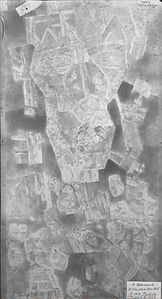
General view of the back of the painting before restoration. Restorer Kirill Golubenkov

General view of the back of the painting after restoration. Restorer Kirill Golubenkov


References used
- "From the history of the museum." Collection of articles and publications. Timing 1995 ISBN 5-900872-04-1
- "Filonov and his school." Timing 1990 DuMont Buchverlag KŐln ISBN 3-7701-2634-3