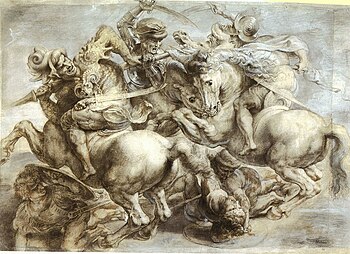
Wars in Lombardy is the common name for a series of military conflicts in Central and Northern Italy between the Republic of Venice and the Duchy of Milan (with various allies). They took place from 1425 until the signing of the Peace of Lodi in 1454. In the course of these wars, the political structure of Italy changed: five states formed from the communes and cities that formed the political map of Italy right up to the Italian wars . The most important political centers of Tuscany and Northern Italy — Siena , Pisa , Urbino , Mantua , Ferrara — were politically marginalized. The wars, broken down into four campaigns, were a struggle for hegemony in Northern Italy, which destroyed the economy of Lombardy and weakened the power of Venice.
Content
First Campaign
The first of the four campaigns against the territorial ambitions of the Duke of Milan Filippo Maria Visconti , was associated with the death of Giorgio Ordelaffi , signor Forli . He made Visconti the guardian of his nine-year-old heir, Theobaldo II . The mother of the latter, Lucretia degli Aldozi , the daughter of Signore Imola , disagreed with this and made herself regent. Disagreeing with this, the Forlivians rebelled and called for help Milan condottiere Agnolo della Pergola (May 14, 1423). The Florentine Republic responded with a declaration of war by the Visconti. Her condottier Pandolfo Malatesta invaded Romagna to help the members of the Alidosi family who ruled in Imola, but was defeated, and the city was taken by storm on February 14, 1424. The last ruler of Imola, Luigi degli Alidozi, was sent to Milan, and a few days later the ruler of Faenza , Gvidantonio Manfredi , took the side of Visconti. The Florentine army, which this time was commanded by Carlo Malatesta , was defeated again in July at the Battle of Sagar ; The captured Carlo was released by Visconti and also joined him. Then Florence hired Niccolò Piccino and Odda da Montone , but these two were also defeated at Val di Lamone. Odda was killed, but Picchino was able to convince Manfredi to declare war on the Visconti.
After the defeat in Romagna, Florence decided to attack Visconti from Liguria , entering into an alliance with the Aragonese from Naples , however, both the fleet of 24 galleys sent by the Aragonese to Genoa and the ground army failed. Meanwhile, Visconti hired Piccino and another condottiere - Francesco Sforza , and also sent an army under the leadership of Guido Torello to invade Tuscany. Torello defeated the Florentine army at Anghiari and at Fadzhuole.
Florence misfortunes were balanced by the pact signed on December 4, 1425 with the Republic of Venice. In accordance with the agreement, all conquests in Lombardy were taken over by the Venetians, all conquests in Romagna and Tuscany — by the Florentines; the captain-general of the League was appointed condotier Francesco Bussone and Carmagnola . In 1426, Bussone, who was recently paid by Visconti, after a long siege with active use of artillery, took Brescia (November 26, 1426), which he himself had recently taken for Visconti. Meanwhile, the Venetian fleet under the command of Francesco Bembo advanced along the Po to Padua , and the Florentines regained all their possessions in Tuscany. Visconti, who had already given Forli and Imola to the Pope in order to earn his favor, requested an armistice. Thanks to the mediation of the papal legate Niccolò degli Albergati, peace was signed on December 30, 1426 in Venice. Visconti got back the lands occupied by the Florentines in Liguria, but he had to abandon the Vercelli region, conquered by the Duke of Savoy Amadeus VIII , and Brescia, crossed by Venice, and promise not to invade Romagna and Tuscany.
Second Campaign
The world, however, did not last very long. On the advice of the Emperor Sigismund, the Visconti did not ratify the peace treaty, and in May 1427 the war broke out again. At first, the Milanese were able to take Casalmaggiore and Breshello ; the fleet sent there was burnt by the Venetian fleet under the command of Bembo, but Niccolò Piccino was able to defeat Busson on Gottolengo on 29 May. The Venetian commander forced him to retreat and captured Casalmaggiore on July 12, while Orlando Pallavicino, who owned several castles near Parma , rebelled against Visconti, and Amadeus VIII and Giovanni Jacopo of Montferrat invaded Lombardy from the east.
Visconti could count on some of the best condottieri of his time, such as Sforza, Della Pergola, Piccino and Guido Torello. However, since they were envious, he made Carlo Malatesta commander-in-chief. The latter commanded the Milanese at the Battle of MacLodio (October 4, 1427) and lost to the Venetians, who commanded Busson. The outcome of the battle was, nevertheless, not indisputable, and Visconti was forced to reconcile with Amadeus, giving him Vercelli and giving him his daughter Maria to him. However, since Sforza was defeated by the Genoese exiles, and Sigismund's help was needed, Visconti asked for peace. With the mediation of the Pope, on April 18, 1428, a peace treaty was signed in Ferrara. The Venetian governor was located in Bergamo and Crema , the Venetian possession of Brescia and her entourage was confirmed. The Florentines got back lost their strongholds with the exception of the city of Volterra , who rebelled against them. The troops under the command of Niccolò Fortebraccio , sent to pacify the city, were then sent against Lucca , who had ruled by Paolo Ginianigi on the side of Visconti.
Third Campaign
The third war (1431–1433) began when the Visconti supported Lucca, sending Francesco Sforza with 3000 horsemen there. However, Sforza was bought by Florentines for 50,000 ducats, who continued the siege of Lucca after the condottiere left. Encouraged by the besieged Visconti, he forced the Republic of Genoa to declare war on Florence. The defeat of their commander Gvidantonio da Montefeltro on the banks of the River Serquio on December 2, 1430, forced the Florentines to again seek help from Venice, and with the support of the new pope Eugenius IV , a Venetian by birth, to restore the League. Visconti responded by hiring Piccinino and Sforza again, who had to confront Bussone again.
On May 17, 1431, the League's army was defeated by Soncino , while Luigi Colonna defeated the Venetians under Cremona, Cristoforo Lavello threw back the troops of Montferrat, and Piccinino took up strong positions in Tuscany. Another source of misery for the restored League was the destruction of the Po River fleet , organized by Niccolò Trevisani near Pavia on 23 June. In 1431, the Visconti also found a valuable ally in the person of Amadeus VIII of Savoy in exchange for help against Giovanni Jacopo of Montferrat.
The Venetians won against the Genoese on August 27, 1431, the naval battle of San Fruttuoso, but on the land of Bussone, commanding the Venetian forces, moved cautiously, avoiding the battles, and it was suspected that he had been bought off by Visconti, while Sigismund, who arrived in Italy for the imperial crown. In the end, Bussone was removed; recalled by the Council of Ten , in March 1432, he was arrested and beheaded in front of the Doge's Palace . In November 1432, Piccinino defeated the Venetian army at the Battle of Delebio with the help of the combined army of Milan and Valtellina , where the troops of Venice invaded in 1431.
The peace treaty, signed in May 1433 in Ferrara, fixed a shaky status quo. The war of Florence against Lucca and the allies of this city ended similarly with a return to the pre-war situation, but the lack of success among the leaders of the League participants led to the loss of most of their charisma: the Venetian doge Francesco Foscari was on the verge of removal; Cosimo Medici was arrested and expelled to Padua . Another result of the peace treaty was that Montferrat became the satellite of Savoy.
Fourth Campaign
In the fourth war, controversial questions were personalized in the battles of the rival condotiers : Gattamelata , and later - Francesco Sforza nominally fought for Venice, while the side of the Visconti was led by Niccolò Piccino , who promised Pope Eugene IV to recapture Marka for him. Instead, he, quite in the spirit of the time, did the opposite: having conquered Ravenna and Bologna, he forced them to recognize Milan as their overlord.
Piccino, supported by Gianfrancesco Gonzaga , invaded the possessions of Venice in Lombardy. In September 1438, he began the siege of Brescia and attacked Bergamo and Verona. In response, Venice made an alliance with Florence and Francesco Sforza, in which some of the famous condotiers of that time participated - such as Astorre II Manfredi, Pietro Perzalliano and Nicolo III Ferrara. In exchange for supporting the latter, the ancient possession of Polesine was restored.
The Milanese were defeated in Tuscany and near Soncino (June 14, 1440). Military happiness began to lean towards Venice, and Sforza arrived in Venice to receive his share of the triumph. However, Piccinino returned to Romagna in February 1441 and defeated the Sforza garrison in Chiari . Sforza was besieged by Martinengo , but when Piccinino cut off all the ways to retreat, the situation seemed more preferable to Milan. Believing that victory was in his hands, Piccinino demanded Visconti in exchange for her signoria Piacenza . The duke of Milan chose instead to propose an agreement to Sforza.
On the field, Cavriana Sforza acted as a negotiator between the two parties, having done what Bussone paid for with his head. When signing a peace treaty in Cremona on November 20, 1441, no major territorial changes occurred: Venice retained Ravenna, Florence - the Casentino valley. Piccino received Orlando Pallavicino in Parmenza as a reward, while Filippo Maria Visconti recognized the independence of Genoa and again promised to stop interfering with the situation in Tuscany and Romagna.
Summary
Important dynastic and political changes took place: Francesco Sforza served Visconti and married his daughter, while Florence entered a new phase of its history under the leadership of Cosimo Medici . After the death of Visconti in 1447, Francesco Sforza, supported by the Medici, in May 1450 entered Milan in triumph. Two coalitions were formed: Milan Sforza, in alliance with Florence. The Medici opposed Venice and the Aragonese kingdom of Naples . The main theater of operations remained Lombardy, where both sides signed in May 1454 the Peace of Lodia - a compromise that formed the basis for a common agreement between the four rivals: Venice, Milan, Florence and Naples. This world was blessed by Pope Nicholas V , who represented the fifth force in Italy. The Lodi peace is often viewed as a manifestation of the constantly emphasized principle of European politics - the balance of power.