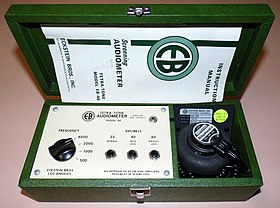
Audiometry (from Latin audio I hear and Greek metron measure), acumetry (from Greek akúo - hear) - measuring hearing acuity, determining auditory sensitivity to sound waves of different frequencies. The study is conducted by an audiologist . Exact research is carried out using an audiometer , but sometimes tuning with tuning forks can be performed. Audiometry allows you to explore both bone and air conduction. The result of the tests is an audiogram, according to which the otolaryngologist can diagnose hearing loss and various ear diseases. A regular examination reveals the onset of hearing loss .
Content
Types of Research
Tonal Audiometry
A study to assess the threshold of audibility (in decibels ) of typical frequencies. Testing is carried out at typical frequencies in the range (125-8000 Hz). For a complete hearing test in the entire frequency range, testing is used in the extended frequency range (125–20,000 Hz). Typical frequencies (125, 160, 200, 250, 315, 400, 500, 630, 750, 800, 1000, 1250, 1500, 1600, 2000, 2500, 3000, 3150, 4000, 5000, 6000, 6300, 8000, 9000 10,000, 11,200, 12,500, 14,000, 16,000, 18,000, 20,000 Hz).
Speech Audiometry
It is carried out to identify the quality of recognition of human speech at various sound levels (in decibels).
In Situ Audiometry
The technique, the advantage [2] of which is that it allows you to take into account in the hearing correction procedure not only the actual defects of the patient’s auditory system, but also the characteristics of the sound reproduction devices, in- ear inserts, vents and sound guides of the hearing aid . Applications built into the hearing aids based on the computing platforms of modern smartphones and tablets, the in situ audiometry function allows the patient to independently perform the tonal audiometry procedure. Digital hearing aids with built- in in situ audiometry use the calculated sound amplification factors, the values of which are calculated using special methods (the English prescription method), of which the most famous are NAL-PR, POGO and Berger [3] .
Research Methods
Air Conductivity
A method to assess the quality of the entire auditory tract. The sound level is adjustable in decibels and has a maximum value of 120 dB.
Bone Conduction
A method to assess the quality of the inner ear . The sound level is adjustable in decibels and has a maximum value of 70 dB.
See also
- Hearing preservation program
- Tympanometry
- Audiometer
- Audiological audits of the condition of the hearing organ (Section 5.5 of the NIOSH Noise Protection Guidelines ).
- Akumetr
Notes
- ↑ Linda Rosenstock et al. Criteria for a Recommended Standard. Occupational Noise Exposure. ( Revised Criteria ) . - NIOSH. - Cincinnati, Ohio: National Institute for Occupational Safety and Health, 1998 .-- 123 p. - (DHHS (NIOSH) Publication No. 98-126). . There is a translation (2016): NIOSH noise protection recommendations; Appendix: Section 3. Results
- ↑ Vashkevich M.I., Azarov I.S., Petrovsky A.A., Cosine-modulated filter banks with phase transformation: implementation and use in hearing aids. - Moscow, Hotline – Telecom, 2014 .-- 210 p.
- ↑ Fonlanten A. Hearing Aids / Fonlanten A., Horst A. - Rostov n / A .: Phoenix, 2009 .-- 304 p.