Vector-06C is a Soviet home computer created in 1986.
| Vector-06Ц | |
|---|---|
 | |
| Type of | Home computer |
| Date of issue | 1987 |
| CPU | KR580VM80A |
| RAM | 64 kb |
| Chipset | KR580 |
| Data storage devices | compact cassette drive |
| OS | BASIC , CP / M , MicroDOS |
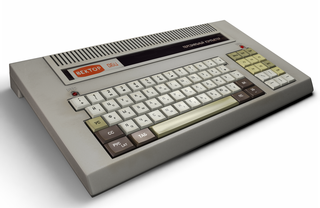
History
The Vector-06C home computer was developed in the mid-1980s by Soviet engineers from Chisinau Donat Temirazov and Alexander Sokolov. Launched after the 33rd All-Union Radio Exhibition in 1987, at which Vector-06C received the first prize [1] [2] and was spotted by the USSR Deputy Minister of Radio Industry. Initially produced at the Chisinau software “Schetmash”. The production of “Vector” and related PCs was mastered by various defense enterprises located in different cities of the USSR , including Astrakhan, Volzhsky, Kirov and Minsk. In 1988, Vektor received the silver medal of the All- Union Exhibition of Economic Achievements of the USSR, and in 1989 it won first place among 8-bit personal computers (second general) at the competition of the USSR CCVTI [3] . In 1989, a computer was sold at a price of 750 rubles [4] .
In 1991, “Schetmash” released the “Vector-06Ц.02” model with a slightly modified scheme, but fully compatible with the previous model and with the same capabilities.
However, with the mass distribution in the mid-1990s in the countries of the former USSR of much more powerful IBM-compatible computers, the Vector, along with other 8-bit computers, was gradually forced out of use.
Key Specifications
- Processor : КР580ВМ80А , operates at an increased clock frequency of 3 MHz (standard maximum frequency is 2.5 MHz); however, due to the braking of the processor by the video controller, each machine cycle expands to 4 cycles, for example, 4- and 8-cycle instructions are executed in 4 and 8 cycles, and 5- and 7-cycle for 8, 10-cycle for 12 etc.
- RAM : 64 KB , of which 8 to 32 KB can be used for video memory (respectively, user memory - from 32 to 56 KB).
- ROM : 512 bytes or 2 KB; contains only the bootloader [5] either only from a tape recorder (512 Bytes), or from a tape recorder, floppy drive, quasi-disk or external ROM (2 Kbytes); BASIC, like any other program, is loaded from a cassette or other external medium.
- Three-channel sound synthesizer, made on a chip programmable timer KR580VI53 .
- One software-generated sound channel.
- Hardware vertical screen scrolling.
- Expandable via system bus and I / O ports.
- Despite the large number of microcircuits - up to 105 pcs. [6] , "Vector-06Ц" had a design that almost did not contain scarce and expensive elements or any specialized microcircuits like ULA or BMK. The cost of "Vector-06Ц" in the late 1980s was 750 rubles. - for 100 rubles. more expensive BK-0010-01.
Video System
Possible video modes "Vector-06c" [5] :
- 256 × 256 pixels with 2, 4, 8, 16 simultaneously displayed colors from a common palette of 256 colors;
- 512 × 256 pixels with a palette of 2 or 4 colors out of 256;
- 1,024 × 256 pixels with a palette of 2 colors out of 256.
Video memory is organized in the form of four 8-kilobyte pages, or bit planes, which can be turned on and off by programming the palette. Disconnected planes can be used as normal memory for programs and data. By changing the number of planes involved in the video memory, you can get video modes with different color depths. So, four included planes give a depth of 4 bits per pixel, that is, 16 simultaneously displayed colors. Two simultaneously working planes give 2 bits per pixel, or 4 colors. One plane gives a monochrome image.
In all graphic modes, setting the border color to any of 256 colors of the general palette is supported. Smooth vertical scrolling is implemented in hardware. By non-standard programming of the video system, it was possible to get various “special effects”, in particular, exceeding the limit of 16 colors displayed simultaneously.
There is no hardware implementation of text modes, text output is carried out programmatically in graphical mode.
As a display device, we used a conventional TV with a video input output, or a monitor with television scan parameters.
Sound
The built-in sound subsystem outputted sound to a single built-in mini- speaker and a linear input of the tape recorder. A sound generator based on the programmable timer KR580VI53 made it possible to synthesize monophonic melodies with three-channel polyphony . At the same time, the sound of a given frequency was reproduced practically without the participation of the central processor, which made it possible to output music and sound in parallel with other actions requiring a significant processor load. True, the sound always had only a rectangular wave shape, and there was no possibility of programmed volume control. However, in a different operating mode of the KR580VI53 timer (as a pulse generator of a given duration), it could programmatically reproduce a sufficiently high-quality digitized sound, approximately corresponding to a 7-bit DAC, with a sampling frequency of about 7-8 KHz (the sampling frequency could be increased several times with a proportional decrease the number of signal levels, that is, the "bit of the DAC").
In the early 1990s, third-party developers created options for connecting an external, more complex three-voice (plus a noise generator) General Instruments AY-3-8910 audio controller, connected either to the VU system connector or to the printer's printer connector.
Expansion Options
Two expansion slots located on the back of the computer, allows you to connect various peripheral devices. At the factory, no additional devices for connecting to these connectors were proposed, but they could be purchased separately.
Data Storage
In the basic configuration, Vector did not have any additional data storage devices, and it was necessary to use a household cassette recorder as the bootloader of the system and external media. The tape recorder was connected to the corresponding PC connector, and the programs were recorded on ordinary audio tapes. A 60-minute cassette could fit up to 512 KB of data.
The standard format for recording on a cassette was different in that the data was divided into short blocks of 256 bytes, each of which was equipped with its own header. Each header contained enough information so that the loader could read blocks in random order. This made it possible to reload bad blocks without repeating the entire file reading. In addition, the process of loading blocks was visually displayed on the screen in the form of a characteristic “matrix” of columns that filled up as the data block was read. A similar splitting into short blocks was used in the recording format of Atari 400/800 computers [8] , however, the block headers did not contain data about the file.
In addition to the standard cassette recording format, for Vektor, several improved options for block data recording were created, which made it possible to further increase the reliability of information storage and speed up the process of downloading programs several times.
The “Vector” scheme initially provided for the connection of an external memory expansion module with a capacity of 64 or 256 KB, which was called a “quasi-disk”, because it was intended for use as a disk drive. A specially adapted version of MicroDOS made it possible to work with a quasidisk as a floppy disk. The initial loading of the quasi-disk was made from a cassette recorder or from a drive. There were third-party developments with a memory capacity of up to 2 MB [9] . Some programs required a quasi-disk and used it as additional RAM.
The "Vector" provided for the use of a 5.25 ″ or 3.5 ″ drive through the external circuit of the HDD controller. Third-party developers created several incompatible controller circuits and adapted the CP / M and MicroDOS operating systems. The capacity of the floppy disks was 640 or 800 KB.
In addition, a ROM disk with a capacity of 65 KB or more was developed, on which commonly used programs were usually placed, for example: BASIC, monitor-debugger, text editor. A hard disk connection scheme was created with the ability to partition the disk into logical areas and an operating system with support for hard disk drives.
To provide support for all connected devices, several versions of the built-in bootloader have been created.
Modifications and derivatives of PCs
The industry produced several home computers similar to Vector-06c. Modifications of the “Vector-06ts” base model: Vector-06Ц.02 , Vector Start-1200 , Krista-2 , PK-6128Ts . There was also an independent private development called Vector Turbo + .
Vector Start-1200
"Vector Start-1200" was sold as a designer. The bootloader and monitor were written to the ROM. The “Start-1200” video system made it possible to select one of 32 possible color palettes; arbitrary programming of the palette was not supported.
Krista 2
Computer "Krista-2" is the previous, intermediate version of the computer Vector 06Ц. Distinctive features of this computer from "Vector 06Ц":
- The central processor operates at a lower frequency, which is 2.5 MHz.
- The image generated by a computer on a standard TV cannot be displayed fully in width.
- There is no way to change the color palette. The computer has 16 fixed colors.
- The format for storing programs on magnetic tape with Vector 06C is incompatible.
- 512 × 256 high resolution video mode is not compatible. The order of the points in the byte differs. [10] .
- There is an additional video mode of 1024 × 256. [11] .
PK-6128Ts
In 1991, in the city of Astrakhan , a modification of the "Vector-06Ц" under the name PK-6128ts was produced . Distinctive features of PK-6128ts:
- Processor: IM1821VM85A (analog of i8085 ), 3 MHz
- RAM: 128 KB
- ROM: 16 KB
- 46 kbaud LAN adapter
- Integrated drive controller
Other Modifications
Vector Turbo + was a modernization of the factory version of the "Vector-06C" developed at NPP Intek (Vladimir). The refinement included installing the Z80 processor at frequencies of 3, 6 and 12 MHz, expanding the RAM to 1-2 MB, improving the performance of the video adapter to a maximum mode of 1024 × 256 pixels with 4 colors, the presence of a system clock, a drive, an IBM AT keyboard, and an interrupt controller . A prototype was created, but serial production was not established [12] [13] .
Software
"Vector-06ts" is one of the few home computers that are useless without an external drive with software (it does not even have a built-in monitor debugger). When you turn on the computer, you must first prepare a tape recorder with software.
The “Vector-06ts” kit included one audio cassette with several system programs and games . Additional programs could be purchased at firms selling computer software for PCs.
Standard cassette audio content:
- "Party 1"
- Test drive test ROM
- BASIC v2.5 ROM
- BAS Advertising
- Inform-1 BAS
- Inform-2 BAS
- BASIC Tutorial (10 programs) BAS
- Kalah BAS
- Hockey BAS
- "Party 2"
- Copy ROM
- ROM device test
- Yeti ROM
- Tetris ROM
- Monitor debugger ROM
- Editor Assembler MON
- Reversi BAS
- BAS torpedo attack
"Vector" could be used both for training or work (programming, texts, tables, databases, drawing graphs, illustrations, etc.), and for entertainment.
For "Vector" was created about 400 games [14] , representing all the main genres characteristic of PC 1980s. The “labyrinths” and “platformers”, such as Adskok, Ambal, Yeti, Grotokhod, Rise Out, Putup, Alibaba, Eric, Binary Land, “Pacman”, “Boulder Dash”, “Digger” and others. There were a variety of logical and sports games - chess, checkers, tetris, billiards, sokobans, reverses, color lines, Filler, Lemmings, etc. There are a lot of “flying shooters” as with vertical scrolling - “Flight”, Death Fight, Back by LSI and others, and with horizontal - Cyber Mutant, “Planet of birds”, “Zone of the future”, Raider 2, “Sea hunter”, “Death satellite”, “Paratrooper”, etc. Fights are well presented - After the war, International karate, Best of the best, Samurai and others. There are several games with real 3D graphics - like Pillars and Star wars - and pseudo-three-dimensional mazes - Maze, Alfred, etc., as well as " as if three-dimensional "" flying "type" Galactic Patrol "and" Vampire Hunt ". Of course, there are other classic 80s games - Exolon, Pairs, Stop the express, Arkanoid, Python, Crazy train, Lode Runner, Frogger, Cybernoid and many others. A lot of good games were ported almost unchanged from the MSX family of PCs, less - with the ZX Spectrum and IBM PC. The widest graphic capabilities of “Vector” in many cases made it possible to simulate the graphics of MSX, Spectrum, IBM PC and other PCs with almost absolute accuracy.
- Games for Vector-06C
"Putup" - a very popular adaptation on the "Vector" game adaptation from a PC standard MSX
Pseudo-three-dimensional game "Maze" Bityutskova S. N. with very fast graphics
The game "Minesweeper" by E. Shamis was written specifically for "Vector-06C"
"Exolon" - a great adaptation of the game with the PC ZX Spectrum
The game "Samurai" A. Sergeev and D. Stepanov
Ambal is one of the most popular games on the Vector. Author - Kuznetsov R.V.
In addition to games, various system and application programs were offered, in particular various dialects of BASIC , Pascal , debug monitors, assembler , text and graphic editors, etc. The presence of a quasi-disk and / or drive made it possible to use CP / M version 2.2 and its domestic version - OS MicroDOS . This allowed the use of programs written for CP / M , such as: dBase II DBMS, WordStar word processor, SuperCalc spreadsheet , C , Ada , Pascal , LISP , Assembler compilers and other programs.
A monitor emulator was created that allowed you to run programs for computers of Radio 86RK , Mikrosh , Specialist without changes. By recompilation using special programs, individual programs with ZX Spectrum and MSX [15] [16] were adapted.
User Community
"Vector" kept in the shadow of the more common in the USSR PC BK-0010 and analogues of the ZX-Spectrum , but had a significant number of adherents. Enthusiasts have written a large number of original gaming and system programs. Many original hardware developments were created and some solutions created for other platforms were adapted. Several companies specialized in supporting the Vector and developing programs for it: the Chisinau center “Computer”, the Moscow company “Coman” and others. The newspapers with hardware circuits and descriptions of programs were published in the Samizdat way: “Coman-Info” (“Coman” company) and Vector-User ”(center“ Computer ”, then V. Fironov) [17] . A number of articles on the "Vector" circuitry and hardware solutions for it were published in the "Amateur Radio" magazines from 1992 to 1997 and "PC for All" in 1994. There were also purely electronic publications: “Invector”, “Vladimir Vector”, etc. In St. Petersburg in 1998 and 1999, enthusiasts held a contest “DemosFan”, which demonstrated games and demo programs for “Vector” [18] [19] .
See also
- Search (computer)
- Mikrosha
- BK (family of computers)
Notes
- ↑ Radio Magazine No. 10, 1987, p. 2
- ↑ 1st cover page (unopened) // Radio. - T. 10/1987 . - ISSN 0033-765X .
- ↑ Results of the competition for the creation of household PCs (neopr.) // Computing technique and its application. - T. 8/1990 .
- ↑ Computer market: Minradioprom // Computer Science and Education. - 1989. - No. 6 .
- ↑ 1 2 Technical information on the PC “Vector” . Date of treatment June 17, 2007. Archived August 23, 2011.
- ↑ For comparison, the BK-0010 had only 45 chips, the first Soviet Spectrum-compatible PCs had about 50.
- ↑ 256 colors (2009), Tselikov D. - Basis
- ↑ Atari data cassette (English)
- ↑ Vector USER 28-29
- ↑ Vector USER 17
- ↑ Secrets of the Vector and Krista . Date of treatment February 28, 2009. Archived August 23, 2011.
- ↑ NPP Intek. Vector Turbo Plus // Vector User. - 1993. - No. 15 . - S. 4 .
- ↑ Bykov V.P. News // InVector. - 1997. - No. 4 .
- ↑ Basis - Game Category
- ↑ Yu. Makrinsky. Universal disassembler of the Z80 and 8080 commands // Vector User. - No. 20, 21 .
- ↑ Вектор-06Ц: Z80-ВМ80 рекомпиляция . Дата обращения 11 июня 2009. Архивировано 23 августа 2011 года.
- ↑ Вектор-06Ц: Электронные издания . Дата обращения 17 июня 2007. Архивировано 23 августа 2011 года.
- ↑ Вектор-06Ц: О главном . Дата обращения 1 марта 2009. Архивировано 23 августа 2011 года.
- ↑ Базис: категория event . Дата обращения 1 марта 2009. Архивировано 23 августа 2011 года.
Links
- 19 лет назад был создан Вектор-06Ц
- Техническое описание ПК Вектор-06Ц Александра Тимошенко
- vector06cc — Открытый проект по воссозданию «Вектор-06Ц» на основе ПЛИС
- Эмулятор «Башкирия-2М», имеет режим эмуляции Вектор-06Ц
- Базис — картотека ПО для Вектора-06Ц
- ПК-6128ц — обсуждение ПК-6128ц
- модернизация Вектор-06ц — ремонт и модернизация емкостной клавиатуры, подключение к современному тюнеру, телевизору
- лучшие игры для «Вектора-06Ц» — видеоролики