
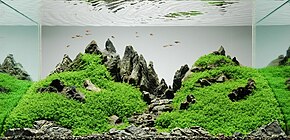
Aquarium design , aquascaping ( Eng. Aquascaping - creating a water landscape , landscape ) - the decoration of aquariums , one of the types of decorative art [1] . It is a kind of aquarium analogue of landscape design .
Content
Destinations
Dutch aquarium
The Dutch aquarium became widely known throughout the world in the 1960s [2] . The key role is played by densely planted plants , the organized complex of which forms an underwater garden . Plants are strictly zoned: they are delimited both in height and in spatial position. The Dutch style is distinguished by contrasts of green and red plants, as well as the presence of a path from the plants (“Leiden Street” [3] ), which goes deeper into the aquarium and emphasizes its perspective . Fish are absent or in limited numbers. The length of the aquarium is 2-3 or more times its height. The height is approximately equal to or less than the width for good permeability of atmospheric oxygen into the water column.
Natural Aquarium
A natural aquarium imitates in miniature, according to the bonsai principle, any part of the land, for example: mountains, valleys, rocks, groves, etc. [4] . It implies the creation of a composition made exclusively using natural materials (stones, driftwood) and living plants. Fish in such an aquarium have a secondary role, their task is only to supplement the composition, and not to attract attention.
The concept of a natural aquarium, which has received international recognition, was put forward by the Japanese photographer and designer Takashi Amano [1] . Thanks to his numerous books, this direction of aqua design has been spreading since 1994 [2] .
Styles of a natural aquarium:
Iwagumi ( Japanese 岩 岩 ) or Ishigumi ( Japanese 石 組 ) is the landscape of a natural aquarium, the main elements of the composition of which are stones.
Ryoboku ( 流 木 木 ) - snags play a key role in the composition.
Wabi-kusa ( Japanese 佗 び 草 , Moss bump) - suggests the presence of underwater and surface parts in the composition. It imitates a floating island or bump. The underwater and surface parts of the composition may not be related to each other, but stylistically are a continuation of one another.
Zen garden - involves the design of an aquarium in accordance with the philosophy of Zen Buddhism . The purpose of such aquariums is to create an atmosphere of peace and tranquility.
Pseudo-Sea
Freshwater aquarium imitating a marine . Its design uses coral chips, artificial corals and sea shells. The aquarium is populated with bright fish. Blue backlight to simulate a marine underwater landscape and landscape.
Equipment
The equipment for aquascaping is similar to the set of an ordinary aquarist, but for the photosynthesis of plants, there are increased requirements for lighting and the presence of carbon dioxide in water. Also, for good growth, plants need fertilizer. Types of equipment:
- Lighting system. Daylight lamps, LED lamps, decorative luminous balls, etc. [5] .
- Filtration system. External, internal filters with various filtering material (synthetic winterizer, activated carbon, special microorganisms for biofiltration, etc.).
- Carbon dioxide supply system (compressed gas cylinders, systems based on fermentation or chemical reactions, effervescent tablets).
- Water temperature control system (heaters, coolers).
Decor elements : background in the form of a glued film on the back and sometimes on the side glass of the aquarium; the internal background installed in the aquarium to its rear wall; stones, grottoes, snags; figures of castles, sunken ships, divers, etc .; decorative soil, aeration of water (air bubbles flowing upward), artificial plants, decorative lighting.
Notes
- ↑ 1 2 Rybalko S.B., Baranovskaya O.V., Uzhik V.V. Aquarium composition: art history aspect // Problems of aquaculture. Vol. 3. Materials of the Intern. scientific-practical conf. in aquarology // Mezhved. Sat scientific and scientific method. tr - M .: Moscow Zoo, Group of companies "Aqua Logo", 2009. - S. 103-106 . Archived December 3, 2013.
- ↑ 1 2 Kasselman K. Aquarium Design = Pflanzenaquarien gestalten / Transl. with him. N. Ignatiev. - M .: Aquarium, 2009. - P. 124-127. - 160 p.
- ↑ Plant Path - High Art
- ↑ Takashi Amano: the world of a natural aquarium
- ↑ Decorative lighting
Literature
- Kasselman K. Aquarium Design = Pflanzenaquarien gestalten / Per. with him. ON. Ignatieff. - M .: Aquarium-Print, 2010 .-- 158 p. - ISBN 978-5-9934-0240-6 .