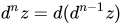
The differential of order n , where n> 1 , from the function {\ displaystyle z}  at some point is called the differential at this point from the differential of order (n - 1) , that is,
- {\ displaystyle d ^ {n} z = d (d ^ {n-1} z)}
 .
.
Content
For a function dependent on one independent variable {\ displaystyle z = f (x)} The second and third differentials look like this:
- {\ displaystyle d ^ {2} z = d (dz) = d (z'dx) = dz'dx = (z''dx) dx = z''dx ^ {2}} ,
- {\ displaystyle d ^ {3} z = d (d ^ {2} z) = d (z''dx ^ {2}) = dz''dx ^ {2} = (z '' dx) dx ^ {2} = z '' 'dx ^ {3}} .
From here you can deduce the general form of the differential of the nth order from the function {\ displaystyle z = f (x)} , provided that {\ displaystyle x} - independent variable:
- {\ displaystyle d ^ {n} z = z ^ {(n)} dx ^ {n}} .
When calculating differentials of higher orders, it is very important that {\ displaystyle dx} there is arbitrary and independent of {\ displaystyle x} which when differentiating by {\ displaystyle x} should be considered as a constant multiplier. If a {\ displaystyle x} is not an independent variable, the differential will be different (see below ) [1] .
If the function {\ displaystyle z = f (x, y)} has continuous partial derivatives of the second order, then the differential of the second order is defined as: {\ displaystyle d ^ {2} z = d (dz)} .
- {\ displaystyle d ^ {2} z = d \ left ({\ frac {\ partial z} {\ partial x}} dx + {\ frac {\ partial z} {\ partial y}} dy \ right) = \ left ({\ frac {\ partial z} {\ partial x}} dx + {\ frac {\ partial z} {\ partial y}} dy \ right) '_ {x} dx + \ left ({\ frac {\ partial z } {\ partial x}} dx + {\ frac {\ partial z} {\ partial y}} dy \ right) '_ {y} dy =}
- {\ displaystyle = \ left ({\ frac {\ partial ^ {2} z} {\ partial x ^ {2}}} dx + {\ frac {\ partial ^ {2} z} {\ partial y \ partial x} } dy \ right) dx + \ left ({\ frac {\ partial ^ {2} z} {\ partial x \ partial y}} dx + {\ frac {\ partial ^ {2} z} {\ partial y ^ {2 }}} dy \ right) dy}
- {\ displaystyle d ^ {2} z = {\ frac {\ partial ^ {2} z} {\ partial x ^ {2}}} dx ^ {2} +2 {\ frac {\ partial ^ {2} z } {\ partial x \ partial y}} dxdy + {\ frac {\ partial ^ {2} z} {\ partial y ^ {2}} dy ^ {2}}
- {\ displaystyle d ^ {2} z = \ left ({\ frac {\ partial} {\ partial x}} dx + {\ frac {\ partial} {\ partial y}} dy \ right) ^ {2} z}
Symbolically, the general form of the differential of the nth order of the function {\ displaystyle z = f (x_ {1}, ..., x_ {r})} as follows:
- {\ displaystyle d ^ {n} z = \ left ({\ frac {\ partial} {\ partial x_ {1}}} dx_ {1} + {\ frac {\ partial} {\ partial x_ {2}}} dx_ {2} + ... + {\ frac {\ partial} {\ partial x_ {r}}} dx_ {r} \ right) ^ {n} z}
Where {\ displaystyle z = f (x_ {1}, x_ {2}, ... x_ {r})} , but {\ displaystyle dx_ {1}, ..., dx_ {r}} arbitrary increments of independent variables {\ displaystyle x_ {1}, ..., x_ {r}} .
Increments {\ displaystyle dx_ {1}, ..., dx_ {r}} considered as constant and remain the same when moving from one differential to the next. The complexity of expressing the differential increases with the number of variables.
With {\ displaystyle n \ geqslant 2} {\ displaystyle n} differential is not invariant (as opposed to the invariance of the first differential ), that is, the expression {\ displaystyle d ^ {n} f} depends, generally speaking, on whether a variable is considered {\ displaystyle x} as independent, or as some intermediate function of another variable, for example, {\ displaystyle x = \ varphi (t)} .
So, for the independent variable {\ displaystyle x} the second differential, as mentioned above, has the form:
- {\ displaystyle d ^ {2} z = z '' (dx) ^ {2}}
If variable {\ displaystyle x} itself may depend on other variables then {\ displaystyle d (dx) = d ^ {2} x \ neq 0} . In this case, the formula for the second differential will have the form [1] :
- {\ displaystyle d ^ {2} z = d (dz) = d (z'dx) = z '' \, (dx) ^ {2} + z'd ^ {2} x} .
Similarly, the third differential will take the form:
- {\ displaystyle d ^ {3} z = z '' '\, (dx) ^ {3} + 3z''dx \, d ^ {2} x + z'd ^ {3} x} .
To prove the non-invariance of higher order differentials, it suffices to give an example.
With {\ displaystyle n = 2} and {\ displaystyle y = f (x) = x ^ {3}} :
- if a {\ displaystyle x} - independent variable, then {\ displaystyle d ^ {2} y = d ^ {2} f (x) = (x ^ {3}) '' (dx) ^ {2} = 6x (dx) ^ {2}}
- if a {\ displaystyle x = \ varphi (t) = t ^ {2}} and {\ displaystyle dx = d \ varphi (t) = \ varphi '(t) dt = 2tdt}
- {\ displaystyle 6x (dx) ^ {2} = 6t ^ {2} (2tdt) ^ {2} = \ color {BrickRed} {24t ^ {4} (dt) ^ {2}}}
- wherein, {\ displaystyle y = x ^ {3} = (t ^ {2}) ^ {3} = t ^ {6}} and {\ displaystyle d ^ {2} y = (t ^ {6}) '' (dt) ^ {2} = \ color {BrickRed} {30t ^ {4} (dt) ^ {2}}}
In view of dependence {\ displaystyle x = t ^ {2}} , already the second differential does not possess the property of invariance when changing a variable. The differentials of orders 3 and higher are also not invariant.
- Using differentials function {\ displaystyle F} subject to its existence {\ displaystyle (n + 1)} first derivatives can be represented by Taylor formula :
- for a function with one variable:
- {\ displaystyle {\ mathcal {4}} F (x_ {0}) = dF (x_ {0}) + {\ frac {d ^ {2} F (x_ {0})} {2!}} +. .. + {\ frac {d ^ {n} F (x_ {0})} {n!}} + {\ frac {d ^ {n + 1} F (x_ {0} + \ theta {\ mathcal { 4}} x)} {(n + 1)!}}} , {\ displaystyle (0 <\ theta <1)} ;
- for a function with several variables:
- {\ displaystyle {\ mathcal {4}} F (x_ {0}, y_ {0}) = dF (x_ {0}, y_ {0}) + {\ frac {d ^ {2} F (x_ {0 }, y_ {0})} {2!}} + ... + {\ frac {d ^ {n} F (x_ {0}, y_ {0})} {n!}} + {\ frac { d ^ {n + 1} f (x_ {0} + \ theta {\ mathcal {4}} x, y_ {0} + \ theta {\ mathcal {4}} y)} {(n + 1)!} }} , {\ displaystyle (0 <\ theta <1)}
- If the first differential is zero, and the second differential of the function {\ displaystyle f (x_ {1}, ..., x_ {n})} is positively defined (negatively defined), then the point {\ displaystyle (x_ {1}, ..., x_ {n})} is a point of strict minimum (according to strict maximum); if the second differential of the function {\ displaystyle f (x_ {1}, ..., x_ {n})} is uncertain then at the point {\ displaystyle (x_ {1}, ..., x_ {n})} no extremum .
- G.M. Fichtengolts "Course of differential and integral calculus", volume 1