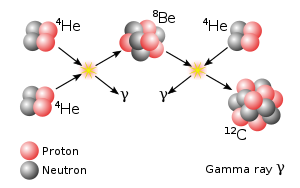
The triple helium reaction (triple alpha process) is a chain of thermonuclear reactions in which three helium-4 nuclei form a carbon-12 nucleus. It starts at a temperature of about 1.5⋅10 8 K and a density of about 5⋅10 7 kg / m 3 . This reaction proceeds in two stages:
- the formation of an unstable beryllium-8 core (half-life 10 −16 s)
| Nuclear processes |
|---|
Radioactive decay
Nucleosynthesis
|
- ,
- Q 0 = 0.092 MeV

- formation of an excited carbon-12 nucleus
- ,
- Q 1 = 7.367 MeV

Despite the short lifetime of beryllium-8 (6.7⋅10 −17 sec), due to the high concentration of 4 He nuclei at high densities of matter in helium thermonuclear sources in the bowels of stars, 8 Be nuclei have time to interact with 4 He.
Another factor contributing to the course of the reaction is its resonance character: the reaction energy is 8 Be ( 4 He, γ) 12 C (Q 1 = 7.37 MeV), which is close to the energy of the second excited state of the 12 C nucleus (7.65 MeV). The resonant nature of the reaction was theoretically predicted by Fred Hoyle .
Links
See also
- Helium flash
- Stellar nucleosynthesis