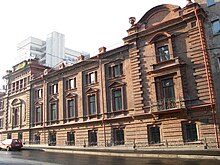
"Brick style" - the symbol of the unplastered buildings of the period of historicism in Russia (the end of the XIX century ). For the "brick style" is characterized by the replacement of stucco and plaster with decorative brick .
Content
Term
The term was put into use by late Soviet art critics to describe the eclectic structures of Viktor Aleksandrovich Schröter . Over time, the lack of decoration became fashionable and “in brick” began to build buildings that are now referred to as rational modernism , neoclassicism , pseudo-Russian style, etc.
In itself, the absence of plaster is not a style-forming attribute.
History
Buildings with non-plastered facades were encountered in Russia at the end of the 18th century — these were mainly industrial and storage facilities, barracks, and park pavilions.
In most publications, the "brick style" refers to the rationalistic trend in the architecture of historicism (the 2nd half of the XIX century). When refusing plaster, brickwork itself acquired a decorative meaning: the facades were laid out of polychrome brick, glazed ceramic tiles, tiles , terracotta inserts, and natural stone was often used.
Such buildings were relatively inexpensive and more “unpretentious” in the conditions of the Russian climate, so they quickly became popular in the provinces. Thus, brick style represents the rationalization of historicism for mass and utilitarian construction.
Non-plastered buildings were designed by such architects as Harald Bosse , Victor Schroeter , Jerome and Maximilian Kitners , P. P. Naranovich , V. V. Khabarov , V. O. Sherwood , R. G. Schmeling , Karl Schmidt , A. F. Snurilov .
USSR
The facades of red brick without plaster were built in the mass architecture of residential buildings in the 1920s - 1930s in the style of simplified constructivism and in the architecture of "ordinary" Stalinist houses , primarily pre-war ones. After the resolution on the fight against “architectural excesses” in 1955, plaster was attributed to “excesses,” and many Stalinist houses under construction lost it, having received the popular name “ragged stalinki”. From that moment until the collapse of the Soviet Union, all brick residential buildings ( Khrushchev , Brezhnevka, etc.) and most other buildings were built without plaster, representing typical functional "boxes" of the most massive white silicate brick . In some cases, for the decoration of facades with white brick combined color, especially red, laying out of it some parts of the facade or wall patterns.
Modernity
A similar practice is being applied even now with the brick and monolith-brick construction of mass housing. The above-mentioned buildings are usually not classified as brick style.
See also
- Brick gothic