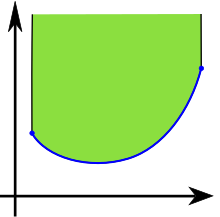
A convex function (a convex downward function ) is a function for which any segment between any two points of the graph of the function in the vector space lies not lower than the corresponding arc of the graph. Equivalently, convex is a function whose epigraph is a convex set .
A concave function ( upward convex function ) is a function whose chord between two points of the graph of which lies no higher than the formed arc of the graph, or, equivalently, whose subgraph is convex .
The concepts of a convex and concave function are dual , moreover, some authors define a convex function as concave, and vice versa [1] .
The concept is important for classical mathematical analysis and functional analysis , where convex functionals are especially studied, as well as for applications such as optimization theory , where a specialized subsection — convex analysis — is highlighted.
Content
- 1 Definitions
- 1.1 Notes
- 2 Properties
- 3 notes
- 4 Literature
Definitions
A numerical function defined on a certain interval (in the general case, on a convex subset of a certain vector space ) is convex if, for any two values of the argument , and for any number Jensen's inequality holds :
Remarks
- If this inequality is strict for everyone and , then the function is called strictly convex .
- If the converse inequality holds, the function is called concave (respectively, strictly concave for the strict case).
- If for some a stronger inequality holds
- then the function is called strongly convex .
Properties
- Function convex in the interval , continuous throughout differentiable throughout with the exception of at most countably many points and is twice differentiable almost everywhere .
- Any convex function is subdifferentiable (has a subdifferential ) in the entire domain.
- For a convex function, a supporting hyperplane of its epigraph passes through any point.
- Continuous function convex on if and only if for all points inequality holds
- A continuously differentiable function of one variable is convex on an interval if and only if its graph lies no lower than the tangent ( supporting hyperplane ) drawn to this graph at any point in the convex interval.
- The convex function of one variable on the interval has left and right derivatives; the left derivative at the point is greater than or equal to the right derivative; the derivative of a convex function is a non-decreasing function.
- A twice differentiable function of one variable is convex on an interval if and only if its second derivative is non-negative on this interval. If the second derivative of a twice differentiable function is strictly positive, such a function is strictly convex, but the converse is not true (for example, the function strictly convex on but its second derivative at the point equal to zero).
- If function , convex, then any linear combination of them with positive odds , also convex.
- The local minimum of a convex function is also a global minimum (respectively, for upward convex functions, the local maximum is a global maximum).
- Any stationary point of a convex function will be a global extremum.
Notes
- ↑ Klyushin V. L. Higher mathematics for economists / ed. I.V. Martynova. - Training Edition. - M .: Infra-M, 2006 .-- S. 229. - 448 p. - ISBN 5-16-002752-1 .
Literature
- Convexity and concavity / Telyakovsky S. A. // Great Russian Encyclopedia : [35 t.] / Ch. ed. Yu.S. Osipov . - M .: Great Russian Encyclopedia, 2004—2017.
- Bulge and concavity // Kazakhstan. National Encyclopedia . - Almaty: Kazakh encyclopedias , 2004. - T. I. - ISBN 9965-9389-9-7 .