Mikhail Vasilyevich Frunze (party pseudonyms Mikhailov , Trifonitch , Arseniy , literary pseudonyms Sergei Petrov , A. Shuysky , M. Mirsky ; January 21 ( February 2 ), 1885 , Bishkek , Semirechensk Oblast - October 31, 1925 , Moscow , Soviet Union) military leader, one of the largest military leaders [1] of the Red Army during the Civil War , military theorist.
| Mikhail Vasilyevich Frunze | |||||||
|---|---|---|---|---|---|---|---|
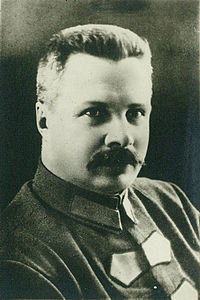 Mikhail Frunze in the early 1920s. | |||||||
| |||||||
| Predecessor | Lev Davidovich Trotsky | ||||||
| Successor | Kliment Efremovich Voroshilov | ||||||
| |||||||
| Head of the government | Alexey Ivanovich Rykov | ||||||
| Predecessor | Lev Davidovich Trotsky | ||||||
| Successor | Kliment Efremovich Voroshilov | ||||||
| |||||||
| Birth | January 21 ( February 2 ) 1885 Pishpek Semirechensk Region , Turkestan Governor General , Russian empire | ||||||
| Death | October 31, 1925 (40 years old) Moscow , RSFSR , USSR | ||||||
| Burial place | |||||||
| The consignment | RCP (b) since 1904 | ||||||
| Education | |||||||
| Autograph |  | ||||||
| Awards |
| ||||||
| Military service | |||||||
| Affiliation |  the USSR the USSR | ||||||
| Rank | front commander | ||||||
| Battles | The first Russian revolution : | ||||||


Activities before the revolution
Of the bourgeois , the son of the medical assistant , Moldovan Vasily Mikhailovich Frunze [2] ( 1854 - 1897 ), who served in Pishpek (now Bishkek ). Married to Sophia Alekseevna Popova, daughter of a people's volunteer . I got acquainted with revolutionary ideas in the circle of self-education in the gymnasium in the city of Verny (now Alma-Ata ). In 1904 he entered the St. Petersburg Polytechnic Institute , joined the Russian Social Democratic Labor Party . In November, he was first arrested for his revolutionary ideas.
On Bloody Sunday January 9, 1905 he participated in a demonstration on Palace Square in St. Petersburg, was wounded in the arm. Later, Mikhail Vasilievich admitted that it was this event that led him to the "generals of the revolution."
During the revolution of 1905-1907 he led party work in Moscow, from May - in Ivanovo-Voznesensk and Shuya (under the pseudonym "Comrade Arseny"), member of the RSDLP committee. One of the leaders of the Ivanovo-Ascension general strike of textile workers (May - July 1905). At the head of the fighting squad of the Ivano-Ascension and Shuysky workers, he participated in the December armed uprising of 1905 in Moscow. In 1906, he was a delegate to the IV Congress of the RSDLP in Stockholm from the Ivanovo-Voznesensky District Organization, where he met with V.I. Lenin .
In 1907 he was elected a delegate to the V Congress of the RSDLP , but was arrested and sentenced to 4 years in hard labor. On February 21, 1907 (already being a prisoner), together with Pavel Gusev, he tried to kill a police officer Nikita Perlov near the village of Dmitrovka. March 24, was arrested in Shuya and involved in the case of armed resistance to the police. For attempted murder twice (27.1. 1909 and 22-23.9. 1910 ) he was sentenced to death, replaced under pressure of public opinion for 6 years of hard labor . After imprisonment in the Vladimir , Nikolaev and Aleksandrovskaya convict prisons in March 1914 he was sent to perpetual settlement in the village of Manzurka, Irkutsk province . In August 1915 , after being arrested for creating an exiled organization, he fled to Chita , where he lived with V.G. Vasilenko’s passport, worked in the statistics department of the resettlement department, and in the editorial office of the weekly newspaper Zabaykalskoye Obozreniye. In 1916 he moved to Moscow, and then in early April with a passport in the name of Mikhail Alexandrovich Mikhailov and a direction from the All-Russian Zemstvo Union to Belarus .
In April 1916, Frunze, on the instructions of the party under the name Mikhailov, entered the position of statistician in the committee of the Western Front of the All-Russian Zemstvo Union (rear, mainly supply organization).
On March 4, 1917, by order of the civil commandant of the city of Minsk, Mikhail Alexandrovich Mikhailov was appointed interim police chief of the All-Russian Zemstvo Union for Law Enforcement in the city of Minsk. This date is considered the birthday of the Belarusian police [3] .
On the night of March 4-5, 1917, detachments of workers fighting teams led by M.V. Frunze (Mikhailov), together with the soldiers of the attached units of the Minsk garrison, disarmed the city police, seized the city police department, as well as the archival and detective offices and secured the most important state institutions. In addition to police affairs (Head of the Minsk City Police), by the summer of 1917 Frunze held the following posts: chairman of the executive committee of the Council of Peasant Deputies of the Minsk and Vilensky provinces, editor of the Peasant Newspaper , one of the editors of the Bolshevik Zvyazda , organizer and member of the Minsk City Committee of the RSDLP , Member of the Soldiers' Committee of the Western Front , member of the Executive Committee of the Minsk Council of Workers' and Soldiers' Deputies (chairman - Lyubimov, I. E. from July 8 (21) to August 1917) [4] . Mikhailov served in Minsk until September 1917, and then the party transferred him to the city of Shuya [5] .
He created underground party cells in the 3rd and 10th armies of the Western Front .
Since the end of August, the chairman of the Shuysky Council of workers, peasants and soldiers' deputies, the chairman of the county zemstvo council and city council; Shui representative at the All-Russian Democratic Conference in Petrograd .
Post Revolution Activities
During the days of the uprising in Moscow in October 1917, he participated in battles near the Metropol Hotel . Member of the Constituent Assembly from the Bolsheviks of Vladimir province . In the first half of 1918 - Chairman of the Ivanovo-Voznesensky Provincial Committee of the RCP (b) , Provincial Executive Committee, Provincial Council of Agriculture and the Military Commissar of Ivanovo-Voznesensky province . Since August 1918 - Military Commissioner of the Yaroslavl Military District . In February - May 1919, the commander of the 4th Army of the Red Army, which defeated the whites during the spring offensive , in May – June –– the Turkestan army, in March – July –– also by the Southern Group of Forces of the Eastern Front , from July 19 to August 15 –– the entire Eastern Front . For the implementation of successful offensive operations against the main forces of Admiral A.V. Kolchak, he was awarded the Order of the Red Banner . From August 15, 1919 to September 10, 1920 - commander of the Turkestan Front . Member of the Turkestan Commission of the All-Russian Central Executive Committee and the Council of People's Commissars (October 1919 - July 1920); a supporter of the "organization" of the revolution in the Bukhara emirate through the invasion of the Red Army, led the assault on Bukhara on August 30 - September 2, 1920 (see. Bukhara operation ) .
Since September 27, he commanded the Southern Front , the organizer of the expulsion of the troops of General P.N. Wrangel from Northern Tavria and Crimea . The fight against the Wrangelites was conducted together with the Rebel Army N.I. Makhno , with whom in October 1920 he signed an agreement on unity of action against the white forces and established good personal relations. After the occupation, Perekopa sent a telegram to the Wrangel troops , inviting them to freely leave Crimea in exchange for an end to the resistance. On December 3, 1920, he was appointed the authorized representative of the Revolutionary Military Council in Ukraine and the commander of the armed forces of Ukraine and Crimea , at the same time he was elected a member of the Politburo of the Central Committee of the Communist Party of Ukraine (B) U, and from February 1922 he was deputy chairman of the Council of People's Commissars of the Ukrainian SSR.
By order from Moscow, Makhno led the rout of the Rebel Army (for which he was awarded the second Order of the Red Banner in 1924 ) and the detachment of Yu. O. Tyutyunnik .
In November 1921, he headed the Extraordinary Embassy in Ankara to establish relations with Turkey , and negotiated with Ataturk [6] .
Since March 1924 - Deputy Chairman of the Revolutionary Military Council of the USSR and the People's Commissar for Military and Naval Affairs [7] , from April 1924 - at the same time the chief of staff of the Red Army and the head of the Military Academy of the Red Army [8] . Since January 1925, the chairman of the Revolutionary Military Council of the USSR and the People's Commissar for Military and Naval Affairs.
Under the leadership of Frunze, a military reform of 1924-1925 was carried out. - reducing the size of the army, introducing the principle of unity of command, reorganizing the military apparatus and political management of the Red Army, combining the structure of the Armed Forces of the standing army and territorial-militia units. The author of a number of military-theoretical works.
The military doctrine developed by Frunze was based on the application of Marxism to military theory and assigned a special place in the army to political departments and communist cells.
Member of the All-Russian Central Executive Committee, Presidium of the Central Executive Committee of the USSR. Since 1921 - a member of the Central Committee of the RCP (b) , since 1924 - a candidate for membership in the Politburo of the Central Committee , a candidate for membership in the Organizing Bureau of the Central Committee of the RCP (b) .
During the Civil War, he repeatedly gave security guarantees for himself personally to those opponents of the Soviet regime who voluntarily lay down their arms and confess to the Cheka (Trans-Ural Cossacks, army officers in Crimea, Bukhara Basmachs, Makhnovists) [9] .
Death
He died after surgery of a stomach ulcer from general infection of the blood (official report) [10] .
Immediately after Frunze’s death, rumors spread around Moscow that he had been killed by order of Trotsky [11] , whom Frunze had replaced as the People’s Commissar and whose adversary Frunze had been during his lifetime [12] .
There is a version that his death was organized by Stalin , who especially insisted on the operation [13] . This version is reflected by Pilnyak in his " Tales of the Unprocessed Moon " [14] , as well as in films staged from these works. The version about the organization of the murder is described in Bazhanov 's book, “Memoirs of the Former Secretary of Stalin.”
Frunze himself wrote to his wife Sofya Alekseevna in Yalta : “I am still in the hospital. On Saturday there will be a new consultation. I’m afraid that they wouldn’t refuse the operation ” [15] . Mikhail Vasilievich writes to his wife that he is satisfied with this decision and hopes that the doctors “will once and for all take a good look at what is there and try to outline the real treatment” [13] .
The medical history of the Soviet military commissar Mikhail Frunze, described by VD Topolyansky in the book “Leaders in the Law” with a detailed and scrupulous analysis of the situation, is noteworthy. MV Frunze was operated on for gastric ulcer. The problem arose already in the process of anesthesia, when a patient who fell asleep badly after ether anesthesia was supplemented with chloroform , which significantly exacerbated the cardiotoxic effect of both anesthetics. At the very beginning of the 20th century, pharmacologists and surgeons knew that the combined use of ether and chloroform dramatically enhances not only their narcotic, but also toxic effects, therefore, with a combination of these drugs, their doses were reduced. Nevertheless, the consumption of ether and chloroform per unit time at Frunze clearly exceeded the maximum limits, not to mention the fact of the combination of drugs itself. According to V. D. Topolyansky, death when using chloroform occurs twice as often as during ether anesthesia, and “people in the color of years and strength” often become “victims of chloroform anesthesia”. An adverse outcome is most often caused by the inability or inattention of the anesthesiologist and, first of all, by the careless handling of chloroform, which is poured onto the mask uncontrollably, as a harmless substance, so that the drug consumption at the beginning of anesthesia exceeds 1 g / min. And so it happened with the Soviet people's commissar [16] .
Funeral
He was buried on November 3, 1925 on Red Square in Moscow near the Kremlin wall .
Family
- Father - Vasily Mikhailovich Frunze (1854 - Feb. 1897) was a native of peasants of the Kherson province, a Moldavian by nationality. At the end of the Moscow paramedic school, he was drafted into the army and sent to Turkestan. After serving his military service in 1879, he settled in Pishpek, where he worked as a paramedic.
- Mother - Mavra Efimovna Bochkareva (1861-1933), a peasant woman from the Russian immigrants of the Voronezh province. In 1879 she married V. M. Frunze.
The family of Vasily Mikhailovich and Mavra Efimovna Frunze had five children: sons Konstantin and Mikhail and daughters Lyudmila, Klavdiya and Lydia.
The elder brother Konstantin Vasilievich (1881-1940) graduated from the Vernensky Gymnasium with a gold medal, which provided privileges for admission to higher educational institutions. He continued his education at the medical faculty of Kazan University, which he graduated in 1906. He participated in the Russian-Japanese war, worked as a zemstvo doctor in Pishpek. During the Civil War and after it in military medical work. Since 1928 in forensic medicine. Honored Doctor of the Tajik SSR, Hero of Labor of the Tajik SSR [17] . In 1940, due to the deterioration of retired health. In 1940 he moved to Moscow, died in Moscow on December 25, 1940. He had two sons: Mikhail, Boris, daughter Nina. The descendants of Konstantin Vasilyevich live in Moscow.
Sister Claudia Vasilievna Frunze-Gavrilova (1887-1948) graduated from Vernensky Gymnasium in 1906 with a gold medal. After marriage, she left for Italy, where her husband studied. Then she returned to Moscow, where she continued her studies. She had two daughters: Julia and Olga. Descendants live in Moscow.
The second sister Lyudmila Vasilievna Frunze-Bogolyubova (1890-1959). She graduated from a female gymnasium in Verny and the St. Petersburg Medical Institute, specializing in general practitioner. She worked as a district doctor in Kyrgyzstan. After the death of her husband, she lived in China with her sons and father-in-law, worked in the trade mission of Russia in China. From June 1930 to the end of her life, she worked in central medical institutions in Moscow. Member of the Great Patriotic War, colonel of the medical service. She has two sons - Igor Semenovich and Vladimir Semenovich. Descendants live in Moscow.
The third sister, Lidia Vasilyevna Nadezhdina-Frunze (1898-1978) was born after the death of her father. At the end of the Vernensky girls' gymnasium, she could not continue to study, she began to work. She lived with her mother in Pishpek. She married geologist Alexei Mikhailovich Nadezhdin. She had a daughter, Lydia Alekseevna. Descendants live in St. Petersburg.
Wife - Frunze (nee Popova, then Koltanovskaya) Sofya Alekseevna (12.12.1890 - 09.09.1926). She committed suicide.
Mikhail Vasilyevich and Sofya Alekseevna Frunze had two children who, after the death of their father in 1925 and their mother in 1926, grew up with their grandmother Mavra Efimovna Frunze (1861-1933). After a grandmother’s serious illness in 1931, their father’s friend K.E. Voroshilov adopted children by special resolution of the Politburo of the Central Committee of the All-Union Communist Party of Bolsheviks .
Son - Frunze, Timur Mikhailovich (1923-1942) - fighter pilot, Hero of the Soviet Union (posthumous).
Daughter - Frunze, Tatyana Mikhailovna (b. 02.08.1920) - professor, doctor of chemical sciences, in the 1960-1970s - a major specialist in organic chemistry. Graduated from Moscow Institute of Chemical Technology.
Memory
Bust in Moscow
Plaque on the street M.V. Frunze , St. Petersburg
Memorial plaque in Smolensk
Honorary cadet of the Moscow Higher Military Command School .
Name memory
The name of Mikhail Vasilyevich Frunze was and still is carried by various settlements and objects.
Natural geographic features
- Frunze peak - a mountain peak in the Zulumart ridge in the north of the Pamirs .
- Mount Frunze in the Kachug district of the Irkutsk region
Settlements and Territorial Units
- Frunze city is the capital of the Kyrgyz SSR (in 1926-1991, now Kyrgyzstan, Bishkek ).
- Frunze city in Moldova .
- Frunze region - in 1939-1959, now - Chui region .
- Frunze areas -
- Frunze district - the former name of the Medeu district of Almaty ( Kazakhstan );
- since 1992, Kadamzhay district ( Kyrgyzstan ) and Dangarinsky district (Uzbekistan) ;
- Frunze district of the Volgograd region in 1937-1963;
- Frunze district of the Voroshilovgrad region in 1949-1966 (now Slavyanoserbsky district , Ukraine ).
- Frunze, Frunzovka and Frunzevets are urban-type villages, towns, villages and villages.
Streets and other objects in settlements
- Frunze district in the cities: Vladivostok , Vladimir , Ivanovo , Minsk , St. Petersburg , Saransk , Saratov , Lipetsk , Yaroslavl ,
- Frunze district in Moscow - at different times this name was borne by different areas, now does not exist.
- Housing estates Frunze 1 and Frunze 2 in the city of Dnieper ( Ukraine ). Renamed in 2016.
- Frunze street in the city of Dnipro (Ukraine). Renamed in 2016.
- Frunze massif of the city of Ferghana ( Uzbekistan ).
- The streets of many cities of the former Soviet Union were named after Frunze (see Frunze Street ) . Some of them were renamed after 1991 .
- In Bishkek , the hometown of Mikhail Vasilyevich Frunze, the street where he was born and raised bears his name . It also houses the Frunze House Museum.
- In Moscow - streets 1st Frunzenskaya, 2nd Frunzenskaya, 3rd Frunzenskaya and Frunzenskaya embankment (all are located near the metro station Frunzenskaya ).
- Arseny Street in Ivanovo (in honor of his pseudonym used in 1905 )
- Frunze radius (now the name is abolished) of the Kirov-Frunze line (now Sokolnicheskaya line) metro in Moscow.
- In addition to the streets, avenues, squares, bridges, embankments and parks were named in honor of Frunze:
- Prospect Frunze (Yaroslavl)
- Frunze Square (Vladimir)
- Frunze Bridge (Omsk)
- Prospect Frunze (Tomsk)
- Frunze street (Petrozavodsk) Frunze street (Serdobsk)
- Frunze Street (Bakhchisaray)
- Frunze Street (Krasnodar)
- Frunze Street (Tolyatti)
- Frunze Street (Samara)
- Frunze Street ( Tula )
- Frunze Street (Gubkin)
- Frunze Street (Kursk)
- Frunze Street ( Yevpatoriya )
- Frunze Street ( Mikhailovka )
- Frunze Street ( Khabarovsk )
- Frunze Street (Ufa) in 2008 was renamed Zaki Validi Street
- Parks in cities: Evpatoria , Novorossiysk , Orenburg , Sochi
- Frunze Street (Taganrog)
- Frunze Street (Kazan)
- Frunze Street (Yekaterinburg)
- Frunze Street (Smolensk)
- Frunze Street (Novosibirsk)
- Frunze Street (Aprelevka)
- Frunze Street (Island)
- Frunze Square (Shuya)
- Several (small) streets of Frunze (Alma-Ata)
- Metro stations Frunzenskaya:
- Frunzenskaya - in Moscow
- « Фрунзенская » — в Санкт-Петербурге
- « Фрунзенская » — в Минске
Enterprises and Organizations
- ГОАО Шахта им. M.V. Frunze
- Харьковский завод по производству перфорированных металлических листов им. М. В. Фрунзе [1]
- Книжная фабрика имени М. В. Фрунзе (Харьков)
- Military Academy named after M.V. Frunze
- Сумское высшее артиллерийское командное дважды Краснознамённое училище им. М. В. Фрунзе
- Одесское высшее артиллерийское командное ордена Ленина училище им. М. В. Фрунзе (влилось в состав Одесского Института Сухопутных Войск и затем расформировано в 2007 году )
- Орловское ордена Ленина Краснознамённое танковое училище им. М. В. Фрунзе (расформировано в 1961 году в Ульяновске )
- Киевское высшее общевойсковое командное дважды Краснознамённое училище им. М. В. Фрунзе (переформировано в 1992 году ) [2]
- Омское высшее общевойсковое командное дважды Краснознамённое училище им. М. В. Фрунзе (в 1999 году преобразовано в Омский кадетский корпус ) [3]
- Высшее военно-морское ордена Ленина Краснознамённое ордена Ушакова училище им. М. В. Фрунзе (бывший Кадетский корпус)
- Ленинградское высшее военное командное училище железнодорожных войск и военных сообщений им. М. В. Фрунзе
- Симферопольский государственный университет имени М. В. Фрунзе
- Кишинёвский сельскохозяйственный институт им. M.V. Frunze
- Центральный аэродром имени М. В. Фрунзе — первый московский аэродром
- Центральный Дом авиации и космонавтики им. M.V. Frunze
- Нижегородский завод им. М. В. Фрунзе — завод по производству электронных приборов
- Пензенский велосипедный завод им. М. В. Фрунзе («ЗИФ»)
- Сумское машиностроительное научно-производственное объединение им. М. В. Фрунзе — один из ведущих в Европе машиностроительных комплексов по выпуску оборудования для нефтяной, газовой и химической промышленности
- Ивановский текстильный институт имени М. В. Фрунзе (1930—1994)
- Производственное объединение « Арсенал » имени М. В. Фрунзе (Санкт-Петербург);
- Центральный дом Красной Армии имени М. В. Фрунзе (Москва) (позднее был переименован в Центральный дом Советской Армии имени М. В. Фрунзе, а затем в Центральный дом Российской Армии)
- В Самаре находится Дом-музей М. В. Фрунзе, в котором он жил в 1919 году
- В Тирасполе находится совхоз-техникум им. M.V. Frunze
- Колхоз имени Фрунзе пос. Александровка ( Донецкая обл. Украина )
- Санаторий имени М. В. Фрунзе (Сочи)
- Центральный республиканский стадион им. Фрунзе в г. Душанбе, Таджикистан (до начала 1990-х годов).
- Четырёхпалубный пассажирский речной теплоход «Михаил Фрунзе» проекта 92-016, построенный в 1980 году в Чехословакии.
- «Фрунзе» (бывший «Быстрый») — эскадренный миноносец типа «Счастливый».
- «Михаил Фрунзе» (бывший «Полтава») — линейный корабль типа «Севастополь».
- «Фрунзе» (в настоящее время «Адмирал Лазарев») — тяжёлый атомный ракетный крейсер проекта 1144.
- «Фрунзе» — крейсер проекта 68-К.
- Шахта им. М. В. Фрунзе, ЧАО «Суха Балка», г. Кривой Рог
- Школа № 2 им. М. В. Фрунзе в г. Красноперекопск, Автономная республика Крым.
Monuments
| Памятник в Иванове | Памятник у Центрального дома Российской армии в Москве | Памятник в Москве | Памятник-бюст на площади перед мелитопольским вокзалом |
| Памятник в Пензе | Памятный знак в Тирасполе | Бюст у Общевойсковой академии | Памятник на площади Таксим в Стамбуле |
- Памятник в Ярославле .
- В Москве (несколько памятников, в том числе бюст на могиле на Красной площади и на станции метро «Фрунзенская» ).
- Во Владимире .
- В Иванове в сквере у здания цирка, в мемориале « Красная Талка », перед главным корпусом текстильной академии.
- В Шуе открыт Государственный мемориальный музей, а также в 1927 году установлен первый в стране памятник.
- В Санкт-Петербурге перед входом на завод «Арсенал» .
- В Киеве (на территории бывшего высшего общевойскового командного училища им. М. В. Фрунзе).
- В Евпатории .
- В Стамбуле (является фрагментом памятника посвящённому Мустафе Кемалю Ататюрку на площади Таксим ).
- В деревне Тайманихе Родниковского района Ивановской области .
- В Ташкенте .
- В Алматы в 1967 году был установлен памятник в сквере по ул. Кабанбай батыра , уг. st. Наурызбай батыра, в феврале 2007 года [16] перенесён в сквер за кинотеатром « Сары-Арка ».
- В Алматы ( Казахстан ) в сквере ниже КБТУ на Аллеи выдающихся деятелей установлен бюст на постаменте.
- В Бишкеке у ж/д вокзала.
- В Минске у Администрации Фрунзенского района.
- В Омске на территории Омского кадетского корпуса , в советское время Омское высшее общевойсковое командное дважды Краснознаменное училище имени М. В. Фрунзе .
- В Омской области в Муромцевском районе в селе Гурово.
- В Саратове у администрации Фрунзенского района.
- В Быхове в военном городке Быхов-1 у Дома офицеров установлен бюст.
In philately
Почтовая марка СССР, 1935 год
Почтовая марка СССР, 1940 год
Почтовая марка СССР, 1960 год
Почтовая марка СССР, 1985 год
Киновоплощения
Образ Фрунзе как известного военачальника гражданской войны был очень популярен в советском, а позже в российском кинематографе.
Исполнители:
- Хомятов, Роман Захарьевич — в 11 кинофильмах:
- На вес золота ( 1983 )
- Две главы из семейной хроники ( 1983 )
- Великая судьба ( 1981 )
- Поезд чрезвычайного назначения ( 1980 )
- Девушка из легенды ( 1980 )
- Красная площадь ( 1970 )
- Гибель чёрного консула ( 1970 )
- Бег ( 1970 )
- Штрихи к портрету В. И. Ленина (1967—1970)
- Шестое июля ( 1968 )
- Товарищ Арсений ( 1964 )
- Самойлов, Евгений Валерианович — « Крушение эмирата » ( 1955 )
- Михайлов, Александр Александрович — « Гроза над Белой » ( 1968 )
- Егоров, Геннадий Семёнович — « Маршал революции » ( 1978 )
- Саитов, Виктор Петрович — « Большая-малая война » ( 1980 ), « Огненные дороги » ( 1984 )
- Гладий, Григорий Степанович — « Не имеющий чина » ( 1985 )
- Никоненко, Сергей Петрович — « Уполномочен революцией » ( 1987 )
- Стеклов, Владимир Александрович — « Повесть непогашенной Луны » ( 1990 )
- Мадянов, Роман Сергеевич — « Троцкий » ( 1993 )
- Скляр, Игорь Борисович — « Московская сага » ( 2004 )
- Мохов, Александр Анатольевич — « Есенин » ( 2005 )
- Шалыга, Валерий Леонтьевич — « Девять жизней Нестора Махно » ( 2007 )
- Крылов, Владимир Викторович — « Мустафа Шокай » ( 2008 ) [4]
- Шингарёв, Павел Анатольевич — « Страсти по Чапаю » ( 2012 )
Proceedings
- Фрунзе М. В. О молодёжи / Фрунзе М. В. — М.: Мол. гвардия, 1937. — 118 с.: портр.
- Фрунзе М. В. Избранные произведения. — М.: 1950.
- Фрунзе М. В. Избранные произведения. Т. 1: 1918—1925 гг. / Фрунзе М. В. — М.: Воениздат, 1957. — 472 с.: портр.
- Фрунзе М. В. Избранные произведения. Т. 2: 1921—1925 гг. / Фрунзе М. В. — М.: Воениздат, 1957. — 498 с.: ил.
- Фрунзе М. В. Избранные произведения / Предисл. М. Гареева. — М.: Воениздат, 1977. — 480 с.: ил.
- Фрунзе М. В. Неизвестное и забытое: Публицистика, мемуары, документы и письма / Фрунзе М. В. — М.: Наука, 1991. — 272 с.
- Фрунзе М. В. Единая военная доктрина и Красная армия // Красная новь : журнал / под ред. А. К. Воронского . — М. , 1921. — № 1 . — С. 94—106 .
- М. Мирский. Европейские цивилизаторы и Марокко . — Шталь А. В. Малые войны 1920–1930-х годов. М.: ACT; СПб.: Terra Fantastica, 2003. — 544 с.: ил. - (Military Historical Library). Тираж 5000 экз. ISBN 5-17-016557-9 , ISBN 5-7921-0605-3 . — Военный вестник, 1925.
Literature
- Сталин И. В. Речь на похоронах Фрунзе, 3 ноября 1925 г . Правда № 253 (5 ноября 1925). Дата обращения 10 января 2013. Архивировано 10 января 2013 года.
- Троцкий Л. Д. Памяти М. В. Фрунзе . Известия № 259 (13 ноября 1925). — Речь на траурном заседании, посвящённом памяти Михаила Васильевича Фрунзе, в г. Кисловодске 2 ноября 1925 г. Дата обращения 10 января 2013. Архивировано 10 января 2013 года.
- Ворошилов К. Е. О молодёжи / Ворошилов К. Е., Фрунзе М. В. — М.: Партиздат, 1936. — 158 с.: ил.
- Попов Ф. Г. Жизнь замечательных большевиков: В. В. Куйбышев, М. В. Фрунзе, В. П. Арцыбушев , Н. Е. Вилонов, А. А. Масленников, П. А. Вавилов, В. П. Мяги , Ф. И. Венцек , С. И. Дерябина, А. А. Буянов, О. Айведе, А. П. Галактионов / Попов Ф. Г., Машковцев Л. В. — Куйбышев: Куйбышев. изд-во, 1938. — 78 с.
- Борисов С. М. В. Фрунзе: Краткий биографич. очерк / Борисов С. — М.: Воениздат, 1938. — 138 с.: ил., портр. То же. 1940. — 118 с.: ил.
- М. В. Фрунзе на фронтах гражданской войны: сборник документов. — М.: Воениздат, 1941. — 471 с.: ил., портр.
- Березов П. И. Михаил Васильевич Фрунзе : Краткий биограф. очерк / Березов Павел Иванович. — М.: Моск. рабочий, 1947. — 110 с.: портр.
- Александров В. А. М. В. Фрунзе о физической подготовке воина / Александров В. А. // Теория и практика физ. культуры. — 1950. — Т. XIII. — Вып. 2. — С. 98-104.
- Михаил Васильевич Фрунзе. Полководческая деятельность. / сб. Art. — М., 1951
- Вигилянский Н. Д. Повесть о Фрунзе / [Илл.: Б. В. Преображенский]. - M .: Owls. писатель, 1957. — 191 с.: ил.
- М. В. Фрунзе: Жизнь и деятельность / Под общ. ed. Ф. Н. Петрова. — М.: Госполитиздат, 1962. — 350 с.: ил., портр.
- Дьеркеи Е. Рядом с Фрунзе / Авториз. per. с венгер. Ю. Шишмонина. — М.: Воениздат, 1963. — 108 с.: ил.
- Архангельский Вл. Фрунзе / Архангельский Вл. - M.: Mol. гвардия, 1970. — 509 с.: ил.
- О комсомоле и молодёжи: Сборник / В. И. Ленин. М. И. Калинин. С. М. Киров. Н. К. Крупская. В. В. Куйбышев. А. В. Луначарский. Г. К. Орджоникидзе. М. В. Фрунзе. К. Е. Ворошилов. - M.: Mol. гвардия, 1970. — 447 с.
- Алдан-Семенов А. И. Гроза над Россией: Повесть о Михаиле Фрунзе / Андрей Алдан-Семенов; [Худож. А. А. Борисов]. — М.: Политиздат, 1980. (Пламенные революционеры). — 414 с.: Цв. silt То же. 1984.
- О Михаиле Фрунзе: Воспоминания, статьи современников. — М.: Политиздат, 1985. — 287 с.
- Ильичев Я. И. Турецкий караван: Роман: [О М. В. Фрунзе] / Яков Ильичев; [Худож. Ю. М. Шабанов]. — Л.: Лениздат, 1987. — 510 с.: ил.
- Тополянский В. Д. Гибель Фрунзе // Вопросы истории. — 1993. № 6.
- Политические партии России. Конец XIX — начало XX века. — М., 1996.
- Тополянский В.Д . «Вожди в законе»: очерки физиологии власти. М.: Права человека, 1996: 352.
See also
- Органы внутренних дел Белоруссии
- Министерство внутренних дел Республики Беларусь
Notes
- ↑ Следует отметить, что М. В. Фрунзе выдающийся военачальник-самоучка, так как, не имея никакого специального военного образования, дослужился до командующего фронтом.
- ↑ Последнюю букву своей молдавской фамилии М. В. Фрунзе отбросил в 1919 году. См. Млечин Л. М. «Фрунзе». М.: Молодая гвардия, 2014 (Жизнь замечательных людей)
- ↑ История ГУВД — ГУВД Минского Горисполкома (недоступная ссылка) . Дата обращения 4 марта 2009. Архивировано 5 июля 2008 года.
- ↑ Крапивин Сергей. День милиции и тень полиции . TUT.BY (4 марта 2009). Дата обращения 31 января 2013. Архивировано 1 февраля 2013 года.
- ↑ Крапивин Сергей. Смена караулов . Советская Белоруссия № 43 (22200) (5 марта 2005). Дата обращения 31 января 2013.
- ↑ Густерин П. В. Советская разведка на Ближнем и Среднем Востоке в 1920—30-х годах. — Саарбрюккен: LAP LAMBERT Academic Publishing, 2014. — С. 92—93. — ISBN 978-3-659-51691-7 .
- ↑ Троцкий писал: « Склянский ( с поста заместителя председателя Реввоенсовета СССР. — Прим. ) был смещён. На его место был назначен Фрунзе, командовавший до того войсками на Украине. Фрунзе был серьёзной фигурой. Его партийный авторитет, благодаря каторжным работам в прошлом, был выше, чем молодой ещё авторитет Склянского. Фрунзе обнаружил, кроме того, во время войны несомненные способности полководца. Как военный администратор он был несравненно слабее Склянского» (Троцкий Л. Д. «Моя жизнь» ).
- ↑ Густерин П. В. Восточный факультет Военной академии РККА им. М. В. Фрунзе. — Саарбрюккен: LAP LAMBERT Academic Publishing, 2014. — С. 35. — ISBN 978-3-659-37302-2 .
- ↑ Телекомпания НТВ . Передача «Советские биографии — М. В. Фрунзе». Эфир от 28 ноября 2009, 14:05 мск.
- ↑ Книга о Ленине. Смерть (недоступная ссылка) . Дата обращения 9 января 2011. Архивировано 21 января 2012 года.
- ↑ Кто убил Михаила Фрунзе . Известия. Дата обращения 23 апреля 2016.
- ↑ М. В. Фрунзе. Военная и политическая деятельность. . М.: Воениздат, 1984. глава 6. Дата обращения 23 апреля 2016.
- ↑ 1 2 Николай Над (Добрюха) . Кто убил Михаила Фрунзе , Известия (26 октября 2010). Date of treatment February 15, 2012.
- ↑ Борис Бажанов. Сталин с близского расстояния . aleksandr-kommari.narod.ru. Дата обращения 23 апреля 2016.
- ↑ ЦГЛСА. Ф. 32392. Оп.1. Д.142. Л. 3-5. Автограф
- ↑ Тополянский В. Д. «Вожди в законе»: очерки физиологии власти. М.: Права человека, 1996
- ↑ ФРУНЗЕ Константин Васильевич | ЦентрАзия
Links
- Mikhail Frunze. Year 1907 . Site of the Moscow District Military Court.
- Frunze, Mikhail Vasilievich . On the Chronos website .
- Frunze Museum in 1 school of the city of Pugachev
- Ganin A.V. Frunze Mikhail Vasilievich . Project RVIO and VGTRK "100 great commanders . " Archived June 22, 2013.