Clever Geek Handbook
📜 ⬆️ ⬇️

Gaussian integral

The Gaussian integral (also the Euler – Poisson integral or the Poisson integral [1] ) is the integral of the Gaussian function :
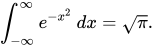
∫-∞∞e-x2dx=π.{\ displaystyle \ int _ {- \ infty} ^ {\ infty} e ^ {- x ^ {2}} \, dx = {\ sqrt {\ pi}}.} \ int _ {- \ infty} ^ {\ infty} e ^ {- x ^ {2}} \, dx = {\ sqrt {\ pi}}.

Evidence

Evidence
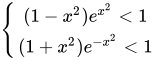
Consider the function(one+t)e-t {\ displaystyle (1 + t) e ^ {- t}} (1+t)e^{-t} . It is bounded above by a unit in the interval(-∞;+∞) {\ displaystyle (- \ infty; + \ infty)} (-\infty ;+\infty ) , and from below by zero on the interval[-one;+∞) {\ displaystyle [-1; + \ infty)} {\displaystyle [-1;+\infty )} . In particular, settingt=±x2 {\ displaystyle t = \ pm x ^ {2}} t=\pm x^{2} we get whenx≠0 {\ displaystyle x \ not = 0} x\not =0 :
{(one-x2)ex2<one(one+x2)e-x2<one{\ displaystyle \ left \ {{\ begin {matrix} (1-x ^ {2}) e ​​^ {x ^ {2}} <1 \\ (1 + x ^ {2}) e ​​^ {- x ^ {2}} <1 \ end {matrix}} \ right.} \left\{{\begin{matrix}(1-x^{2})e^{x^{2}}<1\\(1+x^{2})e^{-x^{2}}<1\end{matrix}}\right.

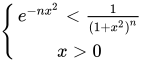
We restrict the change in the first inequalityx {\ displaystyle x} x gap(0,one) {\ displaystyle (0,1)} (0,1) , and in the second - the interval(0;∞) {\ displaystyle (0; \ infty)} (0;\infty ) , raise both inequalities to the powern(n∈N) {\ displaystyle n (n \ in N)} n(n\in N) , since inequalities with positive terms can be raised to any positive degree. We get:
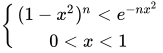
{(one-x2)n<e-nx20<x<one{\ displaystyle \ left \ {{\ begin {matrix} (1-x ^ {2}) ^ {n} <e ^ {- nx ^ {2}} \\ 0 <x <1 \ end {matrix}} \ right.} \left\{{\begin{matrix}(1-x^{2})^{n}<e^{-nx^{2}}\\0<x<1\end{matrix}}\right. and{e-nx2<one(one+x2)nx>0 {\ displaystyle \ left \ {{\ begin {matrix} e ^ {- nx ^ {2}} <{\ frac {1} {(1 + x ^ {2}) ^ {n}}} \\ x> 0 \ end {matrix}} \ right.} \left\{{\begin{matrix}e^{-nx^{2}}<{\frac {1}{(1+x^{2})^{n}}}\\x>0\end{matrix}}\right.

Integrating inequalities within the indicated limits and reducing them into one, we obtain

∫0one(one-x2)ndx<∫0onee-nx2dx<∫0∞e-nx2dx<∫0∞one(one+x2)ndx{\ displaystyle \ int \ limits _ {0} ^ {1} (1-x ^ {2}) ^ {n} \, dx <\ int \ limits _ {0} ^ {1} e ^ {- nx ^ {2}} \, dx <\ int \ limits _ {0} ^ {\ infty} e ^ {- nx ^ {2}} \, dx <\ int \ limits _ {0} ^ {\ infty} {\ frac {1} {(1 + x ^ {2}) ^ {n}}} \, dx} {\displaystyle \int \limits _{0}^{1}(1-x^{2})^{n}\,dx<\int \limits _{0}^{1}e^{-nx^{2}}\,dx<\int \limits _{0}^{\infty }e^{-nx^{2}}\,dx<\int \limits _{0}^{\infty }{\frac {1}{(1+x^{2})^{n}}}\,dx}

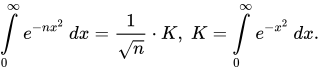
When replacingu=xn {\ displaystyle u = x {\ sqrt {n}}} u=x{\sqrt {n}} we get

∫0∞e-nx2dx=onen⋅K,K=∫0∞e-x2dx.{\ displaystyle \ int \ limits _ {0} ^ {\ infty} e ^ {- nx ^ {2}} \, dx = {\ frac {1} {\ sqrt {n}}} \ cdot K, \; K = \ int \ limits _ {0} ^ {\ infty} e ^ {- x ^ {2}} \, dx.} {\displaystyle \int \limits _{0}^{\infty }e^{-nx^{2}}\,dx={\frac {1}{\sqrt {n}}}\cdot K,\;K=\int \limits _{0}^{\infty }e^{-x^{2}}\,dx.}

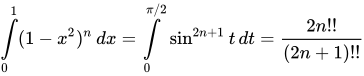
Assumingx=cos⁡t {\ displaystyle x = \ cos t} x=\cos t we obtain, respectively,

∫0one(one-x2)ndx=∫0π/2sin2n+one⁡tdt=2n!!(2n+one)!!{\ displaystyle \ int \ limits _ {0} ^ {1} (1-x ^ {2}) ^ {n} \, dx = \ int \ limits _ {0} ^ {\ pi / 2} \ sin ^ {2n + 1} t \, dt = {\ frac {2n !!} {(2n + 1) !!}}} {\displaystyle \int \limits _{0}^{1}(1-x^{2})^{n}\,dx=\int \limits _{0}^{\pi /2}\sin ^{2n+1}t\,dt={\frac {2n!!}{(2n+1)!!}}}

Replacing the integration limits is due to the fact that when the variable changest {\ displaystyle t}   from 0 toπ/2 {\ displaystyle \ pi / 2}   valuecos⁡t {\ displaystyle \ cos t}   varies from 0 to 1.

And replacingx=ctgt {\ displaystyle x = \ mathrm {ctg} \, t}   we get

∫0∞one(one+x2)ndx=∫0π/2sin2n-2⁡tdt=π(2n-3)!!2(2n-2)!!{\ displaystyle \ int \ limits _ {0} ^ {\ infty} {\ frac {1} {(1 + x ^ {2}) ^ {n}}} \, dx = \ int \ limits _ {0} ^ {\ pi / 2} \ sin ^ {2n-2} t \, dt = {\ frac {\ pi (2n-3) !!} {2 (2n-2) !!}}}  

Here with integration limits is similar:ctgt {\ displaystyle \ mathrm {ctg} \, t}   changes from infinity to zero as the variable changest {\ displaystyle t}   from 0 toπ/2 {\ displaystyle \ pi / 2}   .

The last two integrals can be found as follows: twice integrating them in parts, we obtain recurrence relations, resolving which we arrive at the results on the right-hand side.

Thus, the desired K can be included in the interval

n⋅2n!!(2n+one)!!<K<n⋅π(2n-3)!!2(2n-2)!!{\ displaystyle {\ sqrt {n}} \ cdot {\ frac {2n !!} {(2n + 1) !!}} <K <{\ sqrt {n}} \ cdot {\ frac {\ pi (2n -3) !!} {2 (2n-2) !!}}}  

To find K, we square the entire inequality and transform it. As a result, everything is greatly simplified to

n2n+one⋅(2n!!)2(2n+one)((2n-one)!!)2<K2<n2n-one⋅(2n-one)((2n-3)!!)2((2n-2)!!)2⋅π2four{\ displaystyle {\ frac {n} {2n + 1}} \ cdot {\ frac {(2n !!) ^ {2}} {(2n + 1) ((2n-1) !!) ^ {2} }} <K ^ {2} <{\ frac {n} {2n-1}} \ cdot {\ frac {(2n-1) ((2n-3) !!) ^ {2}} {((2n -2) !!) ^ {2}}} \ cdot {\ frac {\ pi ^ {2}} {4}}}  

It follows from the Wallis formula that both left and right expressions tend toπ/four {\ displaystyle \ pi / 4}   atn→∞ {\ displaystyle n \ rightarrow \ infty}  

Consequently,K2=πfour⟺K=π2 {\ displaystyle K ^ {2} = {\ frac {\ pi} {4}} \ Longleftrightarrow K = {\ frac {\ sqrt {\ pi}} {2}}}  

Due to the parity of the functione-x2 {\ displaystyle e ^ {- x ^ {2}}}   we get that

∫-∞∞e-x2dx=2∫0∞e-x2dx=π.{\ displaystyle \ int \ limits _ {- \ infty} ^ {\ infty} e ^ {- x ^ {2}} \, dx = 2 \ int \ limits _ {0} ^ {\ infty} e ^ {- x ^ {2}} \, dx = {\ sqrt {\ pi}}.}  
Proof 2
Gaussian integral can be represented asI=∫-∞∞e-x2dx=∫-∞∞e-y2dy {\ displaystyle I = \ int \ limits _ {- \ infty} ^ {\ infty} e ^ {- x ^ {2}} \, {\ rm {d}} x = \ int \ limits _ {- \ infty } ^ {\ infty} e ^ {- y ^ {2}} \, {\ rm {d}} y}   . Consider the square of this integralI2 {\ displaystyle I ^ {2}}   . Introducing two-dimensional Cartesian coordinates , passing from them to polar coordinates(x=rcos⁡ϕ {\ displaystyle (x = r \ cos \ phi}   ,y=rsin⁡ϕ {\ displaystyle y = r \ sin \ phi}   ,r2=x2+y2) {\ displaystyle r ^ {2} = x ^ {2} + y ^ {2})}   and integrating overϕ {\ displaystyle \ phi}   (from 0 to2π {\ displaystyle 2 \ pi}   ), we get:
I2=∫-∞∞∫-∞∞e-x2-y2dxdy=∫02πdφ∫0∞e-r2rdr=2π∫0∞e-r2rdr=π∫0∞e-r2dr2=π.{\ displaystyle I ^ {2} = \ int \ limits _ {- \ infty} ^ {\ infty} \ int \ limits _ {- \ infty} ^ {\ infty} \, e ^ {- x ^ {2} -y ^ {2}} {\ rm {d}} x \, {\ rm {d}} y = \ int \ limits _ {0} ^ {2 \ pi} d \ varphi \ int \ limits _ {0 } ^ {\ infty} e ^ {- r ^ {2}} r \; {\ rm {d}} r = 2 \ pi \ int \ limits _ {0} ^ {\ infty} e ^ {- r ^ {2}} r \; {\ rm {d}} r = \ pi \ int \ limits _ {0} ^ {\ infty} e ^ {- r ^ {2}} \; {\ rm {d}} r ^ {2} = \ pi.}  

Consequently,I=∫-∞∞e-x2dx=π {\ displaystyle I = \ int \ limits _ {- \ infty} ^ {\ infty} e ^ {- x ^ {2}} \, {\ rm {d}} x = {\ sqrt {\ pi}}}   .

Proof 3
Gaussian integral can be represented asI=∫-∞∞e-x2dx=∫-∞∞e-y2dy=∫-∞∞e-z2dz {\ displaystyle I = \ int \ limits _ {- \ infty} ^ {\ infty} {{e ^ {- {x ^ {2}}}} dx} = \ int \ limits _ {- \ infty} ^ { \ infty} {{e ^ {- {y ^ {2}}}} dy} = \ int \ limits _ {- \ infty} ^ {\ infty} {{e ^ {- {z ^ {2}}} } dz}}   . Consider the cube of this integralI3 {\ displaystyle I ^ {3}}   . Introducing three-dimensional Cartesian coordinates , passing from them to spherical coordinates :

{x=rsin⁡θcos⁡φy=rsin⁡θsin⁡φz=rcos⁡θr2=x2+y2+z2{\ displaystyle \ left \ {{\ begin {array} {l} x = r \ sin \ theta \ cos \ varphi \\ y = r \ sin \ theta \ sin \ varphi \\ z = r \ cos \ theta \ \ {r ^ {2}} = {x ^ {2}} + {y ^ {2}} + {z ^ {2}} \ end {array}} \ right.}   , the Jacobian transform is equal toJ=r2sin⁡θ {\ displaystyle J = {r ^ {2}} \ sin \ theta}   ,

and integrating overθ {\ displaystyle \ theta}   (from0 {\ displaystyle 0}   beforeπ {\ displaystyle \ pi}   ), byφ {\ displaystyle \ varphi}   (from0 {\ displaystyle 0}   before2π {\ displaystyle 2 \ pi}   ), byr {\ displaystyle r}   (from0 {\ displaystyle 0}   before∞ {\ displaystyle \ infty}   ), we get:

I3=∫-∞∞∫-∞∞∫-∞∞e-x2-y2-z2dxdydz=∫02π∫0π∫0∞e-r2Jdrdθdφ=∫02πdφ∫0πsin⁡θdθ∫0∞e-r2r2dr==2π((-cos⁡π)-(-cos⁡0))(-one2∫0∞rde-r2)=-2π((re-r2)|0∞-∫0∞e-r2dr)=-2π(0-I2)=πI{\ displaystyle {\ begin {array} {l} {I ^ {3}} = \ int \ limits _ {- \ infty} ^ {\ infty} {\ int \ limits _ {- \ infty} ^ {\ infty } {\ int \ limits _ {- \ infty} ^ {\ infty} {{e ^ {- {x ^ {2}} - {y ^ {2}} - {z ^ {2}}}} dx} dy} dz} = \ int \ limits _ {0} ^ {2 \ pi} {\ int \ limits _ {0} ^ {\ pi} {\ int \ limits _ {0} ^ {\ infty} {{e ^ {- {r ^ {2}}}} Jdr} d \ theta} d \ varphi} = \ int \ limits _ {0} ^ {2 \ pi} {d \ varphi \ int \ limits _ {0} ^ {\ pi} {\ sin \ theta d \ theta \ int \ limits _ {0} ^ {\ infty} {{e ^ {- {r ^ {2}}}} {r ^ {2}} dr}} } = \\ = 2 \ pi \ left ({(- \ cos \ pi) - (- \ cos 0)} \ right) \ left ({- {\ frac {1} {2}} \ int \ limits _ {0} ^ {\ infty} {rd {e ^ {- {r ^ {2}}}}}} right) = - 2 \ pi \ left ({\ left. {\ Left ({r {e ^ {- {r ^ {2}}}} \ right)} \ right | _ {0} ^ {\ infty} - \ int \ limits _ {0} ^ {\ infty} {{e ^ {- {r ^ {2}}}} dr}} \ right) = - 2 \ pi (0 - {\ frac {I} {2}}) = \ pi I \ end {array}}}  

Consequently,I=∫-∞∞e-x2dx=π {\ displaystyle I = \ int \ limits _ {- \ infty} ^ {\ infty} {{e ^ {- {x ^ {2}}}} dx} = {\ sqrt {\ pi}}}   .

Variations

Gaussian integrals of a scaled Gaussian function

∫-∞∞αe-x2/β2dx=αβπ{\ displaystyle \ int \ limits _ {- \ infty} ^ {\ infty} \ alpha e ^ {- x ^ {2} / \ beta ^ {2}} \, dx = \ alpha \ beta {\ sqrt {\ pi}}}  

and multidimensional Gaussian integrals

∫αe-(x2/βone2+y2/β22+z2/β32+...)dxdydz⋯=αβoneβ2β3...πn{\ displaystyle \ int \ alpha e ^ {- (x ^ {2} / \ beta _ {1} ^ {2} + y ^ {2} / \ beta _ {2} ^ {2} + z ^ {2 } / \ beta _ {3} ^ {2} + \ dots)} \, dxdydz \ dots = \ alpha \ beta _ {1} \ beta _ {2} \ beta _ {3} \ dots {\ sqrt {\ pi ^ {n}}}}  

elementarily reduced to the usual one-dimensional, described first (here and below, integration throughout the whole space is implied).

The same applies to multidimensional integrals of the form

∫exMxdxonedx2dx3...dxn=πn|det(M)|{\ displaystyle \ int e ^ {xMx} \, dx_ {1} dx_ {2} dx_ {3} \ dots dx_ {n} = {\ sqrt {\ frac {\ pi ^ {n}} {| \ det ( M) |}}}}  

where x is a vector, and M is a symmetric matrix with negative eigenvalues, since such integrals are reduced to the previous one if we make a coordinate transformation diagonalizing the matrix M.

Practical application (for example, to calculate the Fourier transform of a Gaussian function) often finds the following relation

∫-∞∞e-ax2+bx+cdx=πaeb2foura+c,{\ displaystyle \ int \ limits _ {- \ infty} ^ {\ infty} e ^ {- ax ^ {2} + bx + c} \, dx = {\ sqrt {\ frac {\ pi} {a}} } \, e ^ {{\ frac {b ^ {2}} {4a}} + c},}  

History

For the first time, the one-dimensional Gaussian integral was calculated in 1729 by Euler , then Poisson found a simple way to calculate it [2] . In this regard, he received the name of the Euler – Poisson integral.

See also

  • Error function

Notes

  1. ↑ Poisson Integral - an article from the Great Soviet Encyclopedia .
  2. ↑ See ibid.


Source - https://ru.wikipedia.org/w/index.php?title=Gauss Integral&oldid = 99100802


More articles:

  • NGC 2413
  • Chisholm, Shirley
  • Killer Elite
  • NGC 2431
  • NGC 2434
  • Liteuonis
  • Ogorodny (Rostov Region)
  • Elite (Rostov Region)
  • Zabudenovsky
  • Kisses (Belokalitvinsky District)

All articles

Clever Geek | 2019