NGC 2070 (also known as ESO 57-EN6 ) is an emission nebula in the constellation Golden Fish . Also known as Tarantula .
| NGC 2070 | |
|---|---|
| emission nebula | |
 | |
| Research history | |
| Discoverer | Nicola Louis de Lacaille |
| opening date | 1751 |
| Designations | NGC 2070 , ESO 57-EN6 , Tarantula Nebula , 30 Golden Fish , 30 Doradus |
| Observational data ( Age J2000.0 ) | |
| Right ascension | |
| Declination | |
| Distance | |
| Visible magnitude (V) | |
| Photographic magnitude (V) | 5,0 |
| Visible Dimensions (V) | 30.0 '× 20.0' |
| Constellation | Golden fish |
Content
Features
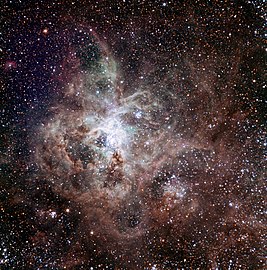
The nebula belongs to the satellite galaxy of the Milky Way - the Large Magellanic Cloud . It is a vast area of ionized hydrogen , where processes of active star formation occur.
This object is one of those listed in the original edition of the New General Catalog .
The huge stars of the nebula are powerful sources of radiation that blows giant bubbles from interstellar gas and dust. Some of the stars exploded in supernovae , causing the bubbles to be illuminated by X-rays .
In the center of the nebula is a small cluster of stars R136 , at the junction of three bubbles. These stars are the result of star formation processes, their age is estimated at approximately two million years. In addition, the nebula contains a supermassive star RMC 136a1 with a mass of 315 [1] [2] solar (this is the most massive star discovered as of July 21 , 2011 )
Along the edge of the nebula are relatively young globular star clusters, as well as groups of young stars that are part of the superassociation.
Illustrations
Image of R136 taken with the Hubble telescope.
The Running Star
Part of the cluster, photographed in high resolution.
See also
- List of Messier objects
- New shared directory
Links
- Information in English and French from the original “ New General Catalog ”
- Information (Eng.) From the Revised New General Catalog
- SIMBAD
- VizieR (English)
- NASA / IPAC Extragalactic Database
- NGC 2070 Publication List
- 30 Doradus at Chandra Observatory website
- star RMC 136a1 (Russian)
- Astronomy Picture of the Day. The Cosmic Web of the Tarantula Nebula
Notes
- ↑ Paul A. Crowther et al (2010) “The R136 star cluster hosts several stars whose individual masses greatly exceed the accepted 150 Msun stellar mass limit”, accepted for publication in Monthly Notices of the Royal Astronomical Society. Available at arXiv: 1007.3284v1 [1] . Advertised in ESO Press Release 1030 [2]
- ↑ Paul A .; Crowther; Caballero-Nieves, SM; Bostroem, KA; Maíz Apellániz, J .; Schneider, FRN; Walborn, NR; Angus, CR; Brott, I .; Bonanos, A .; De Koter, A .; De Mink, SE; Evans, CJ; Gräfener, G .; Herrero, A .; Howarth, ID; Langer, N .; Lennon, DJ; Puls, J .; Sana, H .; Vink, JS The R136 star cluster dissected with Hubble Space Telescope / STIS. I. Far-ultraviolet spectroscopic census and the origin of He II λ1640 in young star clusters (Eng.) // Monthly Notices of the Royal Astronomical Society : journal. - Oxford University Press , 2016 .-- Vol. 458 . - P. 624-659 . - DOI : 10.1093 / mnras / stw273 . - . - arXiv : 1603.04994 .