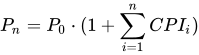
Indexing (from lat. Index - list, register, index) in the economy is a means of protecting against inflation by linking the contract amount, loan , salary , pension , benefits , contributions , etc., to the consumer price index .
Types of Indexing
The indexation of household income is the full or partial reimbursement of losses in income caused by rising prices for consumer goods and services.
In world practice, there are two main forms of indexation of income of the population:
- automatic , in which the indexation of wages and other income increases in proportion to the increase in prices;
- semi-automatic ( contractual ) used in the countries of the European Union . The essence of this indexation is to conduct negotiations with employers, trade unions and government representatives with the involvement of scientists and experts. The result of the negotiations are recommendations that establish a lower social protection threshold for collective bargaining .
Deposit indexation - automatic change of the interest rate paid to the depositor when the general price level changes.
Tax indexation is an automatic change in income tax in accordance with the official consumer price index or wage index.
Examples
Cost indexation
See also
- Consumer price index
- Price and income indices
Literature
- New Economic Dictionary / Edited by A.N. Azriliyana - Moscow: Institute of New Economics , 2006. ISBN 5-89378-014-0