NGC 1892 (other designations - ESO 85-61 , IRAS05169-6500 , PGC 17042 ) is a spiral galaxy in the constellation Golden Fish , the distance to which is estimated at approximately 50.5 million light-years . [1] This object is one of those listed in the original edition of the New General Catalog .
| NGC 1892 | |
|---|---|
| Galaxy | |
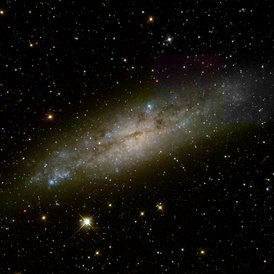 Photograph of the galaxy NGC 1892, obtained by the Hubble Space Telescope. | |
| Research history | |
| Discoverer | John Herschel |
| opening date | November 30, 1834 |
| Designations | NGC 1892 , ESO 85-61 , IRAS05169-6500 , PGC 17042 |
| Observational data ( Age J2000.0 ) | |
| Constellation | Golden fish |
| Right ascension | |
| Declination | |
| Visible dimensions | 2.9 '× 0.8' |
| Apparent magnitude m V | 12.1 |
| Photographic magnitude m B | 12.8 |
| Characteristics | |
| Type of | Sc |
| Radial velocity | |
| Redshift | +0.004540 ± 0.000013 |
| Distance | 50.5 million St. years (15,5 Mpc ) [1] |
| Angular position | 74 ° |
| Surface brightness | 12.9 |
Content
- 1 Features
- 2 notes
- 3 See also
- 4 References
Features
NGC 1892 is a Sc-type spiral galaxy with a faint bulge . [3] The structure of the galaxy is sedentary, relatively calm in terms of star formation with prominent densities from dust regions. [4] These seals are not uniformly distributed. To the Earth observer, the galaxy is turned by an edge. In the night sky, it can be observed in the southern part of the Golden Fish constellation, next to the Large Magellanic Cloud .
In 2017, amateur astronomer Stockler de Moraes accidentally discovered a supernova that erupted in NGC 1892. [1] Observing the galaxy with his 12-inch telescope, he discovered a discrepancy between the photograph taken and the archival image taken in as part of the Carnegie-Irvine Galaxy Survey (CGS ). The bright source present in the 2004 archive photograph was supposedly a type IIP supernova. Such stars have a mass of 8-50 solar masses, the nuclei of which collapse, producing a huge explosion. Thus, thanks to a fluke, an amateur astronomer managed to discover a supernova that had flared up 14 years before.
Notes
- ↑ 1 2 3 James Guillochon et al. Serendipitous Discovery of a 14-year-old Supernova at 16 Mpc . Arxiv.org (1 Sep 2018). Date of treatment April 5, 2019.
- ↑ R. Brent Tully, Courtois H. M., Sorce J. G. Cosmicflows-3 // Astron. J. / J. G. III - IOP Publishing , 2016 .-- Vol. 152, Iss. 2. - P. 50–50. - ISSN 0004-6256 ; 1538-3881 - doi: 10.3847 / 0004-6256 / 152/2/50
- ↑ CM Carollo et al. Spiral Galaxies with HST / NICMOS. I. Nuclear Morphologies, Color Maps and Distinct Nuclei . Arxiv.org (11 Oct 2001). Date of treatment April 5, 2019.
- ↑ Adi Foord et al. AGN Activity in Nucleated Galaxies as Measured by Chandra . Arxiv.org (12 Apr 2017). Date of treatment April 5, 2019.
See also
- List of Messier objects
- New shared directory
Links
- Information in English and French from the original “ New General Catalog ”
- Information (Eng.) From the Revised New General Catalog
- SIMBAD
- VizieR (English)
- NASA / IPAC Extragalactic Database
- List of NGC 1892 publications
- Surprise Discovery of a 14-Year-Old Supernova . The American Astronomical Society (12 September 2018). Date of treatment April 5, 2019.