Not to be confused with domra . See also the article Dumbyr .
| Dombra | |
|---|---|
| Dombyra | |
 | |
| Sound example | Fragment from “Yesterday”, performed on the Kazakh dombra |
| Classification | String plucked musical instrument , chordophone |
| Related tools | Dumbyra , Komuz , Dutar , Balalaika |
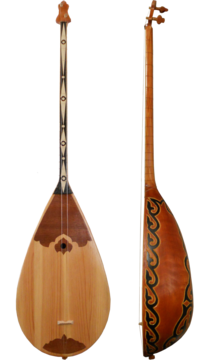
Dombra also Dombyra ( kaz. Dombyra ) is a stringed plucked musical instrument that exists in the culture of the Kazakh people. Dombra is considered a folk musical instrument of the Kazakhs , Nogais , and Kalmyks [1] .
History
In 1989, in Kazakhstan in the Almaty region , high in the mountains on the plateau (Zhailau) “Maytobe” by Professor S. Akitaev, with the help of the ethnographer , a rock drawing depicting a musical instrument and four people dancing in different poses was discovered. According to the research of the famous archaeologist K. Akishev, this figure dates from the Neolithic period. Now this picture is in the Museum of Folk Instruments. Ykylas Dukenuly in the city of Almaty , Kazakhstan . As can be seen from the figure, the tool depicted by an ancient artist on a rock is very similar to dombra in form. Based on this, we can say that the prototype of the current dombra is more than 4000 years old and is one of the first plucked instruments - the forerunner of modern musical instruments of this kind.

Archaeological research has established that Sak nomadic tribes used two-stringed musical instruments that are similar to the Kazakh dombra and can be its prototype more than 2 thousand years ago [2] .
Also, in due time, during the excavations of the ancient Khorezm , terracotta figurines of musicians playing plucked instruments were found. Scientists note that the Khorezm two-strings, which existed at least 2000 years ago, have a typological similarity with the Kazakh dombra and were one of the common tools among the early nomads who lived in Kazakhstan .
From the written monuments of the Eurasian continent, it can be concluded that the dombra and its sister instruments of other peoples on the mainland are well known for a long time. In the monuments of different periods in the Eurasian space, we learn about the presence of this plucked instrument, in particular, from the monuments of Saka , Hun origin. Also found this tool and Cumans. Kumans is the European name for Kipchaks. We have reached the musical works (kui) of those years as: Ertіs tolқyndary (waves of the Irtysh ), Mұңdy Қyz (sad girl), Tepen kөk (lynx), Akқққ az (lame goose), Bozіggen (light camel), Zhelmaya (single-humped camel) , Ölanny ң tarpuy (trampling of Kulan), Kөkeikesti (deep experience), etc.
Under the long-term influence of the Turkic peoples (Huns, Avars, Bulgarians, Khazars, Polovtsy, Horde), Eastern Slavs adopted this musical instrument called domra .
Marco Polo in his writings noted that this tool was present among the warriors of the Türkic nomads, who at that time in Russia were called Tatars. They sang and played on it before the fight, to achieve the appropriate mood.
In 2012, the electromobile was created [3] .
Dombra Day
The first Sunday of July is announced in Kazakhstan as the Day of the national musical instrument dombra. It was first celebrated on July 1, 2018 [4] .
Legends about the origin of dombra
There are legends about dombra and its origin:
- Before that, the modern dombra was like Komuz , Dutar , ... Juchi Khan was the eldest and favorite son of Genghis Khan and the father of Batu Khan. Hunting in the Kypchak steppes, Juchi Khan was brought down from his horse and torn to pieces by the leader of the herd of kulans . No one dared to inform the terrible Genghis Khan of the tragic death of his beloved son. A black messenger was awaiting a cruel execution. Genghis Khan promised to inform him about the death of his son to pour molten lead down the throat. Khan's nukers found a way out. They brought a simple dombrist named Ket-Bug to Genghis Khan’s headquarters and instructed him to voice the terrible news. Ket-Bug did not utter a word in front of the eyes of the formidable Khan. He just played his kyuy (muz.zhanr for dombra) " Aksak kulan ". The beautiful music of the great Zhyrau Ket-Bug conveyed to Khan the stern truth about barbaric cruelty and inglorious death. Angry Genghis Khan, remembering his threat, ordered the execution of dombra. It is said that since then, a hole remained on the top deck of the dombra - a trace of molten lead. The mausoleum of Juchi Khan was preserved on the banks of the ancient river Kara-Kengir in the Dzhezkazgan region . "Aksak-Kulan" (Lame Kulan) is one of the most beautiful Kazakh legends praising the power and immortality of art.
- The legend about the origin of the dombra says that in ancient times two giant brothers lived in Altai. The younger brother had a dombra, in which he loved to play. How to play, so idler about everything in the world forgets. The elder brother was arrogant and conceited. Once he wanted to become famous, for which he decided to build a bridge over a stormy and cold river. He began to collect stones, began to build a bridge. And the younger brother plays and plays.
So the day passed, and the other, and the third. The younger brother is not in a hurry to help the elder, he only knows that he is playing his favorite instrument. The elder brother got angry, snatched the younger dombra from him and that it was the force that hit her on the head of her brother. The magnificent instrument crashed, the melody was silenced, but an imprint remained on the head.
Many years later. The people found this imprint, began to make new dombras on it, and the music in the villages that were silent for a long time began to sound again.
- The legend about the acquisition of the dombra of the modern species says that before the dombra was with five strings and without a hole in the middle. Such an instrument was owned by the glorious horseman Kejendyk known to the whole district. He once fell in love with the daughter of a local khan. Khan invited Kezhedyk to his yurt and ordered to prove his love for his daughter. Dzhigit began to play, long and beautiful. He sang a song about Khan himself, about his greed and greed. Khan got angry and ordered to spoil the tool, pouring hot lead into the middle of the dombra. Then the hole was burned in the middle and only two strings remained.
- Another legend about the origin of dombra is similar to the previous one. The local Khan lost his son on the hunt from boar tusks, and the servants, fearing Khan's anger (he threatened to pour boiling lead over his throat to anyone who told him that something unkind happened to his son) went to the old master Ali for advice. He made a musical instrument that called dombra, came to the khan and played on it. Groans, crying strings, as if the plaintive noise of the forest swept under the silk tent of the Khan's tent. A sharp whistle of wind mixed with the howl of a wild beast. The strings cried out loudly, like a human voice, asking for help, so the dombra told the khan about the death of his son. Out of anger, the khan ordered to splash hot lead into the round hole of the dombra.
Dombra - Kui Instrument
For Kazakhs, the kui is more than a work, it’s a sounding page in the history of its people, its customs and culture. Therefore, the Kazakhs so highly appreciated the performers of kyuis - kuishi , among whom the dombristians constituted the overwhelming majority (the kui are performed not only on the dombra). In the Kazakh people they say: “Naғyz қazak - қazazmes, nғyz azakқ - dombyra!” , Which means “a real Kazakh is not a Kazakh, a real Kazakh is a dombra!” . This underlines the importance of the ability to play dombra for each Kazakh, which emphasizes the special love of the Kazakhs for this instrument.
Dombra in Kazakh culture
Dombra ( kaz. Dombyra ) is a Kazakh national two-stringed plucked musical instrument . It is also a popular tool for the Nogais . It is used as an accompanying and solo, as well as the main instrument in the Kazakh folk music. Used by modern artists.
A pear-shaped body and a long neck, divided by the frets. The strings are usually tuned to a quart or fifth .
One of the greatest dombrists is the Kazakh folk musician and composer Kurmangazy , who had a great influence on the development of Kazakh musical culture, including dombra music: his musical composition “Aday” is popular in Kazakhstan and abroad.
Dombra - the most popular Kazakh musical instrument . Musical instruments such dombra is not only among the Kazakhs, this instrument has its counterparts in many nations. In Russian culture there is a domra instrument similar in form, Dumrak in Tajik culture, Dumbyr in Uzbek culture, Dutrak similar in shape, Dutar , Bash , Dumbyr in Turkmen culture, Dumbyr in Turkmen culture, Nogai culture in Azov. Dombyra, in the Azerbaijani and Turkish culture - Saz , in the Yakut - Taksyr. These instruments sometimes differ in the number of strings (up to 3 strings), as well as in the material of the strings (nylon, metal).
Construction
Dombra length is 80-130 cm. Frets can be imposed, mortise, or, like Uzbek domra, can be absent altogether [5] .
- Chanak - dombra body, plays the role of a sound amplifier.
- Kakpak is the dombra deck. Perceiving the sounds of strings through vibration, amplifies them and gives a certain color to the sound of the instrument - timbre.
- A spring is a beam on the deck from the inside. There was no spring in the Kazakh dombra before. At dombra now to improve the sound of a similar spring is mounted in the upper part of the shell and near the stand. As a rule, it is made of spruce with an aging of several decades with no signs of rot.
- Gateways - disconnect the "keys" on the dombra.
- Shells are made of maple .
- The stand (tiek) is a very responsible functional element of the dombra. By transmitting vibrations of the strings to the deck and creating the first resonant circuit on the path of propagation of vibrations from the strings to the body, the stand is a genuine key to the sound of the dombra. The strength, evenness and timbre of the instrument's sound depend on its qualities, shape, weight and settings.
- The string is the source of the sound vibrations of the dombra. The dombra traditionally used gut strings made from sheep or goat intestines. But the most suitable sound was ordinary fishing line. As a result, today we have a single, widespread type of dombra of standard form with string from a fishing line, which has lost its unique timbre of sound.
Story
| String | Note | Octave |
|---|---|---|
| one | g (salt) | Small |
| 2 | d (re) |
The sound of open dombra strings forms its quarte form. It can also be quint [5] . The sequence of tones for dombra, starting with the first string, the highest in tone: Sol , Re ( small octave ).
The intervals between the strings: g {Part 4} d (the Helmholtz alphabetic notation , Part 4 is pure quart).
The musical range of dombra with 19 frets on the fingerboard is two full octaves (a part of the small octave, the first and a part of the second): from Re of the small octave to Re of the second octave.
See also
- Domra
- Dumbyra
- Kobyz
- Sherter
Notes
- ↑ Erengenov K.E. Golden Spring: about the Kalmyk folk art, crafts and life . - Kalmyk book publishing house, 1990. - p. 46-50. - 126 s.
- ↑ Musical Heritage Archival copy dated August 14, 2009 on Wayback Machine
- ↑ Spirit of the Great Steppe - Electrocombomb helped the Kazakhstani group to reach the top of the rock charts in the USA Archived on April 11, 2015.
- ↑ Eternal companion of the Kazakh: amazing facts about the dombra
- ↑ 1 2 Music Encyclopedic Dictionary. - M .: Great Russian Encyclopedia, 2003. - p. 179. - 672 p. - ISBN 5-85270-254-4 .
Literature
This literature can be found in Kazakhstan, Astana, the National Library of the Republic of Kazakhstan ...
- Akishev K.A. Kurgan Issyk. - Moscow, 1978.
- Alekseeva L.A. Nazhmedenov J. Features of the musical system of the Kazakh dombra. / / Kazakh culture: research and search. Collection of scientific articles, Almaty, 2000.
- Alekseeva L.A. Nazhmedenov J. Features of the Kakha Dombra. / / We and the Universe. 2001. No. 1 (6), pp. 52-54.
- Amanov B. Compositional terminology of dombra kyuis. Alma-Ata, 1982
- Aravin. P. V. Steppe constellations. - Alma-Ata, 1979.
- Aravin. P.V. The Great Kuyshi Dauletkerey.-Alma-Ata, 1964.
- Asafiev B.V. On the Kazakh folk music. / / Musical culture of Kazakhstan.-Alma-Ata, 1955
- Barmankulov M. The Turkic Universe. Almaty, 1996.
- Vyzgo T. Musical Instruments of Central Asia. -Moscow, 1980.
- Gizatov B. Socio-aesthetic foundations of Kazakh folk instrumental music. Alma-Ata, 1989.
- Zhubanov A.K. Kazakh folk instrument-dombra. / / Muzykoznanie.-Alma-Ata, 1976. p. 8-10.
- Stakhov V. Creativity violin master. - Leningrad, 1988.
- Nazhmedenov Zhumagali. Acoustic features of the Kazakh dombra. Aktobe, 2003
- Utegalieva S.I. Mangystau dombrovaya tradition. Almaty, 1997
Links
- Kazakh dombra
- Legend of the origin of the upper dombra
- Site of the Kazakh State National Library [1]
- Asyl Mura project site [2]
- Electronic library " Notes for dombra "
- Notes for dombra. Private music library