Avar District is an administrative unit of the Dagestan region and the Dagestan Autonomous Soviet Socialist Republic , which existed in 1864 - 1928 . The center is the village of Khunzakh .
| Avar District | |
|---|---|
| A country |  Russian empire Russian empire |
| Province | Dagestan region |
| County town | Hunzah |
| History and Geography | |
| Date of formation | 1864 |
| Square | 1,5 thousand km² km² |
| Population | |
| Population | 37.6 thousand (1897) people. |
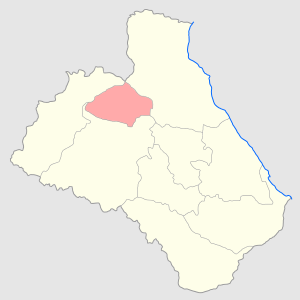 | |
Content
History
The Avar district in the Dagestan region was formed from the Avar Khanate in 1864. In 1921 it became part of the Dagestan ASSR.
In November 1928, canton division was introduced in the Dagestan Autonomous Soviet Socialist Republic and all districts were abolished.
Population
According to the 1897 census, 37.6 thousand people lived in the county. Including Avars - 95.8%; Arabs - 2.4%; Russians - 1.1%. 1587 people lived in the village of Khunzakh. [one]
Administrative Division
The district was divided into naibes , which in 1899 were converted into plots. The plots were divided into societies.
In 1895, there were 4 naivets in the county: Bohlukhskoye (center - the village of Nizhny Bohlukh ), Koysubulinskoye (center - the village of Untsukul ), Khunzakhskoye , Tsatanykhskoye (center - the village of Kharakhi ) [2] .
By 1926, the district was divided into 4 sections: Bakhlukhsky (center - the village of Andik ), Koysubilinsky (center - the village of Untsukul), Kharakhinsky, Khunzakhsky.
Notes
- ↑ Demoscope Weekly - Application. Statistics Handbook
- ↑ Memorial book of the Dagestan region / E.I. Kozubsky. - Temir-Khan-Shura: "Russian Printing House", 1895.
Links
- Avar District // Encyclopedic Dictionary of Brockhaus and Efron : in 86 volumes (82 volumes and 4 additional). - SPb. , 1890-1907.