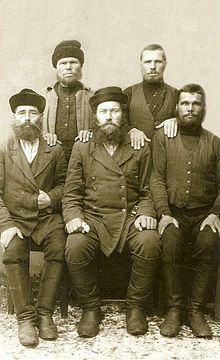
Pomory - a small, but distinctive ethnographic and ethno-religious group of the old-time Russian and Finno-Ugric population on the White Sea , as well as on the coasts of the northern rivers Mezen , Pechora , Onega and Northern Dvina . Subetnos of Russian (emigrants from Novgorod and Pskov ) and the Finno-Ugric peoples in the White Sea North of Russia . Ethnicity remains controversial..
Ethno-horonim may have originated from the name of the western shore of the White Sea from the town of Onega to the town of Kem - the Pomeranian shore [1] . Ethnicon "Pomor" probably began to be used from the end of the XVIII century . At the end of the 19th century, pomors were called industrialists from the Arkhangelsk , Mezen , Onega , Kemsky and Kolsky districts of the Arkhangelsk province [2] who went to Murman and the north of Norway [3] . As the historical successors of the traditional Pomeranian culture, nowadays people living in settlements along the shores of the White Sea and in the lower reaches of the Mezen , Northern Dvina, Onega and Pechora are called Pomors. [four]
Name etymology
From the 16th century, another local term, Pomors, was witnessed in historical documents. He designated the population living on the Pomeranian coast of the White Sea from the r. Onega to Kemi [1] , and engaged in fishing on Murman , the northern coast of the Kola Peninsula . In the course of time, villages whose inhabitants were exclusively engaged in marine industry also appeared on the Summer and Winter shores of the White Sea.
From the end of the XVII century in the Russian North , which in the Moscow state until the XIX century bore the name of Pomerania and included the Pomeranian cities (cities of the Arkhangelsk, Vologda and Olonets gubernias), members of the communities of the so-called Pomors consent [5] , currents began to be called Pomorians " bezopovtsev "in the Old Believers, formed during the split of the Russian Orthodox Church. Perhaps, in connection with this circumstance, a new term for the Pomors instead of the old one became widespread - the Pomorians , to designate the same group of Russian and Finno-Ugric population.
There is reason to believe that the emergence of the terms “Pomeranians” and “Pomors” is closely related to Murmansk fisheries. Written sources of local origin of the second half of the 18th and 19th centuries indicate that the inhabitants of the Pomeranian coast from Onega to Kemi inclusive, some villages of the Karelian coast , the Summer and Winter coasts , which were involved in the risky ocean fish industry and the beast, were called pomors [6] .
However, such a restriction of the extension of the term “Pomors” cannot be considered true, since the “Pomeranians” by M.V. Lomonosov in the XVIII century called the population of the Northern Dvina, Arkhangelsk and other "Pomeranian places":
". ... Above the proper number of sailors and soldiers to take on each ship about 10 people the best hunkers from the city of Arkhangelsky, from Mezen and from other Pomeranian places (here we see that under Lomonosov Mezen was definitely a Pomeranian place, which disproves the opinions of those who offer count Pomorie only Pomorsky (West) coast of the White Sea. ("The Arkhangelsk North in documents of history". Chrestomathy. Arkhangelsk, 2004, p. 175).
“By taking Ermakom of the Siberian kingdom and in many increments to the east of the Russian State, made more private searches than state forces (Lomonosov indicates that it was not the state, but the civilian population mastered Siberia ), where the Cossacks remained and multiplied after the winner in Siberia, but Pomeranians also from the Dvina and from other places, near the White Sea , the main thing is to have a part ”(here Lomonosov clearly indicates that the inhabitants of Dvina and other places in the White Sea were also Pomor inhabitants). (Arkhangelsk North in the documents of history. Reader. Arkhangelsk 2004, p. 174).
Fisheries of the Archangelites
Historically, fisheries for the population of the Arkhangelsk North included:
- Ocean fisheries of cod , pollock and halibut on Murman - the northern coast of the Kola Peninsula;
- The White Sea herring fishery produced in the Kandalaksha, Onega, Una and Dvina bays, as well as fowling and flounder along the shores of the White Sea;
- Salmon fishery produced by the rivers flowing into the White Sea and the North Ocean, as well as along the sea coast of the White Sea, near the mouth of the rivers flowing into it;
- The lake and river fisheries of whitefish, burbot, pike and other freshwater fish species [7] .
The publisher of the journal “Vestnik Severa”, Ivan Alekseevich Shergin (1866–1930), the author of numerous books of short stories and essays about the northern region, described the fishery of the Archangelsk city residents:
Fisheries are divided into freshwater and marine (cod) on Murman. The latter constitutes the subject of the outlying fishery of the coast-dwellers of Kemsky and part of the Onega districts, which migrate annually to Murman. In addition to the aforementioned industrialists of the Pomors, the local inhabitants of the Aleksandrovsky district are also involved in the Murmansk marine industry, but their number is not large. So, in 1906, there were 126 vessels with 400 catchers, whereas in total, there were 993 vessels with 3.446 catchers in the field. And now, the navigation is just opening, as immediately the steamers of the Murmansk Partnership depart from Arkhangelsk and, having taken the coast from the White Sea coast, follow to Murman, where they are engaged in catching cod, havingdock and halibut during the summer. In the middle of August, the steamships of the partnership go around the campsites on Murman and, loading their fisheries, rush to the Margaritinsky fair in Arkhangelsk [8] .
- I. A. Shergin
The Arkhangelsk Governor (in 1893–1901) and the practicing scientist A.P. Engelhardt left the following description of the sea industry on Murman:
From the Arkhangelsk, Onega and Kama districts, up to 3,000 industrialists usually arrive in Murman every year; most of them leave at the beginning of March on foot through Kandalaksha and Raz Navolok to Kola, from where the steamer of the Arkhangelsk-Murmansk Shipping Company, wintering in Ekaterininskaya harbor, delivers them to the camps. ... The main subject of fishing on Murman is cod. In addition to cod, it is caught, in a relatively smaller amount, halibut, haddock, pollock, catfish, flounder, sea bass and sea bury .... Single men catch cod with a bait consisting of flagella in 180 soot. At the end of which a hook with bait is attached ; ... Pomors do not like to fish with a fishing rod, but they catch it in a longline. A longline is a length of several versts and consists of a rope of thickness into the little finger, to which are attached thin strings 1.5–2 yards long, at a distance of one sag from each other; hooks are attached to the free end of these cakes ... The length of the large circle reaches 4000 sazhen; usually 5,000 hooks are attached to it. The longline sinks to the seabed and lies in the water for about six hours, after which it is gradually pulled out and the fish caught from the hooks [9] .
- A.P. Engelhardt
Already in our time, the sociologist Yu. M. Plyusnin conducted in 1995–2001 a survey of the rural population of the coastal part of the White Sea coast, the legendary Pomeranian shores. He revealed and described the following fact. In 5 of the Pomeranian fishing collective farms surveyed by him there were 13 medium fishing seiners . But no more than 10 collective farmers out of almost 400 people in their teams worked in teams. The rest of the crew was recruited in Estonia and Ukraine:
The reasons for the reluctance to go into the sea are called the most different, but for all there is one circumstance: against the background of unprofitable livestock and crop production, sea fishing is profitable and allows the collective farm to support all its workers, regardless of their real contribution. This small salary, on which members of a collective farm live, acts as a form of assistance, thanks to which they still have enough time for their farms (plus hunting, fishing, collecting and renting algae, and other time-consuming, unhurried and often pleasant ) and corresponding to the needs of leisure, which consists in regular and prolonged drunkenness (while dry law was introduced on the courts) ... The psychology of the rentier was formed, which at the level of everyday consciousness was fairly quickly established, was an ideological justification in the current environment as a mechanism situational valuable starts successfully displace the old social and psychological life support mechanisms [4] .
- Yu. M. Plyusnin
Study History
Currently, there is no single point of view on the concept of "Pomors". There are a number of main approaches that differ from each other:
- Pomors are a group of people of a non-ethnic nature associated with a similar lifestyle and type of economic activity;
- Pomors are the indigenous people of the North;
- Pomors is a regional, local and ethnically neutral name of the Russian population living in the Arkhangelsk North;
- Pomory is an ethnographic group of the Russian old-time population living along the shores of the White Sea;
- Pomors is a Russian subethnos living on the White Sea coast;
Pomors in the fishery. Early 20th century
Pomors in summer clothes. Early 20th century
Pomors in winter clothes. Early 20th century
Pomors. Early 20th century
Peasant family in festive costumes. White Sea. Early 20th century
Pomors. Early 20th century
Pomors. Early 20th century
Pomors. Early 20th century
Language and Culture of Speech
The spoken language of Pomors is the Pomor dialect of the Russian language . The characteristic features of Pomeranian dialect are:
- The length and length of vowels in phonetics, characteristic of the part of the Finno-Ugric languages.
- a large number of words inherited from the ancient Russian language (its Novgorod dialect).
- the presence of numerous tumors, in particular those related to the natural conditions and economic activities of the coast-dwellers, as well as linguistic borrowings from the ancient Baltic, Finno-Ugric and Scandinavian languages in the vocabulary.
- some features in the creation of verb forms, selective application of the aorist .
Territorial groups of Pomorians
- Pomors proper: the population of the Pomeranian , Summer and parts of the Karelian coast of the White Sea ; distinguish themselves from the population of the Kandalaksha Bay (calling them pyakka ) and Tersky Shore (calling them Rokans )
- ruins or as they are called by other Pomors - pyakka
- Terchans or as other Pomors call them Rokans
- Ust-tanks and pustozero on Pechora [10]
- Canins of Pomors : a small isolated group; 7 people at the time of the 2002 census called themselves the Canins of Pomors [11] .
Religion
The main religion of the coast is the Orthodoxy of both the new ( Russian Orthodox Church ) and the old ( Old Orthodox Pomeranian Church ) rites.
In 2010, the field expedition of the Institute of Ethnology and Anthropology . N.N. Miklukho-Maklay of the Russian Academy of Sciences investigated the religiosity of modern Pomorians [12] .
Conflict with the Ministry of Justice of the Russian Federation
In 2012, the Ministry of Justice of the Russian Federation decided to liquidate the White Sea territorial neighboring community “Pomory”, which was registered in 2005 [13] . The motive of elimination - the Pomors do not belong to the indigenous peoples [13] . Pomeranian activist Ivan Moseev was convicted on charges of publishing a response comment in 2012 against threats to the ethnographic group of coast-dwellers on the Echo of the North website, which called for the Pomors to be sent to the wall: “What will you do with us? You are millions of cattle, we are two thousand people. " This answer was used by the FSB investigator to accuse Moseev of Part 1 of Art. 282 of the Criminal Code of the Russian Federation to insult a group of persons on the basis of nationality “Russians”. Despite the fact that the word “Russians” was not mentioned in this phrase, the very fact of the appearance of such a comment gave the judicial authorities a reason to begin the prosecution of the defender of the rights of the Pomorians. At the same time, a direct appeal to shoot the coast-dwellers, to which the said answer was given, was ignored by the investigation and the court. As a result, Ivan Moseev was sentenced to a fine of 100 thousand rubles, dismissed from the post of director of the Pomor Institute of Indigenous and Minority Nations NArFU, after which the institute was liquidated [13] .
Culture
Pomeranian Tales
A significant mutual influence on the fairy-tale tradition of Pomorye was exerted by the culture of neighboring peoples. The most beloved in Pomorie are long fairy tales of an adventure character, in which the action is connected with the sea. Usually the main character of such tales is a poor man. No less common are fairy tales with the main female character. Along with a man, she shares all the trials and turns out to be his wonderful assistant. In a number of fairy tales, she is an innocent victim of an insidious enemy [14] .
Pomeranian culture is reflected in the works of S. Pisakhov and B. V. Shergin . In the 80s, based on the works of Pisakhov and Shergin , the famous cartoon series “ Laughter and sorrow at the Bela of the Sea ” was shot on “ Soyuzmultfilm ”. Also, some elements of the Pomor culture and life can be found in the works of Yuri Kazakov .
Numbers according to the 2002 and 2010 censuses
During the 2002 All-Russian Census, 6,571 people called themselves Pomors (6,295 of them live in the Arkhangelsk Region (among them, in particular, the Governor of the Arkhangelsk Region Anatoly Efremov [15] ), in the Murmansk Region 127 [16] .
According to the results of the 2010 All-Russian Population Census, the number of people who identified themselves as Pomors for the 8 years has decreased by half and amounted to 3113 people (including 2015 in the Arkhangelsk region).
See also
- Museum of history, culture and life of Terek coast
- Pomeranian trade
- Roe
- Belk craft
Notes
- ↑ 1 2 Peoples of the European part of the USSR (Volume 1). - M .: Science , 1964. - P. 145. - (Series Peoples of the World. Ethnographic Essays of the USSR Academy of Sciences ).
- ↑ The White Sea subspecies of the ringed seal (P. h. Hispida) is the most common seal of the Arctic Ocean. See: Ringed seal . The harp seal was preyed mainly in the lying place - the throat of the White Sea . Also: Biological Encyclopedia: Family Real Seals (Phocidae)
- ↑ Latkin N.V. Pomory // Brockhaus and Efron Encyclopedic Dictionary : 86 t. (82 t. And 4 add.). - SPb. , 1890-1907.
- ↑ 1 2 Plyusnin Yu. M. Pomory. The population of the White Sea during the crisis, 1995-2001 . - Novosibirsk: Publishing House of Novosibirsk State University, 2003.
- ↑ Pomeranian Accord // Encyclopedic Dictionary of Brockhaus and Efron : 86 t. (82 t. And 4 extra.). - SPb. , 1890-1907.
- ↑ See for example: Ulyanov I.M. Country of Pomorie. (1984) Electronic Resource
- ↑ Danilevsky N. Ya. Fisheries and colonization of the Murmansk coast // Collection of political and economic articles by N. Ya. Danilevsky. - SPb. : N. N. Strakhov's edition, 1890. - p . 588-601 .
- Н. Shergin N. А. The Wealth of the North: Travel Notes, Essays and Stories: In the north; Zyryansky Krai; Ukhten oil; Udora region . - 2nd ed., Again before. and add. - SPb. : Type of. First Labor Artel, 1909. - 136 p.
- ↑ Engelhardt A.P. Marine fisheries on Murman . - Russian land. Region of the Far North, 1899. - T. I. - p. 273.
- ↑ Russians. - M .: Science, 1999.
- ↑ Rosstat . The list of options for self-determination of nationalities in the 2002 census . Demoscope Weekly . The date of circulation is January 20, 2013. Archived on February 1, 2013.
- ↑ Expeditions of the Institute of Ethnology and Anthropology. N.N. Miklukho-Maclay RAS
- ↑ 1 2 3 The ethnopolitical situation in Russia and neighboring states in 2012. Annual report of the network of ethnological monitoring and conflict early warning / ed. V.A. Tishkova and V.V. Stepanova. - M .: IEA RAS , 2013 .-- 676 p. - ISBN 978-5-4211-0071-3 .
- ↑ Pomeranian tales.
- ↑ Real governor appeared among the governors // “Business Press”, no. - 2002. - October 16 ( No. 39 (164) ).
- ↑ Rosstat . Population by nationality and knowledge of the Russian language by subjects of the Russian Federation . - All-Russian census of 2002. Volume 4. Date of treatment January 20, 2013. Archived February 1, 2013.
Atlases and maps (historical)
- Akhmatov I. Atlas Historical, Chronological and Geographical Russian State, compiled on the basis of the history of Karamzin by Ivan Akhmatov. - SPb., 1831. Runivers
- Ilyin A. A. Detailed atlas of the Russian Empire with the plans of the main cities. - SPb .: Publication of a cartographic establishment A. Ilyin, 1876. Runs Map of Arkhangelsk Province
- Kudryashov K.V. Russian historical atlas. - M .; L .: State publishing house of cartography, 1928. - 20 p. Runivers Colonization of the Russian North
- Maksimovich A. Atlas of the Russian Empire, 1824 - St. Petersburg, 1845.
- Russia. Geographical description of the Russian Empire in the provinces and regions with geographical maps. - SPb., 1913. - 286 p. Runivers
- The Russian atlas, consisting of forty-four maps and consisting of forty-two governorships, separates the Empire. - SPb .: Publishing house Sochina, 1792. - 47 p. Runivers Map of Arkhangelsk governorate
Atlases and maps (modern)
- Peoples of Russia. Atlas of cultures and religions. - M .: Design. Information. Cartography, 2010. - 320 p. - ISBN 978-5-287-00718-8 .
- Semushin DL Russian North. Space and time. - Arkhangelsk: Malye Korely, 2010. - 120 p. (Contains 40 maps compiled by the author based on an analysis of written and cartographic sources.)
Literature
- Anufriev V.V. Russian Pomors. Cultural and historical identity. - Arkhangelsk: Solty, 2008 .-- 160 p. - 1000 copies - ISBN 5-7536-0217-7,.
- Bernshtam T. A. Pomory: group formation and economic system / T. A. Bernshtam; USSR Academy of Sciences; Institute of Ethnography; by ed. K.R. Chistova. - L .: Science, 1978. - 176 p.
- Bernshtam T. A. Russian folk culture of Pomerania in the 19th - early 20th centuries. - L. , 1983. - 232 p.
- Bulatov V.N. The Russian North. Prince 1. Zavolochye (IX – XVI centuries). - Arkhangelsk, 1997; Prince 2. Meet the sun (XV – XVII centuries). - Arkhangelsk, 1998; Prince 3. Pomorie (XVI - beginning of the XVIII centuries). - Arkhangelsk, 1999; Prince 4. The light of the polar star (XVIII-XIX centuries). - Arkhangelsk, 2002; Prince 5. Gateway to the Arctic. - Arkhangelsk, 2001. - Arkhangelsk: Izd. Center PSU them. M. V. Lomonosov, 1997-2001.
- Essays on Russian folk culture / resp. ed. and comp. I.V. Vlasova; Institute of Ethnology and Anthropology RAS. - M .: Science, 2009. - 786 p. - ISBN 978-5-02-036744-9 .
- Plyusnin Yu. M. Pomory. The population of the White Sea during the crisis, 1995-2001 . - Novosibirsk: Publishing house of Novosibirsk State University, 2003. - 143 p. - ISBN 5-89554-189-5 .
- Pomeranian encyclopedia : 5 tons / hl. ed. Acad., Vice President of the RAS N. P. Laverov. T. 1: History of the Arkhangelsk North / Pomeranian state. un-t them. M. V. Lomonosov, Lomonosov Foundation, Pomeranian Scientific. fund; Ch. ed. V. N. Bulatov; comp. A.A. Kuratov . - Arkhangelsk: Pomeranian State. University, 2001 (True of the North). - 483 s. : or; 28 l or; 4 l. kart. - ISB No. 5-88086-147-3.
- Russian / Institute of Ethnology and Anthropology. NN Miklukho-Maklay RAS / Series "Peoples and Cultures", vol. I. / Editors of the series: Dr. the story Sciences Yu. B. Simchenko, Dr. a story. Sciences V.A. Tishkov. - M .: Nauka, 1999 .-- 828 p.: Ill. ISBN 5-02-008609-6
- Russian Collection: studies on the history of Russia / ed. O.R. Ayrapetov, Miroslav Jovanovic, M.A. Kolerov, Bruce Menning, Paul Cheysti. Volume XII. - M.: Publishing House Regnum, 2012. - 504 p. - ISBN 978-5-905040-04-7 PDF
- Semushin D. L. “The Pomeranian Question” and the Russian Arctic. - Moscow: Regnum Publishing House, 2013. - 256 p. - 300 copies - ISBN 978-5-91887-024-2 . PDF
- Malashenkov A.A., Fedorov P.V. The soil on the northern rocks: Orthodox necropolis of the Murmansk coast of the Barents Sea (1863-1920) . - 2017. - SPb. : Intern. bank. in-t. - 632 s. - ISBN 978-5-4228-0085-8 .
- Cheremukhina L.A. Northern cuisine. - Arkhangelsk: Sev.-Zap. Prince publishing house, 1992. - 320 p. - 100 000 copies - ISBN 5-85560-168-4 , ISBN 978-5-85560-168-8 .
Links
- Kola maps - Large-scale maps of the Kola Peninsula since 1534, library, toponymy.
- On the origin of the name "Pomors" From the book of I. M. Ulyanov "The Country of Pomorie" (1984)
- Pomors - article from the Great Soviet Encyclopedia
- Official site of the Pomors community . Date of treatment January 20, 2013. Archived February 1, 2013.
- Ovchinnikov A.V. Forest Certification and the Pomors: Information, Activity, New Opportunities for Indigenous Peoples (Results of the Expedition to Onega Pomerania) . - Tysyachnyuk M.S., Konyushatov O.A., Kulyasova A.A., Kulyasov I.P., Teslya I.V. Recommendations on the social aspects of certification under the FSC Forest Stewardship Council scheme - Vologda: CISR , 2009. The date of circulation is January 20, 2013. Archived on February 1, 2013.
- Badigin K.S. The Path to Grumant (Pomeranian Pasture) . - Arkhangelsk book publishing house, 1956. Date of circulation January 20, 2013. Archived February 1, 2013.
- Academician of the Russian Academy of Sciences Valery Tishkov on the relationship between the concepts of “people” and “nation”
- Round table in NArFU: “Cultural and ethnic identity of Russian coast-dwellers” , September 15, 2011
- Anatoly Bednov. The true causes of the “anti-Pomeranian” campaign. Investigation of Eurasian Narodniks
- Pomeranian issue: applications, documents, projects
- Norwegian Barents Secretariat
- June 19, 2013, Tatyana Nefedova, Lotsiya of the White Sea: 100 years later , an expedition will start in Arkhangelsk on a shnyak, a vessel built like a traditional Pomeranian boat. Russian Geographical Society, RGO