Kazakhs in China ( Kazakh. Қytay қазақтары , قىتاي قازاقتارى , Chinese. Exercise. 中国 哈萨克 , pinyin : zhōngguó hāsàkè , pall .: Zhongguo hasake ) - the largest diaspora of Kazakhs . Kazakhs occupy 16th place in terms of numbers among the peoples of the PRC .
| Kazakhs in China | |
|---|---|
| Total: 1,462 (2010 census) [1]
| |
| Tongue | Kazakh , Chinese , Uyghur . |
| Religion | Sunni Islam |
| Included in | Kazakhs |
| Related peoples | Karakalpaks , Nogais |
| Origin | Turkic |
History
The first Kazakhs moved to the territory of Dzungaria in the XVII-XVIII centuries, when most of the Oirats were destroyed by the Qing army in 1757 [2] , and as a result of the demarcation by the Russian Empire and China of the lands of Central Asia, the Kazakhs lost their possessions in the east of modern Kazakhstan [3] .
The first signs of dissatisfaction with the actions of the Chinese government appeared among the Kazakhs in the second half of the 19th century and were associated with a tightening of tax policy. Part of the Kazakhs, led by Zhylkysha Aktayuly and Kobesh Aitbayuly (Kobesh-batyr), moved to Mongolia , crossing the Khovd River [4] . However, the number of Kazakhs in China by the end of the XIX century reached 100 thousand people, and by 1911 in connection with migration processes amounted to almost 225 thousand. In addition, after the suppression of the Central Asian uprising in 1916, another 300 thousand Kazakhs moved to China [5] .
Until 1949, Xinjiang, due to its considerable remoteness, was only nominally under Chinese rule. The indigenous people of this region ( Uyghurs , Dungans , Kyrgyz , Mongols , Kazakhs ) throughout history fought for independence with the Manchu authorities, republican China, and then with the Communists. The Kazakhs took part in the uprisings of 1930-1940, and in the Ili uprising of 1944-1949 they played a leading role [6] . Kazakhs have always been a significant political force in Xinjiang, which was dangerous to ignore [7] , and forces that wished to control this region tried to enlist the support of the Kazakhs or suppress them [8] .
Due to the actions of the Chinese authorities in the person of Jin Shuzhen and Sheng Shitsai to seize Kazakh pastures for further transfer to the Han and Mongols, from the 40s of the XX century, many Kazakhs began to leave Xinjiang .
Research
In the Soviet Union, the topic of the existence of Kazakh diasporas beyond the borders of the Kazakh SSR was banned, a few studies were written under ideological pressure and covered the problem one-sidedly [9] . The monograph of G. V. Astafiev, “Kazakhs of Xinjiang” [10] and the article by N. N. Mingulov, “The National Liberation Movement of the Xinjiang Peoples as an Component of the General Chinese Revolution (1944-1949)”, were devoted to the ethno-historical problems of Xinjiang Kazakhs [11] . 88.8 percent of respondents want to live in Kazakhstan [12] .
Abundance and resettlement
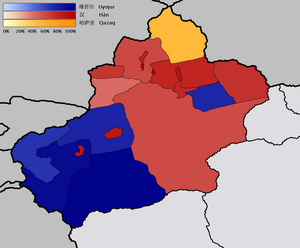
Kazakhs mainly reside in the Ili-Kazakh Autonomous Okrug , the Mora-Kazakh and Barkel -Kazakh Autonomous Districts of the Xinjiang Uygur Autonomous Region (XUAR), as well as in the Haysi-Mongolo-Tibet Autonomous District in Qinghai Province and Aksai-Kazakh Autonomous County in the province Gansu [13] .
In the 1930s, there were about 800 thousand Kazakhs in East Turkestan, of which, by the 1950s, about 100 thousand died as a result of uprisings and the subsequent exodus of Kazakhs to India [14] . According to Chinese sources, in the years 1937-1943, 4,360,020 people lived in Xinjiang, of which 930,000 were Kazakhs [15] , but by 1953, according to the data of the 1953-1954 All-China Census, this number decreased to 421 thousand people ( decrease of 45%) [16] .
According to the official 2000 census, the number of Kazakhs in China amounted to 1250 thousand people [13] , and in 2010 the number of Kazakhs reached 1,462,588 people [17] .
Generic composition
Mostly Naiman and Kerey tribes. According to surveys, 80.5% of Kazakhs in China classified themselves as Middle Zhuz, 12.6% as Junior Zhuz, and 2.9% as Senior Zhuz [18] .
Language
The Kazakhs of China speak the Kazakh language (830 thousand north-east dialect , 70 thousand south dialect [19] ), which is part of the Kypchak subgroup of Turkic languages, use the alphabet based on Arabic script [13] . The language of the Chinese Kazakhs was slightly affected by the northern branch of the Chinese language [20] , in addition, due to the long residence in isolation from each other, there is a difference in the use of certain terms in Kazakhstan and China, for example, the Kazakh word “ doctor” (doctor) corresponds to the word shipager in same value. Not only Chinese Kazakhs, but also some Kazakhs of Kazakhstan do not understand the newly introduced terms ұstanım (principle), әuіr (April), dәrumen (vitamin), қyzanaқ (tomato), payyz (percentage), genya (family) [21] .
Culture
In the second half of the 19th century, literature of Xinjiang Kazakhs began to take shape. In the 1930s, the first Kazakh newspapers and magazines appeared in Xinjiang. In 1954, the Xinjiang People’s Publishing House opened in the PRC, including printing works by Kazakh poets and writers. Later, the Kazakh branch of the National Publishing House in Beijing arose [22] .
In 1947, a Kazakh theater opened in Urumqi. In 1953, "Khasen and Jamilya" was released - the first Chinese film on Kazakh themes, the script of which was created by B. Tyshkanbaev and Chinese writer Wang Ihu. In subsequent years, several more films on Kazakh subjects were shot in China, the most famous of which are Aigul (1964, scriptwriter Wang Ihu) and Tan-Zharyk (1990; 5 episodes) [22] .
Media
The first Kazakh-language newspapers and magazines appeared in Xinjiang in the 1930s. Most modern Kazakh-language newspapers are published in the Ili-Kazakh Autonomous Okrug of the XUAR. Another focus of the Kazakh press is Urumqi. The main newspaper of the Xinjiang Ribbon XUAR is also published in Kazakh [23] .
Since the 1960s, the XUAR People's Radio Station began broadcasting in the languages of national minorities, including Kazakh. In 1971, the Kazakh edition of China Radio in Beijing opened, releasing both news programs and original programs. The first telecasts in the Kazakh language were released in 1983 on the regional television channel of the Altai city district . In 1993, a separate Kazakh-language television channel appeared in the city of Kuldzha . In 1997, the XJTV 3 regional TV channel, entirely in Kazakh, was launched in the XUAR, and in the same year it began satellite broadcasting throughout the PRC and border countries [23] .
With the development of the Internet in China, sites of various subjects in the Kazakh language appear [23] .
Chinese persecution
According to reports of American radio stations broadcasting in the region of Central Asia and Kazakhstan ( Radio Azattyk ) and the region of East and Southeast Asia ( Radio Free Asia ), since 2017, ethnic Kazakhs in the Chinese province of Xinjiang have been harassed by government agencies PRC: they are deprived of foreign passports in order to prevent them from traveling to Kazakhstan, they are arrested and placed in “re-education centers” or are subject to criminal prosecution. Those who have relatives abroad are particularly targeted. The Chinese authorities rejected all these allegations. [24] [25] However, later the Chinese ambassador to Kazakhstan admitted that during the preparation and conduct of the 19th CPC congress in Xinjiang, the authorities carried out “stringent surveillance and search measures” in relation to ethnic Kazakhs as well. According to the ambassador, "local law enforcement officers overdid it, there are isolated cases," while "high-ranking officials did not know about the situation," but now information about these cases has been transmitted to Beijing and the Xinjiang authorities [26] . The Ministry of Education and Science of Kazakhstan reported that 88 students who went on vacation in the 2017-2018 academic year were not able to come from China. [27]
On August 7, 2018, Kazakh President Nazarbayev instructed the Ministry of Foreign Affairs of the Republic of Kazakhstan to deal with the ban on the departure of 675 ethnic Kazakhs from the PRC. [28]
Famous Kazakhs of China
- Ospan-Batyr is the governor of Altai , one of the leaders of the national liberation movement of the Kazakhs of China.
- Dalelkhan Sugurbaev is a political and military leader in the East Turkestan Republic .
- Kanat Islam - Chinese, then Kazakhstan boxer, bronze medalist of the 2008 Olympic Games. Captain of the Astana Arlans (WSB) team.
- Mayra Mohamed-kyzy is a Chinese and Kazakh opera singer (tragic soprano , Italian belkanto ).
- Mukhtar Kul-Mohammed is a Kazakhstani politician.
- Marfuga Aitkhozhina is a Kazakh poetess.
- Kazhigumar Shabdanuly - Kazakh writer, dissident , prisoner of conscience .
See also
- Kazakh administrative units
Notes
- ↑ Ethnic composition of the population of China (in Chinese)
- ↑ Uradyn Erden Bulag. Nationalism and Hybridity in Mongolia . - Oxford University Press, 1998 .-- P. 98. - 302 p. - ISBN 9780198233572 .
- ↑ Mendikulova G.M., 1997 , p. 28.
- ↑ Zhylkysh Aktayuly // Kazakhstan. National Encyclopedia . - Almaty: Kazakh encyclopedias , 2005. - T. II. - ISBN 9965-9746-3-2 .
- ↑ T. Barysheva. Kazakh population outside the region. Repetition of the section "Completion of Kazakhstan's Accession to Russia" // TsOR 232, Grade 8 . Portal "History of Kazakhstan" .
- ↑ Benson, Linda. the Ili Rebellion: the Moslem Challenge to Chinese Authority in Xinjiang. - NY: Armonk, 1990.
- ↑ McLean NLD The Much-Coyrted Kazaks // The Geographical Magazine. - 1948. - Issue. 21 . - S. 263 .
- ↑ Mendikulova G.M., 1997 , p. 113.
- ↑ Mendikulova G.M., 1997 , p. 30-31.
- ↑ Astafiev G.V. Kazakhs Xinjiang (ethnogenesis, history, settlement, tribal composition, position during the Russian-Chinese demarcation in the 50s of the 20th century). - M, 1971.
- ↑ Mingulov N. N. The national liberation movement of the peoples of Xinjiang as an integral part of the general Chinese revolution (1944-1949) // Questions of the history of Kazakhstan and East Turkestan. - Alma-Ata, 1962. - S. 68-102.
- ↑ Many Kazakhs in China are thinking of moving to Kazakhstan
- ↑ 1 2 3 The Kazak Ethnic Group (English) . China Internet Information Center (June 21, 2005). Date of treatment April 8, 2015.
- ↑ Lias, Godfrey, 1956 .
- ↑ Kao Shi-Ping. Sinkiang // The Chinese Yearbook 1936-1937. - 2nd issue. - Shanghai. - P. 168-174.
- ↑ Mendikulova G.M., 1997 , p. 114.
- ↑ Ethnic composition of the population of China (Chinese) . www.stats.gov.cn. Date of treatment April 8, 2015.
- ↑ https://cyberleninka.ru/article/n/nekotorye-aspekty-etnichnosti-kazahov-kitaya.pdf
- ↑ Kazakh (English) . Ethnologue . Date of treatment April 2, 2015.
- ↑ Keith Brown, Sarah Ogilvie. Concise Encyclopedia of Languages of the World . - Elsevier, 2010 .-- P. 589-591. - 1310 p. - ISBN 9780080877754 . (eng.)
- ↑ Aizhan Kөshkenova. Sultan Zhanbolat, professor, Zhazushi: Ұlttyң tіlі men jazuy Ortaқ Bolmay, Birtutas Boluy Qiyin (Kazakh.) // Aygin newspaper. Archived on April 13, 2015. (Kazakh.)
- ↑ 1 2 Kazakh literature and art of China // Kazakhstan. National Encyclopedia . - Almaty: Kazakh encyclopedias , 2005. - T. III. - ISBN 9965-9746-4-0 .
- ↑ 1 2 3 A.K.Samaev. Kazakhs in China. The ability to obtain information in their native language // Bulletin of KarSU : journal. - 2010.
- ↑ Chinese Kazakhs speak of “pressure” . Radio "Azattyk" .
- ↑ China's Mass Detention of Xinjiang's Ethnic Minorities Shows No Sign of Let-up . Radio Free Asia
- ↑ Chinese Ambassador on the situation with Chinese Kazakhs: These are our internal affairs
- ↑ Kazakh students from China are afraid to go on vacation
- ↑ Nazarbayev instructed to deal with the problem of travel abroad by Kazakhs in China - Mail News
Literature
- Mendikulova G.M. Historical Fates of the Kazakh Diaspora. Origin and development . - Alma-Ata, 1997 .-- 265 p.
- Lias, Godfrey. Kazak Exodus. - London, 1956.
Links
- E. Yu. Sadovskaya. Repatriation of ethnic Kazakhs to Kazakhstan . - Demoscope Weekly, 2002.
- Kazakhs in China. The ability to obtain information in the native language . - 2010.
- Problems of repatriation of Kazakhs of China to their historical homeland . - 2010.
- Ethnographic map (Kazakh) (inaccessible link) . Date of treatment April 10, 2015. Archived December 5, 2014.
- Map of the proportion of Kazakhs by counties. on the whale. lang