The great gerbil or zamanik [1] ( Latin Rhombomys opimus ) is a rodent. The only representative of the genus large gerbil [2] .
| Great gerbil | ||||||||||||||||
|---|---|---|---|---|---|---|---|---|---|---|---|---|---|---|---|---|
 | ||||||||||||||||
| Scientific classification | ||||||||||||||||
| ||||||||||||||||
| Latin name | ||||||||||||||||
| Rhombomys opimus ( Lichtenstein , 1823 ) |
Security status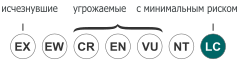 IUCN 3.1 Least Concern : 19686 |
It is the largest gerbil. Body length 150-200 mm, tail slightly shorter than body. At the end of the tail is a well-developed “whisk” of blackish hair.

In nature, it is found in Central Asia - in many parts of Uzbekistan , Turkmenistan , in southern Kazakhstan , as well as in Iran , southern Mongolia, Northwest China and Afghanistan . Inhabits areas with sandy, clay and gravelly soils. Not found on the naked takyrs , salt marshes and on loose sand, devoid of vegetation. It feeds on green parts of herbaceous plants and branches of bushes. In the fall, it collects large stocks of branches of saxaul , camel thorn, and saltworms, which it hides in special storerooms.
The maximum lifespan in the wild is 3-4 years. Pregnancy lasts from 23 to 28 days. On average, 24-25 days.
Notes
- ↑ Baryshnikov G.F., V.E. Garutt, I.M. Gromov et al. 1981. Mammalian Catalog of the USSR (Pliocene - Modernity) / ed. THEM. Gromova and G. I. Baranova. - L .: Science. c.167, - 456 s.
- ↑ ITIS : Rhombomys Wagner, 1841
Literature
- Vinogradov B.S., Gromo I.M. Rodents fauna of the USSR. - M .: Publishing house of the Academy of Sciences of the USSR, 1952. - p. 222-224. - 298 s.