Three-horned inverted bear [1] [2] ( lat. Typhaeus typhoeus ) is a beetle of the family of dung dugouts ( Geotrupidae ).
| Three-horned manure |
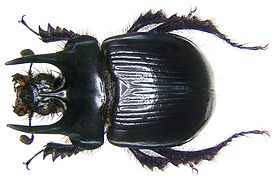
Male |
| Scientific classification |
|---|
| No rank : | Bilateral symmetrical |
| Subtype : | Tracheo-breathing |
| Infraclass : | Winged insects |
| Treasure : | Fully Transformed Insects |
| Infrastructure : | Scarabaeiformia Crowson, 1960 |
|
| International scientific name |
|---|
Typhaeus typhoeus ( Linnaeus , 1758) |
| Synonyms |
|---|
Ceratophyus brunneus Mulsant, 1842
Ceratophyus pusillus Mulsant, 1842
Scarabaeus pumilus Marsham, 1802
Scarabaeus typhaeus Fabricius, 1775
Scarabaeus typhoeus Linnaeus, 1758
Typhaeus vulgaris Leach, 1815 |
|
Content
Beetle 15-24 mm long. Coloring is black, brilliant. Clypeus is rounded in front. Pronotum with protruding anteriorly and somewhat distant from the anterior angular-lateral horns, in males, everything except the sides, in females in the middle of the disk is smooth. Elytra in deeply pointed punctures. [3]
South and central Europe , the Mediterranean coast, Asia Minor . Prefers sandy soil. In Russia, it is noted only in the Kaliningrad region .
It feeds on droppings of rabbits . They make 1.5 meter vertical minks.
- ↑ Medvedev S.I. Larvae of lamellar beetles of the fauna of the USSR. M .: L .: - 1952. - 342 p.
- ↑ Gilyarov M.S. Key to insect larvae of insects. - M.: “Science”, 1964. - 869 p.
- ↑ Bei-Bienko G. Ya. Part 1. Coleoptera and fan-winged // Identifier of insects of the European part of the USSR in five volumes. - Moscow — Leningrad: “Science”, 1965. - T. II. - S. 425. - 668 p.
