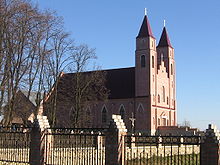
Baranivka ( Ukrainian: Baranivka ) is a city of regional significance in the Zhytomyr region of Ukraine , the administrative center of Baranovsky district .
| City | |||||
| Baranivka | |||||
|---|---|---|---|---|---|
| Ukrainian Baranivka | |||||
| |||||
| A country |  Ukraine Ukraine | ||||
| Status | district center | ||||
| Region | Zhytomyr Oblast | ||||
| Area | Baranovsky district | ||||
| Chapter | Dushko Anatoly Alexandrovich | ||||
| History and Geography | |||||
| Based | 1565 | ||||
| City with | 2001 | ||||
| Square | 77.6 km² | ||||
| Center height | |||||
| Timezone | UTC + 2 , in summer UTC + 3 | ||||
| Population | |||||
| Population | ▼ 1 [1] people ( 2018 ) | ||||
| Katoykonim | baranovets, baranovets [2] | ||||
| Digital identifiers | |||||
| Telephone code | +380 4144 | ||||
| Postcode | 12700 | ||||
| Car code | AM, KM / 06 | ||||
| KOATUU | 1820610100 | ||||
| mrada.baranivka.info | |||||


Content
Geographical position
It is located on the river Sluch [3] [4] , which flows through the city.
At 22 km from the city is the railway station Radulino [3] [4] .
History
It was first mentioned in the annals of 1565 as a village of the Grand Duchy of Lithuania [5] .
After the Union of Lublin in 1569 - as part of the Volyn Voivodeship of the Commonwealth [5] .
In 1593 and 1618 Baranivka was destroyed by the Tatars.
After the second partition of Poland in 1793 it became part of the Russian Empire [5] .
In 1905, Baranivka was a small town of Novograd-Volyn county of Volyn province , which operated a china factory , post office and telegraph. Of the 2000 inhabitants, half were Jews [6] .
In February 1918, Soviet power was established in Baranovka [5] , after the end of the civil war , in 1923 Baranovka became a district center, and here the development of industry became more active [3] .
In 1938, Baranovka was given the status of an urban-type settlement [5] .
After the outbreak of World War II on August 12, 1941, Baranivka was occupied by the advancing German troops [5] , here the killings of the civilian population began and a ghetto was created for Jews. On July 19, 1941, 74 Jews [7] were executed in Baranivka, 100 Jews [7] on July 29, and 180 Jews [7] on August 24. In October 1941, there was a mass execution of Jews. Since November 1941, the remaining Jews were gathered in a labor camp. On January 6, 1942, 594 Jews [7] from surrounding villages were executed in Baranivka.
Under the German occupation, an underground anti-fascist organization operated in Baranovka. January 3, 1944 Baranivka was liberated by Soviet troops [5] .
In 1950, there was a porcelain factory, several other enterprises of the ceramic industry and food industry enterprises [3] .
In 1959, the population was6183 people [8] .
In 1970, the population was 10.1 thousand people, there was a porcelain factory, a brick factory, a creamery and several other enterprises [4] .
As of the beginning of 1978, there was a porcelain factory, a brick factory, a factory for cultural and household goods, a food factory, a leshozzag, an inter-collective farm construction organization, regional agricultural machinery, a consumer services factory, 5 secondary schools, a vocational school, a hospital, a cultural center, six libraries, a museum of a porcelain factory, a museum of local history and a room-museum of Lesya Ukrainka [5] .
May 17, 2001 Baranivka was given the status of a city [9] .
Population
| 1923 | 1959 | 1970 | 1989 | 2001 | 2006 | 2011 | 2015 |
|---|---|---|---|---|---|---|---|
| 1,784 | ↗ 6 183 | ↗ 10 546 | ↗ 12 638 | ↘ 12 584 | ↘ 12 326 | ↘ 12 128 | ↘ 11 918 |
Economics
Baranivka is a center for the production of porcelain products, there is also a food industry and others.
The city has 12 industrial enterprises of various ownership forms, more than 20 private companies and three utilities that produce products and provide a variety of services.
Famous People
In Baranovka, the head of the Novocherkassk administration was born in 1989-2001, Nikolai Ivanovich Prisyazhnyuk .
Notes
- ↑ The number of the explicit population of Ukraine on 1 September 2018 rock. State Statistics Service of Ukraine. Kiev, 2018.
- ↑ Gorodetskaya I. L., Levashov E. A. Baranovka // Russian names of inhabitants: Dictionary-reference book. - M .: AST , 2003 .-- S. 41 .-- 363 p. - 5,000 copies. - ISBN 5-17-016914-0 .
- ↑ 1 2 3 4 Baranovka // Great Soviet Encyclopedia. / redkoll., ch. ed. B. A. Vvedensky. 2nd ed. volume 4. M., State Scientific Publishing House "Great Soviet Encyclopedia", 1950. p. 226
- ↑ 1 2 3 Baranovka // Great Soviet Encyclopedia. / ed. A.M. Prokhorova. 3rd ed. volume 2. M., "Soviet Encyclopedia", 1970. p. 620
- ↑ 1 2 3 4 5 6 7 8 Baranivka // Ukrainian Soviet Encyclopedia. volume 1. Kiev, “Ukrainian Soviet Encyclopedia”, 1978. p. 360
- ↑ Baranovka // Brockhaus and Efron Encyclopedic Dictionary : in 86 volumes (82 volumes and 4 additional). - SPb. , 1890-1907.
- ↑ 1 2 3 4 DRUM
- ↑ All-Union Census of 1959
- ↑ City registration card on the website of the Verkhovna Rada (in Ukrainian)
Literature
- Baranówka (1), mko - Warszawa: Filip Sulimierski i Władysław Walewski, 1880. - T. I: Aa - Dereneczna. (floor) - S. 104
- Baranivka // Encyclopedia of History of Ukraine: at 10 tons / editorial board: V. A. Smoliy (head) and ін. ; Institute of History of Ukraine NAS of Ukraine. - K.: Science. Dumka, 2003. - T. 1: A - B. - S. 182. - ISBN 966-00-0734-5 .