Zhukovsky 's theorem is a theorem on the lifting force of a body streamlined by a plane - parallel flow of an ideal liquid or gas . Formulated by N.E. Zhukovsky in 1904 .
The statement of the theorem:
The lifting force of a wing segment of infinite scope is equal to the product of the density of the gas (liquid), gas (liquid) velocity , circulation of the flow velocity and the length of the selected wing segment. The direction of action of the lifting force is obtained by turning the velocity vector of the incoming flow at a right angle against circulation.
In the formula form:
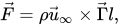
Where
- - lifting force
- - fluid density
- - fluid flow rate at infinity,
- - velocity circulation (the vector is directed perpendicular to the profile plane, the direction of the vector depends on the direction of circulation),
- - the length of the considered wing segment (perpendicular to the profile plane).


This theorem was the basis for constructing the modern theory of wing and propeller. It makes it possible to calculate the lifting force of a wing of a finite size, the propeller thrust, the load on the turbine blades , and so on.
To determine the velocity circulation of a wing profile with a sharp trailing edge, it is convenient to use the empirical postulate of Zhukovsky - Chaplygin .
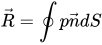
Note It can be deduced from the Bernoulli principle and from the formula for pressure forces .
History
Before Zhukovsky, the occurrence of lifting force was explained by Newton's shock theory, which describes air particles that are not connected with each other and impact on a streamlined body. This theory gives an underestimated value of the lifting force of the wing.
Zhukovsky for the first time presented the mechanism of formation of the lifting force of a wing discovered by him in the fall of 1904 at a meeting of the Mathematical Society on November 15, 1905. [one]
The provisions of the theorem were published in the works “On the fall in air of light elongated bodies rotating about their longitudinal axis” (1906) and “On the attached vortices” (1906). [2]
A German scientist Martin Wilhelm Kutta was also engaged in research in this area; in foreign literature, Zhukovsky’s theorem is known as Kutta-Joukowski .
See also
- Magnus Effect
- Bernoulli Integral
- Chaplygin's formula
Notes
- ↑ Strizhevsky S. Ya. Nikolai Yegorovich Zhukovsky - the founder of modern aviation science. Archived copy of December 29, 2010 at Wayback Machine / M .: Pravda Publishing House. - 1951
- ↑ Scientific works of N.E. Zhukovsky