Suleiman I the Great ( Eve ; Ottoman. سليمان اول - Süleymân-ı evvel , tour. Birinci Süleyman, Kanuni Sultan Süleyman ; November 6, 1494 - September 5/6 , 1566 ) - the tenth sultan of the Ottoman Empire (1520—15) Caliph since 1538.
| Suleiman the Magnificent | |||||||
|---|---|---|---|---|---|---|---|
| osman. سليمان اول Suleymân-ı evvel | |||||||
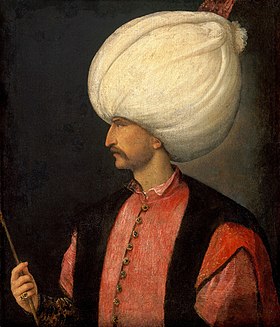 Ottoman (Turkish) Sultan Suleiman I the Magnificent | |||||||
| |||||||
| Predecessor | Selim I the Terrible | ||||||
| Successor | Selim II | ||||||
| Birth | November 6, 1494 Trabzon , Ottoman Empire | ||||||
| Death | September 6, 1566 (71 year) Szigetvar , Ottoman Empire | ||||||
| Burial place | Suleymaniye Mosque | ||||||
| Rod | |||||||
| Father | Selim I | ||||||
| Mother | Hafsa Sultan | ||||||
| Spouse | 1) Fulan-Khatun 2) Gulfem-Khatun 3) Makhidevran Sultan 4) Hurrem-Sultan | ||||||
| Children | sehzade Makhmud, sehzade Murad, sehzade Mustafa , sehzade Mehmed , sehzade Abdullah, Mirimah-sultan , Selim II , sehzade Bayazid , sehzade Dzhikhangir . | ||||||
| Religion | Sunni Islam | ||||||
| Tugra |  | ||||||

Suleiman is considered the greatest sultan of the Ottoman dynasty; under him the Ottoman Porta reached the apogee of its development. In Europe, Suleiman is most often called Suleiman the Magnificent , whereas in the Muslim world Suleiman Kanuni . Sometimes the Turkish word “Kanuni” ( Arabic القانونى ) is mistakenly translated as “Legislator”.
Politics, external wars
Date of birth of Suleiman is indicated in different sources in different ways. Basically two dates are named: either November 6, 1494, or April 27, 1495 [1] . On the plate at the burial indicated the second date. He was born in Trabzon , his father was sehzade Selim . Suleiman's mother, Hafsa-sultan , according to one of the versions was the daughter of the Crimean Khan Mengli I Giray [2] . Until 1512, he was a ballerbay in Caffe [3] . At the time of the death of his father, Sultan Selim I, in 1520 , Suleiman was governor of Manisa (Magnesia) [4] . Headed the Ottoman state at the age of 26 years. Cardinal Wolsi said about him to the Ambassador of Venice at the court of King Henry VIII Tudor : “This sultan Suleiman is twenty-six years old, and he is not devoid of common sense; it is necessary to fear that he will act in the same way as his father ” [5] .
His reign, Suleiman I, began by releasing several hundred Egyptian captives from noble families who were kept in chains by Selim [6] . Europeans rejoiced at his accession, but they did not take into account that although Suleiman was not as bloodthirsty as Selim I , he loved fatherhood as much as his father. Initially, he was friends with the Venetians, and Venice looked without fear at his preparations for wars with Hungary and Rhodes .
Suleiman I sent Ambassador Lajos (Louis) II to the King of Hungary and the Czech Republic demanding a tribute [7] . The king was young and powerless against his own magnates , who arrogantly rejected negotiations with the Turks and threw the ambassador into prison (according to other sources, killed [7] ), which became the formal pretext for the sultan to war.
In 1521, the troops of Suleiman took the strong fortress of Sabac on the Danube and besieged Belgrade ; in Europe they did not want to help the Hungarians, everywhere they were coldly met by the Hungarian ambassadors. Belgrade resisted to the last; when 400 people remained from the garrison , the fortress surrendered, the defenders were treacherously killed. In 1522, Suleiman landed a large army in Rhodes , on December 25, the main citadel of the Knights of St. John surrendered . Although the Turks suffered huge losses, Rhodes and the nearby islands became possessions of Porta . In 1524, the Turkish fleet , which had left Jeddah , defeated the Portuguese in the Red Sea , which was thus temporarily cleared from Europeans. In 1525, the corsair Hayreddin Barbarossa , who became a vassal of the Turks six years ago, finally established himself in Algeria ; from that time on, the Algerian fleet became the strike force of the Ottoman Empire in naval wars.
In 1526, Suleiman sent a 100-thousand army in the campaign against Hungary ; On August 29, 1526, the Turks utterly defeated and destroyed almost completely the army of Lajos II at the battle of Mojac , the king himself drowned in a swamp during his flight. Hungary was devastated, the Turks brought tens of thousands of inhabitants out of it into slavery . The Czech Republic was saved from the same fate only by the subjugation of the Austrian Habsburg dynasty: from this time long wars between Austria and Turkey begin, and almost all the time Hungary remains the battlefield. In 1527 - 1528, the Turks conquered Bosnia , Herzegovina and Slavonia , in 1528 the ruler of Transylvania - Janos I Zapolya , a contender for the Hungarian throne, declared himself a vassal of Suleiman. Under the slogan of defending his rights, Suleiman in August 1529 took the capital of Hungary I would , driving out the Austrians from here, and in September of the same year, at the head of the 120-thousand army, besieged Vienna , the advanced Turkish troops invaded Bavaria . The fierce resistance of the imperial troops, as well as the epidemic among the besiegers and the lack of food forced the Sultan to lift the siege and move to the Balkans [8] . On the way back, Suleiman destroyed many cities and fortresses, taking thousands of prisoners. The new Austro-Turkish war of 1532-1533 limited the siege of the border fortress K Кszeg by the Turks, her heroic defense thwarted the plans of Suleiman, who intended to besiege Vienna again. Across the world, Austria recognized the domination of Turkey over eastern and central Hungary and pledged to pay an annual tribute of 30,000 ducats . Suleiman no longer undertook campaigns against Vienna, especially since in this war he was confronted not only by Austrians, but also by Spaniards: the brother of Archduke Ferdinand I of Austria , the king of Bohemia and Hungary was the king of Spain and the emperor of the Holy Roman Empire, Charles V Habsburg. However, Suleiman’s power was so great that he successfully waged an offensive war against a coalition of the most powerful countries of Christian Europe.
In the 15-16 centuries, there were wars between the most powerful states of that time. In 1533, Suleiman launched a grand war with the Iranian Safavid state) (1533-55), which was ruled by Shah Tahmasp I. Using the campaign of the Safavid troops against the Uzbeks of the Bukhara Khanate , who seized the Khorasan possessions of the Safavids , the sultan invaded Iranian Azerbaijan in 1533, where the emir of the Tekelu tribe Ulama, who surrendered the Safavid capital Tebriz to the Turks, took his side. In September 1534, Suleiman entered Tabriz with the main forces of the Turks, then joined the troops of the Grand Vizier Ibrahim Pasha Pargal, and in October their combined forces moved south to Baghdad . In November 1534, Suleiman I entered Baghdad [10] . The rulers of Basra , Khuzistan , Luristan , Bahrain and other principalities on the southern shore of the Persian Gulf obeyed him (Basra was finally conquered by the Turks in 1546 ). In 1535, the Shah Tahmasp went on the offensive and won Tabriz, but Suleiman in the same year again took the city, then went through Diyarbakir to Aleppo and in 1536 he returned to Istanbul.
In 1533, Hayreddin Barbarossa was appointed Kapudan Pasha - commander of the Ottoman fleet. In 1534 he conquered Tunisia , but in 1535 Tunisia itself was occupied by the Spaniards, who thus wedged a wedge between the Turkish possessions in Africa. But in 1536, Suleiman I concluded a secret alliance with the French king Francis I Valois, who had fought with Charles V for domination over Italy for many years. Algerian corsairs were able to base in ports in the south of France. In 1537, the Algerians launched a war against the Christians in the Mediterranean , Hayreddin robbed the island of Corfu , attacked the coast of Apulia , threatened Naples .
In 1538, Venice attacked Turkey in alliance with the Spaniards and the Pope, but Hayreddin devastated the islands of the Aegean Sea belonging to Venice and conquered Zante , Heguina , Cherigo , Andros , Paros , Naxos . On September 28, 1538, the emperor’s best admiral , Andrea Doria , was defeated by the Ottoman fleet at Preveza . In the same year, Suleiman I invaded the Moldavian principality and subjugated it, annexing directly to the Turkish possessions of the lower Dniester and Prut .
In 1538, the Turks undertook a great sea voyage to South Arabia and India . On 13 June, the Ottoman fleet left Suez, on 3 August the Turks arrived in Aden , the local ruler Amir gave them a solemn reception, but was hanged on a mast, the city was taken and plundered. Capturing Aden, the Turks sailed to the shores of Gujarat , besieged the Portuguese city of Diu, which they tried unsuccessfully to take. Indian Muslims helped the besiegers, the fortress was already ready to surrender when a rumor spread about the approach of the Portuguese squadron; Gujarati people made peace with the Portuguese and treacherously killed the Turks besieging the city. Thus, the Sultan’s attempt to expel Europeans from the Indian Ocean failed, but in the land war his commanders and vassals won victory after victory. In the world concluded with Venice on October 20, 1540 , the sultan forced her to surrender all the islands already captured by Hyraddin, as well as two cities in Morea , which remained with her - Napoli di Romano and Malvasia ; Venice also paid a contribution of 30 thousand ducats. The dominance of the Mediterranean was entrenched for the Turks until the battle of Lepanto , where they suffered a crushing defeat. Then Suleiman renewed the war with Austria ( 1540 - 1547 ) In 1541, the Turks took Buda, in 1543 - Esztergom , the old capital of Hungary, in 1544 - Visegrad , Nograd , Hatvan . On the Peace of Adrianople on June 19, 1547, Austria continued to pay tribute to Turkey; in the central regions of Hungary, a separate pashalik was created, and Transylvania became a vassal of the Ottoman Empire, like Wallachia and Moldavia .
Having concluded peace in the west, Suleiman once again launched an offensive in the east: in 1548, the Turks took Tabriz for the fourth time (inability to keep their capital forced Shah Tahmasp to move his residence to Qazvin ), penetrated to Kashan and Kuma , captured Isfahan . In 1552 they took Yerevan . In 1554, Sultan Suleiman I captured Nakhichevan [11] . In May 1555, the Safavid state was forced to make peace in Amasya, according to which it recognized the transition to Turkey of Iraq and Southeast Anatolia (the former northwestern possessions of the state Ak-Koyunlu ); in exchange, the Turks ceded the Safavids most of the Transcaucasus , but Western Georgia ( Imereti ) also became part of the Ottoman Empire.
France, under pressure from the public opinion of Christian Europe, was forced to break the alliance with the Ottomans, but in fact, during the rule of Suleiman I, France and Turkey were still blocked against Spain and Austria. In 1541, Hayraddin Barbarossa repelled a large campaign of the Spaniards against Algeria, in 1543 the Turkish fleet helped the French in the capture of Nice , and in 1553 in the conquest of Corsica .
Turkey’s relations with Russia under Suleiman were tense. The main reason was the constant hostility of Moscow State and the Crimean Khanate, which is part of the Ottoman Empire. At various times, Kazan ( Safa-Girey in 1524) and even Siberian khans recognized vassal dependence on Suleiman. The Kazan and Siberian Khanates hoped to receive diplomatic and even military assistance from the Turks, but due to the great distance from Istanbul, these hopes were groundless. The Turks occasionally took part in the campaigns of the Crimeans to the Moscow kingdom (in 1541 - to Moscow , in 1552 and 1555 - to Tula , in 1556 - to Astrakhan ). In turn, in 1556 - 1561, the Lithuanian prince Dmitry Vishnevetsky together with Danila Adashev made raids on Ochakov , Perekop and the coast of Crimea , in 1559 - 60, unsuccessfully tried to take the fortress of Azov .
In 1550, the Turks conquered al-Qatif , captured by the Portuguese; in 1547 - 1554, the Turkish fleet in the Indian Ocean more than once engaged in battle with the Portuguese, smashing their trading posts. In 1552, the Turkish squadron took away the strong Muscat fortress from the Portuguese, but in 1553 the Turks were defeated by them in the Strait of Hormuz, and in 1554 from the Muscat.
Two new wars with Austria at the end of Suleiman’s rule ( 1551–1562 and 1566–1568 ) did not lead to any significant changes in the borders. In August 1551, the Turkish fleet captured Tripoli , soon the whole Tripolitania (modern Libya ) submitted to Suleiman. In 1553, the Turks invaded Morocco , trying to restore the overthrown Wattasides dynasty to the throne and thus establish their influence in this country, but failed. The campaign of the Turks in Sudan ( 1555 - 1557 ) led to his submission to the Ottomans; in 1557, the Turks seized Massawa , the main port of Ethiopia , and by 1559 conquered Eritrea and fully controlled the Red Sea . Thus, by the end of his reign, Sultan Suleiman I, who in 1538 also took the title of Caliph , ruled the greatest and strongest empire in the history of the Muslim world.
On May 18, 1565, a huge Turkish fleet of 180 ships landed a 30-thousand army in Malta , but the Knights of Joannites , who had owned this island since 1530, repulsed all the storms . The Turks lost up to a quarter of the army and in September were forced to evacuate from the island.
May 1, 1566 Suleiman I made the last - thirteenth military campaign. The army of the Sultan on August 7 began a siege of Szigetvara in Eastern Hungary. Suleiman I the Magnificent died on the night of September 5 in his tent during the siege of the fortress, from dysentery .
The body of the Sultan was brought to Istanbul and buried in a turbo at the cemetery of the Suleymaniye mosque next to the mausoleum of his beloved wife Roksolana . According to historians, the heart and internal organs of Suleiman I were buried on the very spot where his tent stood. In 1573-1577, on the orders of the son of Suleiman and the successor of Selim II, a mausoleum was erected here, along with a mosque , a dervish monastery and a small barracks . These buildings were completely destroyed during the war of 1692-1663. In 2013, the Hungarian explorer Norbert Pap from the University of Pec announced the discovery of a tomb in the area of the village of Jibot ( Hung. Zsibót ) [12] [13] .
Personal Life
Suleiman I patronized poets ( Baki and others), artists, architects, wrote poems himself, under the pseudonym Mukhibbi , was considered a skilled blacksmith and personally participated in the ebb of guns, as well as fond of jewelry. The grandiose buildings built under his rule — bridges, palaces, mosques (the most famous is the Suleymaniye Mosque, the second largest in Istanbul ) became a model of the Ottoman style for centuries to come. An uncompromising fighter with bribery , Suleiman severely punished officials for abuses; he won the people's favor with good deeds, released artisans who had been forcibly removed, built schools, “but he was a ruthless tyrant : neither merit nor kinship saved him from suspicion and cruelty.” [14] .
Family
The first concubine who gave birth to her son Suleiman - Felane . This concubine gave birth to a son of Mahmoud in 1512, who died during a smallpox epidemic on November 29, 1521 . In the life of the Sultan, she played almost no role, and in 1550 she died.
The second concubine was called Gulfem-Khatun . In 1513, she gave birth to a son to the Sultan Murad, who also died of smallpox in 1521 [15] [1] . Gulfem was excommunicated from the Sultan and did not give birth to more children, but for a long time remained a true friend to the Sultan. Gulfem was strangled by the order of Suleiman in 1562 .
The third concubine of the Sultan was Makhidevran-Sultan , also known as Gulbahar (“Spring Rose”), allegedly Circassian [16] [17] [18] . Makhidevran was the mother of several sehzade, including Mustafa (1515-1553). He was very popular among the people [19] . In 1553, during the war against the Persians, Mustafa was executed on charges of conspiracy. Makhidevran was sent to Bursa , where she died in 1580/1581. She was buried next to her son in the mausoleum of the sekhzade of Mustafa in Bursa [19] .
The fourth favorite and the only concubine of Suleiman, with whom he entered into an official marriage in 1534, was Alexandra Anastasia Lismere-Sultan. In Europe, it became known as Roksolana . There is no reliable information about the girl's name before entering the harem and the exact origin, but it is known that she was captured by the Tatars during a raid on the territories now in Western Ukraine, and at that time belonged to the Polish-Lithuanian state [20] [21] [ 22] .
In 1521, Hürrem and Suleiman had a son, Mehmed [23] , in 1522 - a daughter of Mihrimah , in 1523 - a son Abdullah, and in 1524 - Selim . In 1525, their son Bayazid was born, but Abdullah died in the same year [15] . In 1531 Roksolana gave birth to the son of Cihangir to the sultan. The protege of Roksolana at the post of Grand Vizier was Rustem Pasha ( 1544-1553 and 1555-1561 ), for whom she married her 17-year-old daughter Mihrimah. Rumors and speculations of that time stated that by the end of Suleiman I’s reign, the struggle for the throne between his sons became obvious. Mustafa was executed; a few days later, Mustafa’s seven-year-old son, Mehmed, was also executed [24] . It is not known whether Mustafa was going to overthrow the sultan or whether he was slandered [19] .
The heir to the throne was Selim, the son of Roksolana; however, after her death ( 1558 ), another son of Suleiman from Roksolana, Bayezid ( 1559 ), revolted. He was defeated by his brother Selim in the battle of Konya in May 1559 and tried to hide in Safavid Iran , but Shah Tahmasp I betrayed his father for 400 thousand gold, and Bayazid was executed ( 1561 ). Five sons of Bayazid were also killed (the youngest of them was three years old).
There is a version that Suleiman had another daughter who survived infancy - Razie-Sultan. Whether she was the blood daughter of Sultan Suleiman and who her mother is is not known for sure; historian Chagatay Ulujay assumes that Makhidevran was her mother. An indirect confirmation of the existence of Razie can be the fact that there is a burial in the turb of Yahya-efendi with the inscription “Carefree Razia Sultan, the blood daughter of Kanuni Sultan Suleyman and the spiritual daughter of Yahya Efendi” [25] .
In culture
- In 2003, the mini-series “ Alexandra Süratan ” was shot in Turkey.
- In 1996—2003 He appeared on the screens of the Ukrainian TV series " Roksolana ". The role of Sultan Suleiman played Anatoly Hostikoev .
- In 2011—2014 The Turkish series “The Magnificent Century ” appeared on the screens. The role of the sultan played a famous actor Halit Ergench .
- Roman Bertris Small "Harem" (1978).
- Occasionally appears in the video game " Assassin's Creed: Revelations" (2011), a friend of the main protagonist Ezio Auditor da Firenze .
- Sultan Suleiman is the leader of the Ottoman Empire in the computer strategy games of the Sid Meier's Civilization series and Age of Empires III .
Illustrations
Suleymaniye Mosque
in Istanbul ,
built by SinanTurbe Suleiman I
near the mosque Suleymaniye
Notes
- ↑ 1 2 Yılmaz Öztuna. Kanûnı̂ Sultan Süleyman . - Kültür Bakanlığı, 1989. - P. 163. - ISBN 9751703743 , 9789751703743.
- ↑ M. Th Houtsma. First encyclopaedia of Islam: 1913-1936 . - BRILL, 1993. - p. 522. - ISBN 9004097961 , 9789004097964.
- ↑ Ekaterina Nikolaevna Kusheva . The peoples of the North Caucasus and their ties with Russia: the second half of the XVI - 30s of the XVII century. - Publishing House of the Academy of Sciences of the USSR, 1963. - p. 201.
- ↑ Suleiman, Sultan // Encyclopedic dictionary of Brockhaus and Efron : in 86 tons (82 tons and 4 extra). - SPb. , 1890-1907.
- ↑ Kinross Lord. The rise and decline of the Ottoman Empire. - M .: KRON-PRESS, 1999. - P. 214. - ISBN 5-232-00732-7 .
- ↑ Turkey // Brockhaus and Efron Encyclopedic Dictionary : 86 tons (82 tons and 4 extras). - SPb. , 1890-1907.
- ↑ 1 2 Turkish Wars // Encyclopedic Dictionary of Brockhaus and Efron : 86 tons (82 tons and 4 extra). - SPb. , 1890-1907.
- ↑ I. B. Grekov, Institute of Slavonic and Balkan Studies (USSR Academy of Sciences). The Ottoman Empire and the countries of Central, Eastern and Southeastern Europe in the XV-XVI centuries: the main trends in political relations. - M .: Science, 1984. - p. 165.
- ↑ History of Iran from ancient times to the end of the XVIII century . - L .: Publishing House of the Leningrad University, 1958. - 390 p.
- ↑ Kinross Lord. The rise and decline of the Ottoman Empire. - M .: CROWN PRESS, 1999. - p. 247-248. - ISBN 5-232-00732-7 .
- ↑ The history of the peoples of the North Caucasus from ancient times to the end of the XVIII century. - Moscow : Nauka, 1988. - p. 313.
- ↑ Suleiman's Heart Divides and Then Unites Two Countries ; Norbert Pap. Nagy Szulejmán szultán szigetvári türbéjének kutatása (1903—2015) IX, 2015, no 2, S. 2-19.
- ↑ The grave of the Ottoman Sultan Suleiman the Magnificent was discovered: Science: Science and Technology: Lenta.ru
- ↑ Georg Weber. General history. - 1889. - T. XI. - p. 283.
- ↑ 1 2 Sir HAR Gibb. The Encyclopaedia of Islam . - Brill Archive, 1979. - Vol. 5, parts 79-80. - p. 66.Original text (rus.)According to the tradition, it was established by Hammer-Purgstall (GOR, iii, 673), she was Polish, from Rogatin of a Greek Catholic papas; Aleksandra Lisowska. Tatar raids; a slave in Istanbul.
- ↑ Yermolenko, 2013 , p. 2
- ↑ Avtorkhanov, Broxup, 1996 , p. 29.
- ↑ Peirce, 1993 , p. 55.
- ↑ 1 2 3 Peirce, 1993 , p. 56.
- ↑ donna di nazion russa (Bragadino);
“[Donna] ... di nazione russa” (Navagero);
Sultana, ch'è di Russia (Trevisano). Yermolenko G. Roxolana: "The Greatest Empresse of the East" - ↑ “and the favorite wife of the current Turkish emperor, the mother of his firstborn [son], who will rule after him, was abducted from our land” . Mihalon Litvin . On the customs of the Tatars, Lithuanians and Muscovites
- ↑ Samuel Tvardovsky wrote that the Turks told him that Roksolana was the daughter of an Orthodox priest from Rogatin . Przewazna legacja JO Ksiazecia Krzysztofa Zbaraskiego
- ↑ Peirce, 1993 , p. 59.
- ↑ Kinross, 2002 , p. 233.
- ↑ Uluçay, 1985 , pp. 35, 39.
Literature
- Avtorkhanov, Abdurakhman; Broxup, Marie. Barrier: The Russian Advance Towards the Muslim World . - C. Hurst & Co. Publishers, 1996. - 252 p. - ISBN 1850653054 , 9781850653059.
- İnalcık, Halil; Kafadar, Cemal. Süleymân The Second [ie the First and his time]. - Isis Press, 1993. - 394 p.
- Lord Kinross. Ottoman Centuries . - HarperCollins, 2002. - 640 p. - ISBN 0688080936 , 9780688080938.
- Peirce, Leslie P. The Imperial Harem: Women and Sovereignty in the Ottoman Empire . - Oxford: Oxford University Press, 1993. - 374 p. - ISBN 0195086775 , 9780195086775.
- Uluçay, M. Çağatay. Padişahların kadınları ve kızları . - Türk Tarih Kurumu, 1985. - 220 p.
- Yermolenko, Galina I. Roxolana in European Literature, History and Cultur . - Ashgate Publishing Ltd, 2013. - 334 p. - ISBN 1409476111 , 9781409476115.
Links
- Suleiman the Magnificent. The program "Echo of Moscow" from the series "Everything is so"
- Harold Lamb Suleiman. Sultan of the East
- A. A. Sharibzhanova, R.V. Sharibzhanov. The symbolism of the power of the Ottoman Sultan: fantastic animal images on the scimitar of Suleiman the Magnificent
- Mausoleum of Suleiman the Magnificent on the Art of Islam
- A. B. Shirokorad Sultan Suleiman the Magnificent and his Empire