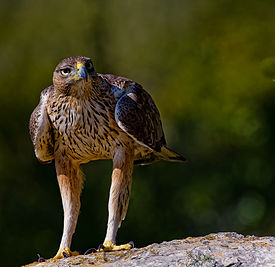
Wing length from 46 to 55 cm, total length 65–75 cm, weight 1.5–2.5 kg. The coloring of adult birds on the dorsal side is blackish-brown, the tail is gray with a transverse dark pattern. The ventral side of the hawk eagle is buffy or white with blackish longitudinal mottles and with transverse dark stripes on the feathers of the lower leg and undertail. Young hawk eagles in the first annual outfit on the ventral side are reddish with barreled strokes on the goiter and chest, on the head and neck there are red streaks. Rainbow yellow in adults, pale brown in young. Bill is grayish-black, claws are black, waxen and legs are yellow. Females are larger than males.
The hawk eagle is widespread in the tropical and subtropical zone of the eastern hemisphere: in southern Europe, Africa (except for the Sahara ), Anterior , Central and South Asia , and on the Lesser Sunda Islands . A small and sporadic hawk eagle is found in Central Asia from Turkmenistan and Tajikistan in the south to the Karatau mountains in the north [2] . Hawk eagles prefer to live in places overgrown with xerophytic shrubs [3] .
The hawk eagle feeds on mammals and medium-sized birds - hares , rabbits , gray and stone partridges , wild pigeons, ravens (jackdaws) and others. The hawk eagle catches prey mainly on the ground, but also in the air, like a falcon . Recently, hawk eagles in Western Europe have been successfully used as hunting birds [2] .
From late January to mid-April, usually 2 eggs are laid (rarely 1 or 3), which are mainly incubated by the female for 37-40 days. Young become winged at the age of 60-65 days. The relationship of partners is extremely strong, and they can remain together throughout life. Being near the nest, two partners alternately dive, perform other pieces, playing in the air [4] .
In China, the masonry of the hawk eagle was found in March, in India from November to February. Hatching lasts about 40 days, chicks become flying at the age of about 8-10 weeks. [2]
In many areas of the European range, the hawk eagle is in danger of extinction. The reason may be the extermination by man and a change in the habitat of this species, the death of birds on the wires of power lines and a decrease in the amount of basic food [4] .