COROT-7 is a star located in the constellation Unicorn at a distance of about 489 light years from us. Around the star, at least two planets and one candidate for the planet.
| COROT-7 | |||
|---|---|---|---|
| Star | |||
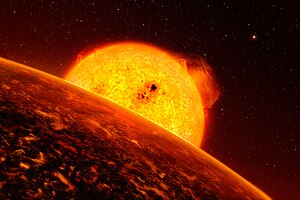 The COROT-7 system as presented by the artist. | |||
| Observational data ( Age J2000.0 ) | |||
| Right ascension | |||
| Declination | |||
| Distance | 489 ± 65 St. years (150 ± 20 pc ) | ||
| Constellation | Unicorn | ||
| Astrometry | |||
| Own movement (μ) | RA: 12.9 [2] Dec: -4.0 [2] | ||
| Parallax (π) | |||
| Specifications | |||
| Spectral class | G9V [3] | ||
| physical characteristics | |||
| Weight | 0.93 ± 0.03 [3] M ☉ | ||
| Radius | 0.87 ± 0.04 [3] R ☉ | ||
| Age | (1.2 - 2.3) ⋅10 9 [3] years | ||
| Temperature | 5275 K | ||
| Metallicity | [M / H] = 0.03 ± 0.06 | ||
| Rotation | 3.5 km / s | ||
| |||
| Database Information | |||
| SIMBAD | data | ||
| Sources: [2] | |||
Content
Features
According to the data obtained during the COROT mission [3] , this star belongs to the class of yellow dwarfs with a mass and radius of 93% and 87% of the sun, respectively. Spectral analysis showed that the chemical composition of the star is close to solar. The surface temperature reaches 5275 degrees Kelvin . The approximate age of COROT-7 is estimated at 1-2 billion years. The star has strong seismic activity [4] , which is why determining its planetary companions was very difficult.
Planet System
In 2009, a group of astronomers announced the discovery [3] of two planets COROT-7 b and COROT-7 c in this system. The Earth-type inner planet was discovered using the transit method . Their mass is approximately equal to 4.8 and 8.4 Earth masses ( b and c, respectively). Both planets turn close to the parent star, and make a complete revolution in a very short period of time - planet b in less than a day, and planet c in 85 hours. It is possible that the system also has a third (outer, non-transit) planet d - Neptune with a mass of 17 Earth and a circulation period of 9 days, but the strong noise of the star makes it difficult to confirm.
| Planet | Weight ( M ♁ ) | Radius ( R ♁ ) | Circulation period ( days ) | Semimajor axis orbits ( a.u. ) | Eccentricity orbits |
|---|---|---|---|---|---|
| b | 4.8 ± 0.8 | 1.58 ± 0.1 | 0.853585 ± 0.000024 | 0.0172 ± 0.00029 | 0 |
| c | 8.4 ± 0.9 | ? | 3,698 ± 0,003 | 0,046 | 0 |
| d (unconfirmed) | 16.8 | ? | 9.021 ± 0.019 | 0.08 | 0 |
Galactic Longitude 01.1400 °
Galactic latitude −00.4722 °
Distance 489 + 65 St. years old
Notes
- ↑ 1 2 3 4 5 Gaia Data Release 2 - 2018.
- ↑ 1 2 3 SIMBAD - COROT-7 in the SIMBAD database . Date of treatment December 17, 2009.
- ↑ 1 2 3 4 5 6 A. Leger, D. Rouan, J. Schneider, P. Barge, M. Fridlund, B. Samuel, M. Ollivier, E. Guenther, M. Deleuil, HJ Deeg, M. Auvergne, R. Alonso, S. Aigrain, A. Alapini, JM Almenara, A. Baglin, M. Barbieri, H. Bruntt, P. Borde, F. Bouchy, J. Cabrera, C. Catala, L. Carone, S. Carpano , Sz. Csizmadia, R. Dvorak, A. Erikson, S. Ferraz-Mello, B. Foing, F. Fressin, D. Gandolfi, M. Gillon, Ph. Gondoin, O. Grasset, T. Guillot, A. Hatzes, G. Hebrard, L. Jorda, H. Lammer, A. Llebaria, B. Loeillet, M. Mayor, T. Mazeh, C. Moutou, M. Paetzold, F. Pont, D. Queloz, H Rauer, S. Renner, R. Samadi, A. Shporer, Ch. Sotin, B. Tingley, G. Wuchterl, et al. Transiting exoplanets from the CoRoT space mission VIII. CoRoT-7b: the first Super-Earth with measured radius (inaccessible link - history ) . Arxiv.org (Aug 3, 2009). Date of treatment December 17, 2009.
- ↑ CoRoT-Exo-7b: Confirming the first transiting rocky planet
See also
- Unicorn constellation stars list
- List of exoplanets discovered in 2009