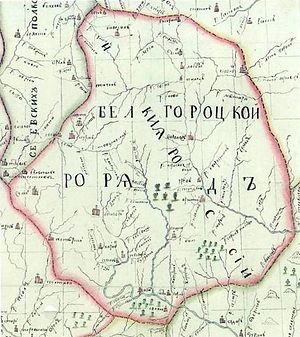
The category is a military- administrative-territorial unit in the Russian kingdom of the XVI - XVII centuries . He obeyed the discharge governor and was part of the discharge order .
The warriors who lived in the territory of the discharge were called up to serve in discharge regiments ( connection of regiments ) to serve . Each regiment included several regiments of arms ( archers , dragons , dragoons , soldiers , etc.). The ranks obeyed the Rank Order .
Content
History
The traditional basis of the administrative division of the Russian kingdom was counties . As the borders of the state expanded, the shortcomings of such a system began to appear. The shortcomings of the existence of many small counties that communicated directly with Moscow were sharply revealed on the outskirts of the state, which required the extension of the governor’s power for a more successful operation of the troops [1] . It is here that, on the basis of the Ukrainian counties, large military-administrative units - Ranks - begin to be created. In 1615, all 53 border cities of Russia were divided into five departments (categories):
- 1) Ukrainian (later - Tula)
- 2) Ryazan
- 3) Seversky
- 4) steppe
- 5) grassroots.
- 2) Ryazan
In 1616, the number of garrisons in these fortified cities reached 24,350.
Documents from the end of the 16th century inform about the Ukrainian service of Moscow servicemen : “The Tsar ordered the Ukrainian voivods to all in all Ukrainian towns and cities to stand in their place according to the old painting and to be in the gathering according to the old painting in the regiment; and how will the arrival of military people come to the sovereigns of Ukraine, and the sovereign ordered them to be in the front line in the Ukrainian regiment ” [2] .
The center of the first Ukrainian rank created in the 16th century was Tula . The Tula governor began to lead the activities of the regimental and city governor of the cities that were on the territory of the "field" from the Oka to Upa . The governor of the rank combined military and administrative power in the rank, was in charge of fundraising and management [3] . The Ukrainian category, later renamed Tula , existed for more than a hundred years until the early 1660s . Gradually created new ranks. Some categories, such as Ryazan , were canceled and then restored [4] .
The discharge included several counties. As a result of the reform (military-administrative territorial reform) of 1680, the entire territory of the Russian kingdom was divided into categories, and all military men were redistributed into 9 categories. The warriors were distributed among the discharge regiments. A permanent Large Regiment was formed, located in one of the border (Ukrainian) ranks.
The essence of this reform was set forth in the “Mural by the Brown Military Men, which in 1680 were painted in regiments according to rank” [5] . The ranks were mainly of the nature of a military administrative unit (approximately like modern military districts ), at the head of the ranks were the discharge governors. The rank governors were endowed not only with military, but also with administrative power, since this was required by the needs of defense [6] . The ranks became an intermediate link between the central government and counties and prepared the creation of large administrative units — provinces — at the beginning of the 18th century [6] .
List of ranks (regiments)
There were the following categories (regiments):
- Moscow
- Sevsky
- Vladimirsky
- Novgorod
- Kazan
- Smolensky
- Ryazan
- Belgorod
- Tambovsky
- Tula (formerly Ukrainian)
- Tobolsk
- Tomsk
- Lensky
- Yenisei
See also
- Bit order
- Discharge shelves
- Large regiment
Notes
- ↑ Epiphany S. K. , Veselovsky S. B. Local government // "Essays on the history of the USSR. The period of feudalism, XVII century. ”/ Ed. A. A. Novoselsky and N. V. Ustyugov. - M. , 1955 .-- S. 392.
- ↑ Gaida F.A. From Ryazan and Moscow to Transcarpathia. The origin and use of the word "Ukrainians" // Homeland . 2011. No 1
- ↑ Epiphany S. K., Veselovsky S. B. Local government // Essays on the history of the USSR. The period of feudalism, XVII century. - S. 392-393.
- ↑ Epiphany S. K., Veselovsky S. B. Local government // Essays on the history of the USSR. The period of feudalism, XVII century. - S. 393.
- ↑ LIST OF LISTS BY THE MILITARY PEOPLE, WHICH IN 189 ARE SCHEDULED IN THE SHOP BY DISCHARGE.
- ↑ 1 2 Epiphany S. K., Veselovsky S. B. Local government // Essays on the history of the USSR. The period of feudalism, XVII century. - S. 394.
Literature
- Epiphany S. K. , Veselovsky S. B. Local government // Essays on the history of the USSR. The period of feudalism, XVII century. / Ed. A. A. Novoselsky and N. V. Ustyugov. - M. , 1955.
- Chernov A.V. Armed forces of the Russian State in the XV — XVII centuries. (From the formation of a centralized state to the reforms under Peter I) . - M. , 1954.
- Vodarsky Ya. E. Territory and population of the Sevsky discharge in the second half of the 17th-early 18th centuries // Issues of the history of the economy and population of Russia of the 17th century. Essays on historical geography of the 17th century. M., 1974.
- Gaida F.A. From Ryazan and Moscow to Transcarpathia. The origin and use of the word "Ukrainians" // Homeland . 2011. No 1