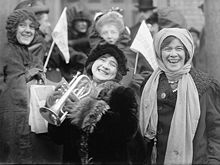
Women's suffrage is the right of women to participate in the election of people's representatives. Includes the right to vote and the right to be elected.
Until the 19th century, women's right to vote was granted locally and, as a rule, was accompanied by additional restrictions (property qualification , position in the family, society, etc.). Then began a period of growing activity of the women's suffrage movement. This led to its consolidation in international law in the middle of the 20th century.
Currently introduced in most countries of the world. New Zealand (1893), Australia (1902) were among the first to introduce women's suffrage, the Grand Duchy of Finland (as part of the Russian Empire , 1906) in Europe, and the Crimean People's Republic (1917) in the Islamic world [1] . Some of the latter are Kuwait (2005), the United Arab Emirates (2006) and Saudi Arabia (2011).
Content
- 1 Women's suffrage in international law
- 2 History
- 3 Women's suffrage movement
- 4 Women's suffrage in the world
- 4.1 Europe
- 4.1.1 Bulgaria
- 4.1.2 UK
- 4.1.3 Germany
- 4.1.4 Greece
- 4.1.5 Denmark
- 4.1.6 Spain
- 4.1.7 Netherlands
- 4.1.8 Norway
- 4.1.9 Poland
- 4.1.10 Portugal
- 4.1.11 Russia
- 4.1.12 Finland
- 4.1.13 France
- 4.1.14 Switzerland
- 4.1.15 Sweden
- 4.2 Asia
- 4.2.1 Azerbaijan
- 4.2.2 Indonesia
- 4.2.3 Kuwait
- 4.2.4 Lebanon
- 4.2.5 Sri Lanka
- 4.2.6 Japan
- 4.3 North America
- 4.3.1 United States of America
- 4.3.2 Canada
- 4.4 Australia and Oceania
- 4.4.1 Australia
- 4.4.2 New Zealand
- 4.1 Europe
- 5 Countries with restrictions on women's suffrage
- 6 years of the introduction of female suffrage
- 7 notes
- 8 Literature
- 9 References
Women's suffrage in international law
Voting rights for women became part of international law in 1948 , when countries of the Organization of American States adopted the Inter-American Convention on the Promotion of the Political Rights of Women [2] , and the United Nations adopted the Universal Declaration of Human Rights . Article 21 [3] of the declaration defines:
 | 1. Everyone has the right to take part in the government of his country, directly or through freely chosen representatives. 2. Everyone has the right to equal access to public service in his country. |  |
Women's suffrage is expressly enshrined in the Convention on the Political Rights of Women [4] and the Convention on the Elimination of All Forms of Discrimination against Women [5] , adopted by the UN in 1952 and 1979, respectively.
History
The patriarchal structure of most communities suggested that women and men perform different social functions, and accordingly gave them different sets of rights and obligations. Women were usually dependent on their father or husband, and therefore their property and civil rights, including the right to vote and to be elected, were often limited [6] .
In different countries, women received voting rights at different times. In many countries, this happened before the introduction of universal suffrage, because of which women of certain races and social status were not able to vote.
In medieval France and some other European countries, city heads had the right to vote heads of families regardless of gender [7] . The origins of the modern women's suffrage movement can be found in France at the end of the 18th century in the works of Antoine Condorcet and Olympia de Gouges , who fought for its introduction nationwide.
From 1718 to 1771 , during the Freedom Era , women's suffrage was introduced in Sweden. It applied only to women in guilds and paying taxes [8] .
Since 1755, the National Assembly of the Corsican Republic, in accordance with the constitution, was elected by all residents older than 25 years, including unmarried or widowed women. Women's suffrage in Corsica was abolished when France annexed the island in 1769. [9]
In 1756, Lydia Taft (née Chapin) became the first woman to receive a vote in America [10] . She used it at least three times during city meetings in Uxbridge , Massachusetts , with the consent of other voters. These events took place from 1756 to 1768 during the Colonial period [11] .
In accordance with the 1776 constitution, New Jersey empowered women with suffrage on an equal basis with men (however property qualifications did not allow married women who did not own property), where all "residents" were declared voters without indicating gender or race. Women of New Jersey, along with “strangers, colored or blacks,” lost their right to vote in 1807 under the pretext of combating election fraud, after which only white men could vote [12] .
In 1838, women's suffrage was introduced on the Pitcairn Islands .
In the second half of the 19th century, many countries, colonies, and states gave women limited suffrage. The beginning was laid by South Australia in 1861 . The territory in which suffrage has been operating since 1869 is Wyoming ( USA ). In 1871, the Paris Commune proclaimed the right to vote for women, but after the defeat of the revolution it was canceled and returned only in July 1944 by Charles de Gaulle (most of France, including the capital, was occupied by Nazi Germany at that time; Paris was only released a month later).
In 1881, the Isle of Man announced the introduction of female suffrage. [13]
The Pacific colony of Franceville declared independence in 1889 , becoming the first independent state in which all citizens had the right to vote, regardless of gender and color (only white men could occupy elected posts) [14] . However, soon enough, the territory again came under the control of France and Great Britain .
In New Zealand , a British colony that enjoyed internal self-government, women gained the right to elect (but not be elected) in the early 1890s. As a result of a campaign organized by Kate Sheppard, women's suffrage in New Zealand was introduced just a few weeks before the general election of 1893. [15] Thanks to this, New Zealand became the first of the current states where women enjoyed equal voting rights with men.
The colony of South Australia , also enjoying internal self-government, gave women the right to elect and be elected to the colonial parliament in 1895 [16] . The Australian Union extended the right to an entire federal state in 1902 (with the exception of indigenous Australian women).
In 1906, women's suffrage came to continental Europe. The first country where women's rights were approved was the Grand Duchy of Finland , at that time part of the Russian Empire . The administrative reform following the 1905 uprising gave Finnish women the right to vote and the right to be elected. The first women in the world elected to parliament also appeared in Finland: 19 women won seats in the Sejm as a result of the 1907 election [17] .
In the years before World War I, women's suffrage was introduced by Norway ( 1913 ) and Denmark , and it was also extended to the remaining states of Australia . Shortly before the end of the war, women received voting rights in Canada , Russia , Germany , Poland , Azerbaijan [18] . British women over 30 were admitted to the elections in 1918 , Dutch women in 1919 . American women, in those states where previously had no right to vote, received it in 1920 . The women of Turkey got the right to vote in 1926 . In 1928, in the territory of the British Empire, women were equalized in suffrage with men, having the opportunity to vote from the age of 21. One of the last states in which female suffrage was introduced was Bhutan in 2008 [19] [20] .
Women's suffrage movement
The struggle for women's suffrage was massive and was fought by both women and men of various views. One of the main differences between the participants of the movement, especially in Britain, was the division into suffragists ( English suffragist ), who sought to change by constitutional means, and suffragettes ( English suffragette ), headed by Emmeline Pankhurst , who created the Social and Political Union of Women in 1903 [21 ] and practicing more radical actions. There were also differences in views on the place of women in society. Some believed that women by nature are better, more tender and more concerned about the situation of unprotected members of society, especially children [22] . In accordance with these views, the participation of women in the elections should lead to a more civilized policy and, in particular, will help to introduce control over the circulation of alcohol [22] [23] . They also believed that the main task of a woman was to maintain a home, and that a woman should be able to influence laws regarding her home. Other participants indicated that women should be fully equated with men, and there is no such thing as a woman’s “natural destiny” [24] . Different opinions were also on the right to vote for other categories of people. Some believed that all adults, regardless of property, gender and race, had the right to vote; others believed that women's suffrage should abolish the right to vote for members of the poor and men with non-white skin color [25] [26] .
Radical changes in women's suffrage are currently expected in Saudi Arabia [27] [28] [29] . The main problem is the specific perception of the role of women by the society of this country [30] .
Women's suffrage in the world
Europe
Bulgaria
There were no special restrictions for Bulgarian women to participate in the elections, however, the country's traditions implied that only men were full citizens. It was not possible to overcome the usual way of society until 1937, when women were able to vote for the first time in local elections, but only “married mothers” got this right. In 1938, women's suffrage was expanded to parliamentary elections, and almost all adults were allowed to vote: “married, widowed, and divorced.” At the same time, women's right remained only active: they were not allowed to participate in the elections as candidates themselves [31] . Women were equalized in rights with men and received all voting rights only in 1944, after the overthrow of the pro-German government [32] .
UK
The women's suffrage movement gained strength in the first half of the 19th century, when women's political activity sharply increased, particularly during the campaign for reform of suffrage in the UK . John Stuart Mill , who was elected to parliament in 1865 and openly supported the empowerment of women with voting rights (his work “ Subjugation of Women ” was soon published), advocated introducing women's suffrage into the Charter . After repeated failure in the purely male parliament under the conservative government, the problem became apparent [33] .
In the second half of the 19th century, several groups were formed to lobby for the interests of women in parliament. In 1897, 17 organizations merged into the National Union of Women's Societies (NUWSS). The union organized meetings, sent letters to politicians, and published various materials. In 1907, the union organized the first mass march, which went down in history as the Mud March , since more than three thousand women had to walk in the cold along the broken streets of London from Hyde Park to Exeter Hall .
In 1903, several organizations broke away from the National Union of Women's Societies, united under the leadership of Emmeline Pankhurst into the Social and Political Union of Women (WSPU). As the national media lost interest in the movement, the newly formed union decided to act by other methods. The new tactic was first used in 1905 during a speech by Sir Edward Gray , a member of the newly created liberal government. During his speech, two activists constantly shouted "Will the liberal government give women the right to vote?" After refusing to stop the noise, the police were called. The suffrages (as the newspapers called them after the incident) resisted and were arrested and charged with assault. They refused to pay a fine and were sent to prison. Shocked British society drew attention to a new way to fight for women's rights.
After informational success, WSPU has increasingly resorted to violent acts. In 1908, suffragettes attempted to break into the House of Commons , set fire to the house of David Lloyd George (despite his support for the introduction of women's suffrage). In 1909, Lady Constance Lytton was imprisoned, but she was quickly released after being identified. Then she began to impersonate the seamstress Jane Wharton and experienced inhuman treatment in the form of forced feeding . In 1913, during the Epsom Derby, Emily Davison ran out in protest in front of a horse belonging to King George V ; falling under the hooves she was seriously injured and died four days later.
During World War I, the WSPU temporarily refused to hold rallies, and its participants, along with everyone, helped the country. NUWSS, in turn, announced the cessation of the political struggle, although secretly continued to lobby for the interests of women. In 1918, after the end of the war, parliament passed a law that opened access to elections for women over 30 who are the head of the family or married to the head of the family or graduated from university [34] [35] . In 1928, when the People's Representation Act was passed, women in the United Kingdom were equalized in voting rights with men. [36]
In 1999, Time magazine, calling Emmeline Pankhurst one of the hundred most influential personalities of the 20th century, wrote:
| ... She shaped the worldview of women of our time; she shook society, changing it forever [37] |
Germany
There was no legal basis for removing women from elections in Germany . For the first time, the question of legislative consolidation of the established practice was posed in 1848, but the decision was not made because the role of the woman was considered obvious. The issue of women's suffrage first reached the Reichstag of the German Empire in 1891 [38] .
The women of Germany gained the right to vote in the elections to the National Assembly on November 30, 1918, and first used it in the general election the following year. However, for a long time, until 1926, two types of ballots were used in elections in the Weimar Republic , separately for men and women [38] . With the advent of the National Socialists, women's suffrage was abolished in 1933 [39] . The restoration of women's rights occurred only in 1948 in West Germany and in 1949 in the GDR [40] .
Greece
The first public demands by Greek women of the right to vote date back to the end of the 19th century: in 1887-88, the slogan "The right to vote for women" was voiced from the pages of the newspaper Ladies Newspaper . In 1921, Prime Minister Dimitrios Gunaris proposed that the National Assembly grant women the right to vote, but it was not approved. In 1924, the National Assembly decided to give women the right to vote in local elections, however, providing for a five-year postponement [41] [42] [43] .
The municipal elections of February 11, 1934 were the first in which women were allowed to vote. However, only literate women over 30 years old got the right to vote. On May 28, 1952, suffrage was extended to all adult women in Greece who first participated in the February 19, 1956 parliamentary elections [41] [42] .
In 1975, equal rights for men and women were first enshrined in the Greek constitution [41] .
Denmark
In 1886, the issue of empowering women was first raised in the Danish Parliament. A law was put forward for consideration by which women could vote in elections to the Copenhagen City Council. The attempt was unsuccessful: the bill was rejected at the preliminary reading. In the future, while the majority in the lower house of parliament were retained by liberals, new bills on women's suffrage were approved, but rejected by the upper house. Finally, in 1908, both houses of parliament supported women's suffrage in local elections. [44]
On April 20, 1909, Danish women voted in municipal elections. At the state level, equality could not be established until the adoption of a new constitution in 1915. After the entry into force of the new law, women took part in the elections to the Rigsdag on June 5, 1915 [44] [45] .
Spain
In the Basque province of Bizkaia, women who paid a special election tax received the right to elect and be elected until the abolition of Basque autonomy [46] .
Женское избирательное право было официально введено в 1931 году при оппозиции Маргариты Нелкен и Виктории Кент, двух женщин в парламенте, утверждавших, что испанские женщины слишком наивны и невежественны, чтобы голосовать ответственно, а это может поставить под угрозу существование Второй республики [47] . При режиме Франко к референдумам (парламентских выборов не существовало, поскольку в стране была установлена диктатура) допускались только женщины, считавшиеся главами семейств [48] . С 1976 года во время перехода Испании к демократии все женщины получили право избирать и быть избранными. Первые парламентские выборы с их участием прошли в 1977 году [49] .
Нидерланды
Впервые вопрос о женском избирательном праве был официально поставлен в 1882 году. Доктор Алетта Якобс , будущий лидер женской ассоциации, направила письмо бургомистру Амстердама , требуя объяснить, почему она не была допущена к выборам. Выяснилось, что, хотя в законе не было прямого указания, к выборам допускаются только мужчины, это подразумевалось. Впоследствии в текст закона была внесена соответствующая поправка, закрепившая дискриминационную норму [50] .
За женское избирательное право в Нидерландах боролась ассоциация «Vereniging voor Vrouwenkiesrecht» (Women's Suffrage Association), созданная в 1894 году. В 1917 году голландские женщины получили право участвовать в национальных выборах, что привело к победе на парламентских выборах 1918 года Сюзи Грёневег от Социал-демократической рабочей партии. Но социалисты, боровшиеся за всеобщее право голоса встретили резкое неприятие со стороны суфражисток, представлявших обеспеченные классы: камнем преткновения стало право голоса женщин низших слоёв общества [51] . В конце концов, стороны пришли к компромиссу, и 15 мая 1919 года был принят новый закон, снявший все ограничения на участие женщин в выборах. Воспользоваться этим правом женщины смогли на всеобщих выборах 1922 года [52] [53] .
Norway
Активная борьба за право голоса для женщин началась в Норвегии в начале 1880-х годов. В 1885 была создана женская ассоциация, усилия которой привели к тому, что Норвегия стала первой суверенной страной, в которой женщины получили право голоса наравне с мужчинами [54] .
Норвежские женщины среднего класса (имевшие определённый уровень дохода) впервые получили право голоса в 1907 году. Всеобщее женское избирательное право вводилось на местных выборах с 1910 года, а 11 июня 1913 году парламент единогласно принял закон, наделявший женщин правом голоса на парламентских выборах [54] [55] .
Poland
Женское движение в Польше носило национально-освободительный характер: по мнению его участниц, путь к равноправию шёл через обретение страной независимости, а до тех пор интересы женщин представлялись второстепенными. Радикальные формы женской активности распространены не были. Кроме того, католическая церковь, проповедовавшая традиционное поведение женщин, также снижала женскую активность. После революции 1905 года в Польше резко возросла политическая активность. В 1907 году был создан Союз равноправия польских женщин, программой которого стало требование избирательного права для всех, без различия пола, национальности и религии [56] .
Женское избирательное право появилось в Польше сразу после обретения независимости от Российской империи в 1917 году. В 1919 году Роза Померантц-Мельтцер стала первой женщиной, избранной в Сейм от Сионистской партии [57] [58] .
Португалия
Каролина Беатриз Ангело стала первой португалкой , получившей право голоса. В 1911 году она добилась права голоса на выборах в парламент Первой Португальской республики , доказав, что является главой семейства. Позднее соответствующий закон был изменён, чтобы явно допустить к участию в выборах только глав семейства мужского пола. В 1931 году при режиме Нового государства было впервые введено женское избирательное право, но только для лиц, окончивших старшую школу или университет, в то время как мужчинам было достаточно умения читать и писать. В 1946 году новый закон о выборах расширил права женщин, но по-прежнему ущемлял их по сравнению с мужчинами. Закон 1968 года провозглашал равные политические права для мужчин и женщин, но в избирательном праве у мужчин имелись некоторые преимущества. После Революции гвоздик в 1974 году женщины получили избирательные права наравне с мужчинами [59] .
Russia
Женское избирательное право в России впервые было введено в 1906 году на территории пользовавшегося широкой автономией Великого княжества Финляндского , но входившего в состав Российской империи .
На остальной территории России женщины получили право только весной 1917 года.
Получение женщинами избирательного права стало результатом деятельности российского женского движения, оказывавшего давление на политиков. Сначала Временное правительство и Советы рабочих и солдатских депутатов посчитали требования женщинами избирательного права несвоевременными и неактуальными и отказались их поддержать. Но 40-тысячная демонстрация женщин 19 марта 1917 года в Петрограде под лозунгами «Свободная женщина в свободной России!», «Без участия женщин избирательное право не всеобщее!», «Место женщины в Учредительном собрании !», митинг участниц демонстрации у Таврического дворца , в котором пришлось принять участие председателю Государственной Думы М. В. Родзянко и председателю Совета рабочих и солдатских депутатов Н. С. Чхеидзе , развёрнутая дискуссия в прессе, переговоры представительниц женских организаций Петрограда и Москвы с министром-председателем Временного правительства князем Г. Е. Львовым привели к желаемому результату [60] . 15 апреля 1917 года Временное правительство приняло постановление «О производстве выборов гласных городских дум, об участковых городских управлениях» [61] , согласно которому избирательными правами наделялись все граждане, достигшие 20 лет, без различия национальности и вероисповедания. 20 июня 1917 года Временное правительство приняло положение о выборах в Учредительное собрание [62] , высший законодательный орган государства, вступившее в силу с 11 сентября 1917 года, в котором было прямо указано о «всеобщем избирательном праве „без различия пола“» [63] . Весной 1917 года прошли выборы в городские думы, в которых женщины смогли принять полноправное участие. Уже в апреле в Вологодскую городскую думу были избраны две женщины-гласные [64] .
После Октябрьской революции в Советской России в 1918 году была принята конституция, закрепившая юридическое равноправие женщин с мужчинами [63] .
Finland
Великое княжество Финляндское было частью Российской империи (1809—1917). Женское движение стало частью общей борьбы за либеральные преобразования в стране, которые включали право голоса не только для женщин, но и для большинства населения (на рубеже XIX и XX веков правом голоса обладали лишь 8 % финнов). После всеобщей забастовки 1905 года Финляндия получила широкую автономию, и в 1906 году учредила однопалатный парламент, наделив мужчин и женщин равными правами избирать и быть избранными. В парламенте первого созыва 19 мест получили женщины [65] . Однако участие женщин в местных выборах оставалось невозможным вплоть до провозглашения независимой Финляндской республики в 1917 году [17] .
France
Организованное женское движение возникло во Франции во время Великой французской революции . Женщины принимали активное участие в революционных выступлениях, создавали собственные организации и выпускали журнал, посвященный борьбе за равенство. В 1791 году Национальному собранию была представлена Декларация прав женщины и гражданки , подготовленная Олимпией де Гуж и требовавшая признания полного социального и политического равноправия женщины. Однако идея женского равноправия была отвергнута, а в конце 1793 прекращена деятельность женских организаций. Возрождение движения произошло в середине XIX века, а в 1882 году появилась Французская лига прав женщин [66] .
Женщины Франции стали полноправными участниками выборов 21 апреля 1944 года по постановлению Французского временного правительства [67] [68] . Первыми выборами, в которых женщины смогли принять участие наравне с мужчинами, стали муниципальные выборы 29 апреля 1945 года и парламентские выборы 21 октября 1945 года. Коренные мусульманки Французского Алжира получили право голоса только по декрету от 3 июля 1958 года [69] [70] .
Switzerland
Референдум о женском избирательном праве был проведён в Швейцарии 1 февраля 1959 года. Большинство швейцарцев проголосовало против, хотя в некоторых кантонах женщины получили поддержку [71] . До 1971 года [71] Швейцария оставалась последней западной республикой , где женщины не имели права голоса (в Лихтенштейне , являющемся конституционной монархией , женское избирательное право было введено только в 1984 году) [72] . Следующий референдум был проведён в 1971 году, в результате которого избирательное право для женщин было одобрено. Однако в некоторых кантонах женщины не имели права голоса на местных выборах и после 1971 года. Последним кантоном, уравнявшим женщин в правах с мужчинами, в 1991 году стал Аппенцелль — Иннерроден [73] .
Sweden
Во время Эры свободы (1718—1771) женщины, состоящие в гильдиях и платящие налоги, получали право голоса. С 1726 по 1742 год они приняли участие в 30 % всех выборов. С 1743 года новая система налогообложения сделала участие женщин в выборах ещё более частым [8] .
Иногда за женщин голосовали представлявшие их мужчины, что являлось одним из аргументов против женского избирательного права. В 1758 году женщин лишили права голоса на городских и местных выборах, позволив им голосовать только на парламентских. В 1771 году, с принятием новой конституции, женщины полностью потеряли право голоса [8] .
В 1862 году вдовам и незамужним женщинам, платящим налоги, вновь позволили голосовать на местных выборах. В 1906 году предложение ввести женское избирательное право на парламентских выборах было отклонено парламентом [74] . Однако в том же году право голоса на муниципальных выборах получили замужние женщины, что ранее исключалось из-за их подчинённости мужьям. В 1909 году женщины получили право избираться в муниципальные советы [74] , и на выборах 1910-11 годов 40 женщин были избраны в местные органы власти [74] . Одной из наиболее известных женщин-политиков того времени была Оливия Нордгрен.
Национальные выборы оставались закрыты для женщин до 1919 года, первое голосование, к которому были допущены женщины, прошло в 1921 году, после 150-летнего перерыва [8] .
В политической жизни Швеции женщины изначально играли заметную роль. Несколько женщин заняли важные посты ещё до 1919 года, например, Ката Дальстрём, первая женщина, возглавившая Социал-демократический комитет (1900), и Анна Стерки, председатель Женского профсоюза (1902—1907).
По результатам выборов 1921 года женщины, среди которых была Керстин Хесселгрен [75] , получили места в шведском парламенте. После выборов 1998 года женщины получили 43 % мест в парламенте, что вывело Швецию на первое место в мире по этому показателю [76] .
Азия
Azerbaijan
После провозглашения 28 мая 1918 года Азербайджанской Демократической Республики в стране за кратчайшие сроки были проведены очень глубокие демократические преобразования, составной частью которых стало предоставление женщинам права избирать и быть избираемыми. Закон о наделении женщин избирательным правом был принят Национальным советом за день до высадки в Баку британских войск под командованием генерала Уильяма Томсона . Азербайджанские женщины стали первыми в исламском мире, получившими право голосовать, и даже опередили в этом плане большинство своих европейских и американских коллег [18] .
Индонезия
В первой половине XX века Голландская Ост-Индия была одной из территорий, где движение за женское избирательное право не находило широкой поддержки. Борьба за права началась в 1905 году, когда в муниципальных советах появились женщины, избранные по некоторым округам. Право голоса имели только грамотные мужчины, из-за чего большинство неевропейцев в выборах не участвовало: в это время грамотными были только 11 % мужчин и 2 % женщин. Наиболее значимой организацией, требовавшей от правительства введения женского избирательного права, была Dutch Vereeninging voor Vrouwenkiesrecht (VVV-Women's Suffrage Association), созданная в 1894 году в Голландии . Участники группы пытались привлечь в свои ряды индонезийцев, но из-за неумения работать с массами их постигла неудача. В 1918 году в колонии появился национальный представительный орган, получивший название Фольксраад , но на выборах в него женщинам право голоса предоставлено не было. В 1935 году колониальная администрация использовала свою власть, чтобы допустить в парламент европейских женщин. В 1938 году администрация ввела право голоса для женщин на городских выборах, в результате чего европейские и индонезийские женщины вошли в составы муниципальных советов. В окончательном варианте закона были упомянуты только европейские женщины и только муниципальные советы, что исключило из выборов остальных женщин и местные советы. В сентябре 1941 года Фольксраад провёл поправку к закону, которая наделила избирательным правом всех женщин независимо от расы. Наконец, в ноябре 1941 года женщины получили право голоса на муниципальных выборах наравне с мужчинами (что подразумевало имущественный и образовательный ценз ). [77] А уже в марте 1942 года Голландская Ост-Индия была оккупирована Японией .
В 1945 году была провозглашена Республика Индонезия . В 1947 году президент Сукарно выпустил декрет, который провозгласил равенство мужчин и женщин, впоследствии закреплённое конституцией. В 1961 году Индонезия ратифицировала соответствующую конвенцию ООН. Однако Сукарно одновременно отмечал, что женщины должны всегда находиться под опекой мужчин. Практически это привело к тому, что до окончания правления Сукарно лишь несколько женщин смогли добиться высокого положения в государственной иерархии страны [78] .
Кувейт
Женское избирательное право в Кувейте было введено поправкой к закону о выборах 17 мая 2005 года [79] . Одним из главных возражений, выдвигаемых консервативными парламентариями, было требование ислама, чтобы во главе нации стоял мужчина, а значит, женщины не должны избираться в законодательные органы. При этом для участия в голосовании никаких препятствий обнаружено не было [80] . После преодоления сопротивления в парламенте, женщинам Кувейта пришлось ожидать ещё четыре года, чтобы полностью реализовать своё право: на выборах 2009 года, после двух неудачных кампаний, четыре женщины были избраны в высший законодательный орган [81] .
Ливан
В Ливане женщины получили право голоса в 1952 году, однако вплоть до 1957 года они, в отличие от мужчин, должны были представить свидетельство о начальном образовании [82] [83] . При этом сдерживающим фактором участия женщин в политике является патриархальное устройство общества и политическая система, основанная на религиозном разделении партий. На общегосударственном уровне женщины становились законодателями только как главы семей, традиционно управляющих Ливаном, в связи с отсутствием наследников-мужчин, притом по состоянию на 2009 год в парламент Ливана за всю его историю было избрано всего 17 женщин. На муниципальном уровне представительство женщин выше в абсолютном выражении, однако практически не меняется в течение многих лет, составляя не более 3 % от общего числа народных представителей [84] [85] .
Шри-Ланка
Шри-Ланка (в то время — Цейлон ) в 1931 году стала первой азиатской страной, наделившей женщин старше 21 года правом голоса [86] . С тех пор женщины играют важную роль в политической жизни страны. В 1960 году премьер-министром Шри-Ланки стала Сиримаво Бандаранаике , первая в мире женщина, занявшая пост главы правительства [87] . Её дочь, Чандрика Кумаратунга , в 1994 году также стала премьер-министром, а затем была избрана президентом страны, став четвёртой женщиной, занявшей подобный пост [88] [89] .
Япония
До 1880-х годов законы Японии явно не запрещали женщинам голосовать. Поскольку общегосударственного представительного органа ещё не существовало, женщины могли участвовать только в местных выборах. «Женский вопрос» был поднят на конференции представителей местных администраций в 1878 году, после чего начались изменения в местном законодательстве в пользу мужчин. Вопрос был закрыт на многие десятилетия 11 февраля 1889 года, когда был принят закон, установивший имущественный ценз и наделивший правом голосовать и избираться только японских мужчин [90] .
В период между Первой и Второй мировыми войнами давление на японских женщин усилилось. В то время как для японских мужчин был отменён имущественный ценз, женщинам было отказано в любой политической активности [90] [91] .
25 августа 1945 года, за несколько дней до оккупации Японии союзными войсками, был сформирован Женский комитет по послевоенному устройству. На собрании комитета 24 сентября 1945 года одним из вопросов стало избирательное право для женщин: голосование с 20 лет и право избираться с 25 лет. Эти требования были поддержаны со стороны оккупационных сил США, что и определило их полное удовлетворение в декабре 1945 года [90] .
North America
Соединённые Штаты Америки
Лидия Тафт (урождённая Чапин) стала первой женщиной Колониальной Америки , получившей право голоса во время трёх городских собраний Новой Англии , начиная с 1756 в Уксбридже , Массачусетс [92] .
После Американской революции женщины имели право голоса в Нью-Джерси с 1790 по 1807 годы, с учётом их имущественного положения. В 1807 году этого права женщины были лишены [12] [93] .
В июне 1848 года Джеррит Смит включил женское избирательное право пунктом в программу Партии свободы . В июле на Конференции в Сенека-Фоллз в северном Нью-Йорке Элизабет Кейди Стэнтон и Лукреция Мотт начали продлившуюся 70 лет борьбу за женское избирательное право (см. Декларация чувств ). В 1850 году Люси Стоун организовала массовую встречу — Национальное собрание по правам женщин в Вустер , Массачусетс . Сьюзен Б. Энтони , уроженка Рочестера , Нью-Йорк, присоединилась к движению в 1852 году, прочитав речь Стоун 1850 года. Активный борец за права женщин, она объездила США и Европу, читая до ста речей ежегодно в течение 45 лет [94] [95] [96] [97] .
Активистки движения указывали, что негры получили право голоса, хотя не были явно упомянуты в тексте Четырнадцатой (равные гражданские права всех «лиц» и право на защиту закона) поправки к Конституции США . В частности, Сьюзен Б. Энтони была арестована за попытку проголосовать. Она отстаивала это право, ссылаясь на Четырнадцатую поправку. Когда в Конгрессе обсуждалась Пятнадцатая поправка (право голоса независимо от расы или предшествовавшего нахождения в рабстве), была сделана попытка распространить её и на женщин, но сделать этого не удалось [98] .
Первые победы в борьбе были одержаны на территориях Вайоминга (1869) [99] и Юты (1870), хотя женщины Юты были лишены права голоса федеральным законом Эдмундса-Такера, принятого Конгрессом в 1887 году. Женское избирательное право в Юте вводилось в надежде, что женщины откажутся от полигамии , однако когда избирательницы полигамию поддержали, они были лишены права голоса [100] . К концу XIX женское избирательное право действовало в штатах Айдахо , Колорадо , Юта и Вайоминг.
Возросшее влияние движения привело к арестам активистов, многие оказались в тюрьмах [101] . Один из наиболее масштабных маршей протеста прошёл на Пенсильвания-авеню и возле Белого дома накануне инаугурации президента Вильсона. Участники марша, от 5 до 8 тысяч человек, подверглись нападениям, оскорблениям и плевкам. В результате чего общественное мнение склонилось в пользу дискриминируемых [102] [103] . В конце концов, президент Вудро Вильсон убедил Конгресс принять законодательный акт, после ратификации в 1920 году ставший Девятнадцатой поправкой , запрещавшей дискриминацию на выборах по половому признаку [104] .
Введение женского избирательного права привело к изменениям результатов выборов, так как женщины голосуют иначе, чем мужчины [105] [106] . На федеральном уровне пятую часть преимущества демократов над республиканцами обеспечивают женщины [105] .
Канада
Вдовы и незамужние женщины имели право голоса на местных выборах в Онтарио с 1884 года. Эта практика была распространена на остальные провинции Канады к концу XIX века, но на провинциальных выборах женщины не голосовали до 1916 года, когда соответствующий закон удалось принять в Манитобе . На федеральном уровне процесс проходил в два этапа: 20 сентября 1917 года женщины получили ограниченное право голоса в соответствии с «Законом о военных избирателях», который позволял голосовать им за близких родственников, находящихся на службе в армии; в начале 1919 года в соответствии с «Законом о распространении избирательного права на женщин» право голоса получили все женщины. Все провинции быстро последовали этому примеру, за исключением Квебека , который принял соответствующий закон только в 1940 году. Первой женщиной, избранной в парламент, в 1921 году стала Агнес Мак-Фейл [107] .
Австралия и Океания
Australia
Первые выборы в парламент только что образованного Австралийского Союза в 1901 году проходили по правилам каждого из шести входивших в него штатов. Таким образом, женщины Южной и Западной Австралии имели право голоса на федеральном уровне. В 1902 году Союз принял собственный закон о выборах, распространив избирательное право на женщин всех штатов [108] . Однако закон не наделил правом голоса аборигенов, которые частично имели его до 1901 года (в выборах в Парламент штатов могли участвовать все, кто проходил по определённому имущественному цензу, хотя среди коренного населения таких было немного). Такое положение сохранялось до 16 декабря 1966 года, когда была принята поправка к закону о выборах (она не была следствием референдума 1967 года, наделившего Парламент Союза полномочиями в вопросах коренного населения) [109] .
Новая Зеландия
Женщины Новой Зеландии боролись за свои права, вдохновлённые Джоном Стюартом Миллем и активностью британских борцов за права женщин. Кроме того, деятельность американского Женского христианского общества трезвости дала им дополнительную мотивацию. Среди мужчин-политиков были те, кто оказывал поддержку движению, в том числе Джон Холл, Роберт Стаут, Юлиус Фогель и Уильям Фокс. В 1878, 1879 и 1887 годах поправки, наделяющие женщин правом голоса, не были приняты при минимальном перевесе противников. В 1893 году реформаторы, наконец, добились успеха. Важную роль в женском движении за право голоса сыграла Кейт Шеппард .
Хотя , принявшее закон, стремилось к социальным и политическим реформам, к нововведению оно относилось настороженно, так как опасалось, что женщины станут поддерживать консервативную партию. Без проблем преодолевая нижнюю палату новозеландского парламента, закон не был в очередной раз остановлен в верхней только благодаря политическим интригам: в последним момент голоса в поддержку женского избирательного права отдали члены парламента, возмутившиеся давлением на законодателей премьер-министра страны. В результате закон был одобрен 20 голосами против 18, а затем был подписан генерал-губернатором и вступил в действие.
Право быть избранными в парламент новозеландские женщины получили только в 1919 году. В 2005 году почти треть мест в законодательном собрании получили женщины. Женщины также заняли высокие посты премьер-министра, генерал-губернатора, спикера палаты представителей и министра юстиции [110] .
Страны с ограничением женского избирательного права
- Бруней — власть в стране сосредоточена в руках султана. Выборы в парламент Брунея отменены, парламентариев назначает султан. Местные выборы проводятся, женщины имеют на них право голоса наравне с мужчинами с 18 лет [111] .
- Саудовская Аравия — абсолютная монархия . На местных выборах женщины также не имеют права голоса. Впервые местные выборы в Саудовской Аравии прошли в 2005 году. Женщины в них не участвовали. В 2009 году ожидалось введение женского избирательного права [27] , однако изменение законодательства пока не проведено [28] [112] . В 2011 году объявлено о разрешении женщинам участвовать в выборах с 2015 года [29] .
- Объединённые Арабские Эмираты — ограниченное избирательное право для мужчин и женщин. На выборах 2011 года только примерно 12 % от общего числа граждан (как мужчин, так и женщин) получили право принять участие в голосовании [113] .
- Ватикан — абсолютная теократическая монархия [114] , управляемая Святым Престолом . Сувереном Святого Престола, в руках которого сосредоточены абсолютная законодательная, исполнительная и судебная власть, является Папа Римский , избирающийся кардиналами на пожизненный срок. Поскольку кардиналом может быть только мужчина, женщины не обладают избирательным правом [115] .
Годы введения женского избирательного права
В списке приведены даты первого введения в странах и на территориях права женщин избирать народных представителей [116] [117] .
Содержимое таблицы можно отсортировать по годам или алфавиту с помощью иконки .
| A country | Year | Age |
|---|---|---|
| Australia | 1902 | 18 years |
| Austria | 1918 | 16 years |
| Azerbaijan | 1918 | 18 years |
| Albania | 1920 | 18 years |
| Algeria | 1962 | 18 years |
| Виргинские Острова (США) | there is no data | 18 years |
| Американское Самоа | 1990 | 18 years |
| Ангилья | 1951 | 18 years |
| Ангола | 1975 | 18 years |
| Андорра | 1970 | 18 years |
| Антигуа и Барбуда | 1951 | 18 years |
| Макао | there is no data | 18 years |
| Argentina | 1947 | 18 years |
| Armenia | 1921 | 18 years |
| Аруба | there is no data | 18 years |
| Afghanistan | 1963 | 18 years |
| Багамские Острова | 1960 | 18 years |
| Bangladesh | 1972 | 18 years |
| Барбадос | 1950 | 18 years |
| Бахрейн | 2002 | 18 years |
| Белиз | 1954 | 18 years |
| Belarus | 1919 | 18 years |
| Belgium | 1919/1948 [п 1] . | 18 years |
| Бенин | 1956 | 18 years |
| Бермуды | 1944 | 18 years |
| Bulgaria | 1944 | 18 years |
| Боливия | 1938 | 18 years |
| Bosnia and Herzegovina | 1949 | 18 years |
| Ботсвана | 1965 | 18 years |
| Brazil | 1931 | 16 years |
| Виргинские Острова (Великобритания) | there is no data | 18 years |
| Brunei | 1959 | 18 лет [п 2] |
| Буркина-Фасо | 1958 | 18 years |
| Бурунди | 1961 | 18 years |
| Бутан | 1953 | 18 years |
| Vanuatu | 1975 | 18 years |
| United Kingdom | 1918 | 18 лет [п 3] |
| Hungary | 1918 | 18 years |
| Venezuela | 1946 | 18 years |
| East Timor | there is no data | 17 years |
| Vietnam | 1946 | 18 years |
| Габон | 1956 | 21 years |
| Гаити | 1950 | 18 years |
| Гайана | 1953 | 18 years |
| Гамбия | 1960 | 18 years |
| Гана | 1954 | 18 years |
| Guatemala | 1946 | 18 years |
| Гвинея | 1958 | 18 years |
| Гвинея-Бисау | 1977 | 18 years |
| Germany | 1918 | 18 years |
| Гернси | there is no data | 18 years |
| Гибралтар | there is no data | 18 years |
| Гондурас | 1955 | 18 years |
| Hong Kong | 1949 | 18 years |
| Гренада | 1951 | 18 years |
| Гренландия | there is no data | 18 years |
| Greece | 1952 | 18 years |
| Georgia | 1918 | 18 years |
| Гуам | there is no data | 18 years |
| Denmark | 1915 | 18 years |
| Демократическая Республика Конго | 1967 | 18 years |
| Jersey | there is no data | 16 years |
| Джибути | 1946 | 18 years |
| Доминика | 1951 | 18 years |
| Dominican Republic | 1942 | 18 years |
| Egypt | 1956 | 18 years |
| Zambia | 1962 | 18 years |
| Зимбабве | 1957 | 18 years |
| Israel | 1948 | 18 years |
| India | 1947 | 18 years |
| Indonesia | 1945 | 17 лет [п 4] |
| Иордания | 1974 | 18 years |
| Ирак | 1980 | 18 years |
| Iran | 1963 | 16 years |
| Ireland | 1918 | 18 years |
| Iceland | 1915 | 18 years |
| Spain | 1931 | 18 years |
| Italy | 1946 | 18 лет [п 5] |
| Йемен | 1967 | 18 years |
| Кабо-Верде | 1975 | 18 years |
| Kazakhstan | 1924 | 18 years |
| Острова Кайман | there is no data | 18 years |
| Cambodia | 1955 | 18 years |
| Cameroon | 1946 | 20 years |
| Canada | 1917 | 18 years |
| Катар | 1997 | 18 years |
| Kenya | 1963 | 18 years |
| Cyprus | 1960 | 18 years |
| Киргизия | 1918 | 18 years |
| Kiribati | 1967 | 18 years |
| China | 1949 | 18 years |
| Republic of China | 1947 | 20 years |
| Coconut islands | there is no data | 18 years |
| Colombia | 1954 | 18 years |
| Comoros | 1956 | 18 years |
| DPRK | 1946 | 17 years |
| Costa Rica | 1949 | 18 years |
| Cote d'Ivoire | 1952 | 19 years |
| Cuba | 1934 | 16 years |
| Kuwait | 2005 | 21 years |
| The Republic of Korea | 1948 | 19 years |
| Chad | 1958 | 18 years |
| Chile | 1935 | 18 years |
| Republic of the Congo | 1963 | 18 years |
| Cook Islands | 1893 | 18 years |
| Croatia | 1945 | 18 years |
| Czech | 1920 | 18 years |
| Ecuador | 1929 | 18 years |
| Salvador | 1939 | 18 years |
| Equatorial Guinea | 1963 | 18 years |
| Eritrea | 1993 | 18 years |
| Ethiopia | 1955 | 18 years |
| Falkland Islands | 1984 | 18 years |
| Faroe Islands | there is no data | 18 years |
| Fiji | 1963 | 21 years |
| Finland | 1906 | 18 years |
| France | 1944 | 18 years |
| French polynesia | there is no data | 18 years |
| Vatican | no | no [n 6] |
| Jamaica | 1944 | 18 years |
| Japan | 1945 | 20 years |
| Laos | 1958 | 18 years |
| Latvia | 1918 | 18 years |
| Lebanon | 1952 | 21 years old [n 7] |
| Lesotho | 1965 | 18 years |
| Liberia | 1946 | 18 years |
| Libya | 1964 | 18 years |
| Liechtenstein | 1984 | 18 years |
| Lithuania | 1918 | 18 years |
| Luxembourg | 1919 | 18 years |
| North Macedonia | 1946 | 18 years |
| Madagascar | 1959 | 18 years |
| Malawi | 1961 | 18 years |
| Malaysia | 1957 | 21 years |
| Maldives | 1932 | 21 years |
| Mali | 1956 | 18 years |
| Malta | 1947 | 18 years |
| Marshall Islands | 1979 | 18 years |
| Mauritania | 1961 | 18 years |
| Mauritius | 1956 | 18 years |
| Mayotte | there is no data | 18 years |
| Mexico | 1947 | 18 years |
| Micronesia | 1979 | 18 years |
| Moldova | 1940 | 18 years |
| Monaco | 1962 | 18 years |
| Mongolia | 1924 | 18 years |
| Montenegro | there is no data | 18 years |
| Montserrat | there is no data | 18 years |
| Morocco | 1963 | 18 years |
| Mozambique | 1975 | 18 years |
| Myanmar | 1922 | 18 years |
| Namibia | 1989 | 18 years |
| Nauru | 1968 | 20 years |
| Nepal | 1951 | 18 years |
| Netherlands | 1919 | 18 years |
| Netherlands Antilles | there is no data | 18 years |
| New caledonia | there is no data | 18 years |
| New Zealand | 1893 | 18 years |
| Nicaragua | 1955 | 16 years |
| Niger | 1948 | 18 years |
| Nigeria | 1958 | 18 years |
| Niue | there is no data | 18 years |
| Norfolk Island | there is no data | 18 years |
| Northern Mariana Islands | there is no data | 18 years |
| Norway | 1913 | 18 years |
| Oman | 2003 | 21 years |
| Isle Of Man | 1881 | 16 years |
| Pakistan | 1947 | 18 years |
| Palau | 1979 | 18 years |
| Panama | 1941 | 18 years |
| Papua New Guinea | 1964 | 18 years |
| Paraguay | 1961 | 18 years |
| Peru | 1955 | 18 years |
| Philippines | 1937 | 18 years |
| Pitcairn Islands | 1838 | 18 years |
| Poland | 1918 | 18 years |
| Portugal | 1931 | 18 years |
| Puerto rico | 1929 | 18 years |
| Romania | 1938 | 18 years |
| Russia | 1917 | 18 years |
| Rwanda | 1961 | 18 years |
| Saint Barthelemy | there is no data | 18 years |
| Islands of St. Helena, Ascension and Tristan da Cunha | there is no data | there is no data |
| Saint Kitts and Nevis | 1951 | 18 years |
| Saint lucia | 1924 | 18 years |
| Saint martin | there is no data | 18 years |
| Saint Pierre and Miquelon | there is no data | 18 years |
| Saint Vincent and the Grenadines | 1951 | 18 years |
| Samoa | 1990 | 21 years |
| San marino | 1959 | 18 years |
| Sao Tome and Principe | 1975 | 18 years |
| Saudi Arabia | 2011 | 21 years |
| Senegal | 1945 | 18 years |
| Serbia | 1945 | 18 years |
| Seychelles | 1948 | 17 years |
| Sierra leone | 1961 | 18 years |
| Singapore | 1947 | 21 years |
| Slovakia | 1920 | 18 years |
| Slovenia | 1945 | 18 years old [n 8] |
| Solomon islands | 1974 | 21 years |
| Somalia | 1956 | 18 years |
| CAR | 1986 | 21 years |
| South Africa | 1930; 1994 [n 9] | 18 years |
| Sri Lanka | 1931 | 18 years |
| Sudan | 1964 | 17 years |
| Suriname | 1948 | 18 years |
| Swaziland | 1968 | 18 years |
| Sweden | 1919 | 18 years |
| Switzerland | 1971 | 18 years |
| Syria | 1949 | 18 years |
| Tajikistan | 1924 | 18 years |
| Tanzania | 1959 | 18 years |
| Thailand | 1932 | 18 years |
| Togo | 1945 | 18 years |
| Tokelau | there is no data | 21 years |
| Tonga | 1960 | 21 years |
| Trinidad and Tobago | 1946 | 18 years |
| Tunisia | 1959 | 18 years |
| Turkey | 1930 | 18 years |
| Turkmenistan | 1924 | 18 years |
| Turks and Caicos Islands | there is no data | 18 years |
| Tuvalu | 1967 | 18 years |
| Uganda | 1962 | 18 years |
| Ukraine | 1919 | 18 years |
| UAE | 2006 | there is no data |
| USA | 1920 | 18 years |
| Uruguay | 1927 | 18 years |
| Uzbekistan | 1924 [119] | 18 years |
| Wallis and Futuna | 2001 | 18 years |
| Estonia | 1919 [p 10] | 18 years |
| Yugoslavia | 1945 | 18 years |
Notes
- Comments
- ↑ The right to vote for certain categories of women was introduced in 1919. In 1920, women were allowed to vote in municipal elections. Universal women's suffrage was introduced in 1948 [118] .
- ↑ Voting is conducted only in local elections.
- ↑ Until 1928, there was an age limit of 30 years and other restrictions.
- ↑ Married women have the right to vote, regardless of age.
- ↑ You can vote in the Senate elections from the age of 25, and run from 40 years of age (Article 58 of the Constitution ).
- ↑ Only cardinals have the right to vote, women are prohibited from being cardinals.
- ↑ Women's suffrage is limited by educational qualifications.
- ↑ For workers - 16 years.
- ↑ In 1930, women of the white race received suffrage, in 1994 - black women.
- ↑ The right to vote was introduced in 1919. It was abolished in 1934. Restored in 1940.
- Sources
- ↑ 100 rokіv samovryaduvannya: Yakim Buv first Kurultay krimskotarskogo people (Ukrainian) . Radio Liberty. Date of treatment November 7, 2018.
- ↑ Inter-American Convention on the Granting of Political Rights to Women . Department of International Law. Date of treatment March 11, 2013. Archived March 12, 2013.
- ↑ Universal Declaration of Human Rights on the UN website.
- ↑ Convention on the Political Rights of Women on the UN website.
- ↑ Convention on the Elimination of All Forms of Discrimination against Women on the UN website.
- ↑ Mill, John Stuart. The Subjection of Women. - Dover Thrift Editions, 1997 .-- P. v. - ISBN 0-486-29601-6 .
- ↑ Pernoud, Régine. La Femme Au Temps Des Cathédrales (Fr.) . - 1984 .-- 304 s. - ISBN 2234017653 .
- ↑ 1 2 3 4 Åsa Karlsson-Sjögren. Männen, kvinnorna och rösträtten: medborgarskap och representation 1723-1866 (Swedish) . - 2006. - 239 p.
- ↑ Ottaviani, Thierry. La Corse pour les Nuls (Fr.) . - 2010 .-- S. 46. - 516 p. - ISBN 978-2754015462 .
- ↑ Chapin, Judge Henry. Address Delivered at the Unitarian Church in Uxbridge; 1864. - Worcester, Mass. : Charles Hamilton Press (Harvard Library; from Google Books), 2081.
- ↑ "Uxbridge Breaks Tradition and Makes History: Lydia Chapin Taft by Carol Masiello" . The Blackstone Daily. Date of treatment September 29, 2007. Archived August 14, 2011.
- ↑ 1 2 Klinghoffer, Judith Apter; Elkis, Lois. "The Petticoat Electors": Women's Suffrage in New Jersey, 1776-1807. - 1992. - Vol. 12, no. 2 .
- ↑ 125th Anniversary of Women's Suffrage on the Isle of Man . myGov.im (October 10, 2006). Date of treatment March 11, 2013. Archived March 12, 2013.
- ↑ "Wee, Small Republics: A Few Examples of Popular Government," Hawaiian Gazette , Nov 1, 1895, p1
- ↑ Aikman, Colin Campbell. History, Constitutional // An Encyclopaedia of New Zealand / McLintock, Alexander H. .. - Wellington, NZ: RE Owen, Government Printer, 1966. - Vol. 2. - P. 67-75.
- ↑ Constitution (Female Suffrage) Act 1895 (SA) . National Archives of Australia. Date of treatment December 10, 2007. Archived on August 14, 2011.
- ↑ 1 2 Country Report Finland . Archived March 12, 2013.
- ↑ 1 2 Swietochowski, Tadeusz. Russian Azerbaijan, 1905-1920: The Shaping of a National Identity in a Muslim Community . - Cambridge University Press, 2004 .-- P. 144. - 272 p. - ISBN 0521522455 .
- ↑ CIA - The World Factbook - Bhutan . Date of treatment March 12, 2013.
- ↑ In Bhutan, the first ever elections to the lower house of parliament Began . RIA Novosti (March 24, 2008). Date of treatment March 12, 2013. Archived March 16, 2013.
- ↑ New Statesman - The real Mrs Pankhurst . Archived March 21, 2013.
- ↑ 1 2 Parker, Mary Elizabeth. Surviving Change: It Wasnt Going to Be Love At First Sight When These Two Souls Met, But Their Journey Will Take a Lifetime . - AuthorHouse, 2009. - P. 41. - ISBN 1438990251 .
- ↑ Goldstein, Joel H. The Effects of the Adoption of Woman Suffrage: Sex Differences in Voting Behavior - Illinois, 1914-21. - Praeger, 1984. - P. 59. - 252 p. - ISBN 003064187X .
- ↑ Garner, Les. Stepping Stones to Women's Liberty: Feminist Ideas in the Women's Suffrage Movement, 1900-1918 . - Fairleigh Dickinson Univ Press, 1984. - 142 p. - ISBN 0838632238 .
- ↑ Terborg-Penn, Rosalyn. African American Women in the Struggle for the Vote: 1850 - 1920 .-- Indiana University Press, 1998 .-- 192 p. - ISBN 025321176X .
- ↑ Gordon, Ann Dexter; Collier-Thomas, Betty. African American Women and the Vote, 1837-1965. - Univ of Massachusetts Press, 1997 .-- 217 p. - ISBN 1558490590 .
- ↑ 1 2 Women voters will have to wait until 2009 . Archived March 21, 2013.
- ↑ 1 2 At least 2 years wait . Archived March 21, 2013.
- ↑ 1 2 Women of Saudi Arabia gained the right to vote . DELFI (September 25, 2011). Date of treatment March 17, 2013. Archived March 21, 2013.
- ↑ Saudi's Small Steps . Time Archived March 21, 2013.
- ↑ Women's Movements: Networks and Debates in Post-communist Countries in the 19th and 20th Centuries / Edith Saurer, Margareth Lanzinger, Elisabeth Frysak .. - Böhlau Verlag Köln Weimar, 2006 .-- P. 425. - 528 p. - ISBN 3412322059 .
- ↑ The Struggle for Female Suffrage in Europe: Voting to Become Citizens ( Blanca Rodriguez Ruiz, Ruth Rubio-Marín .. - BRILL, 2012 .-- P. 335. - 500 p. - ISBN 9004224254 .
- ↑ Mill, John Stuart // Brockhaus and Efron Encyclopedic Dictionary : in 86 volumes (82 volumes and 4 additional). - SPb. , 1890-1907.
- ↑ PlanetPapers - The Growth of Democracy . Archived March 21, 2013.
- ↑ Great Britain (state) // Great Soviet Encyclopedia : [in 30 vol.] / Ch. ed. A.M. Prokhorov . - 3rd ed. - M .: Soviet Encyclopedia, 1969-1978.
- ↑ Poulsen, Charles. English rebels .
- ↑ Emmeline Pankhurst - Time 100 People of the Century . Time Magazine - "She shaped an idea of women for our time; she shook society into a new pattern from which there could be no going back. ". Archived on August 14, 2011.
- ↑ 1 2 Home - Lomonosov (Unavailable link) . Date of treatment March 9, 2013. Archived on April 8, 2014.
- ↑ d'Almeida, Fabrice. La vie mondaine sous le nazisme. - 2008.
- ↑ Germany - Status of Women . Archived March 12, 2013.
- ↑ 1 2 3 Country Report Greece . Date of treatment March 8, 2013. Archived March 12, 2013.
- ↑ 1 2 Women's Suffrage: An International Timeline . DePaul University. Date of treatment March 8, 2013. Archived March 12, 2013.
- ↑ Greece: Country Report . Date of treatment March 8, 2013. Archived March 12, 2013.
- ↑ 1 2 How Danish women got the vote . kvinfo.dk. Date of treatment March 8, 2013. Archived March 12, 2013.
- ↑ Country Report Denmark . European Database: Women in Decision-making. Date of treatment March 8, 2013. Archived March 12, 2013.
- ↑ Herbert, Henry. Portugal and Gallicia: with a review of the social and political state of the Basque Provinces: and a few remarks on recent events in Spain. - 1836. - Vol. 2.
- ↑ ¿Qué pasó entre Clara Campoamor y Victoria Kent hace 80 años? (Spanish) . Date of treatment March 9, 2013. Archived March 12, 2013.
- ↑ Sufragio Femenino en España . Archived March 21, 2013.
- ↑ Country Report Spain . Archived March 12, 2013.
- ↑ Women suffrage . www.alettajacobs.org. Archived March 12, 2013.
- ↑ Country Report Netherlands . Archived March 12, 2013.
- ↑ Rappaport, Helen. Encyclopedia of women social reformers. - 2001 .-- P. 329-331. - 888 p. - ISBN 1576071014 .
- ↑ Ruiz BR, Marín RR The Struggle for Female Suffrage in Europe: Voting to Become Citizens. - 2012. - 500 p. - ISBN 9004224254 .
- ↑ 1 2 Centenary of Women's Right to Vote in Norway 1913-2013 . Archived March 12, 2013.
- ↑ Country Report Norway . Archived March 12, 2013.
- ↑ Nikolaenko O. Comparative analysis of the Russian and Polish women’s movements in the second half of the 19th – beginning of the 20th centuries: historiographic review .
- ↑ Davies, Norman. God's Playground: A History of Poland. - Columbia University Press, 1982. - P. 302.
- ↑ Strauss, Herbert Arthur. Hostages of Modernization: Studies on Modern Antisemitism, 1870-1933 / 39. - Walter de Gruyter, 1993 .-- P. 985.
- ↑ Country Report Portugal . European Database: Women in Decision-making. Archived March 12, 2013.
- ↑ Yukina I.I. Russian feminism as a challenge of our time. - SPb. : Aletheia, 2007 .-- 539 p. - ISBN 978-5-903354-21-4 .
- ↑ About the election of vowels of city councils, about precinct city administrations . Date of treatment April 23, 2013. Archived on April 28, 2013.
- ↑ Regulation on Elections to the Constituent Assembly . Date of treatment April 23, 2013.
- ↑ 1 2 Feminism in Russia // Encyclopedia " Circumstances of the World ".
- ↑ Yukina, Irina. The electoral rights of Russian women as a historiographic problem . Archived March 12, 2013.
- ↑ In Finland, 110 years ago, universal and equal suffrage was introduced. // © Yle Uutiset = Yle News Service. = Website of the television and radio company Yleisradio Oy (yle.fi) June 1, 2016. (Retrieved June 1, 2016)
- ↑ Women's movement // Great Soviet Encyclopedia : [in 30 vol.] / Ch. ed. A.M. Prokhorov . - 3rd ed. - M .: Soviet Encyclopedia, 1969-1978.
- ↑ Ordonnance du 21 avril 1944 relative à l'organization des pouvoirs publics en France après la Libération . Archived March 21, 2013.
- ↑ Assemblée nationale. La citoyenneté politique des femmes - La décision du Général de Gaulle (French) . Date of treatment December 19, 2007. Archived on August 14, 2011.
- ↑ Patrick Weil. Le statut des musulmans en Algérie coloniale. Une nationalité française dénaturée. (Fr.) . in La Justice en Algérie 1830-1962 , La Documentation française, Collection Histoire de la Justice, Paris, 2005, pp. 95-109. Date of treatment December 19, 2007. Archived on August 14, 2011.
- ↑ Daniel Lefeuvre. 1945-1958: un million et demi de citoyennes interdites de vote! (Fr.) . Clio, numéro 1/1995, Résistances et Libérations France 1940-1945 (26 mars 2003). Date of treatment December 19, 2007. Archived on August 14, 2011.
- ↑ 1 2 The Long Way to Women's Right to Vote in Switzerland: a Chronology
- ↑ Liechtenstein Women Win Right to Vote . New York Times. Archived March 21, 2013.
- ↑ EXPERTS IN WOMEN'S ANTI-DISCRIMINATION COMMITTEE RAISE QUESTIONS CONCERNING REPORTS OF SWITZERLAND ON COMPLIANCE WITH CONVENTION . Archived March 21, 2013.
- ↑ 1 2 3 417-418 (Nordisk familjebok / Uggleupplagan. 15. Kromat - Ledvätska)
- ↑ Nordisk familjebok . - P. 383–384.
- ↑ Country Report Sweden . Archived March 12, 2013.
- ↑ Blackburn, Susan, 'Winning the Vote for Women in Indonesia' Australian Feminist Studies , Volume 14, Number 29, April 29, 1 April 1999, pp. 207–218
- ↑ Sitasari, Arnita. The Future of Women in Indonesian Politics. - 2007. - P. 24-26. - 93 p. - ISBN 0549995420 .
- ↑ Kuwaiti women win right to vote . BBC news (17 May 2005). Date of treatment March 17, 2013. Archived March 21, 2013.
- ↑ Lawmakers Block Women From Voting in Kuwait . New York Times. Archived March 12, 2013.
- ↑ Woman elected in Kuwait says gender in politics is 'history' . CNN (May 17, 2009). Date of treatment March 10, 2013. Archived March 12, 2013.
- ↑ Nohlen D. , Grotz F. , Hartmann C. Elections in Asia and the Pacific: A Data Handbook: Volume I: Middle East, Central Asia, and South Asia . - OUP Oxford, 2001 .-- S. 174. - ISBN 9780191530418 .
- ↑ United Nations. Dept. of Economic , Social Affairs , United Nations Commission on the Status of Women. Civic and Political Education of Women . - UN, 1964. - S. 65. - (United Nations. [Document] E / CN.6 / 405 / rev.1).
- ↑ A Woman's Place, in Lebanon (July 2, 2009). Date of appeal September 21, 2016.
- ↑ Mona Chemali Khalaf. Women's Rights in the Middle East and North Africa: Progress Amid Resistance: Lebanon (2010).
- ↑ Rappaport, Helen. Encyclopedia of women social reformers. - 2001. - P. 181. - 888 p. - ISBN 1576071014 .
- ↑ Rappaport, Helen. Encyclopedia of women social reformers. - 2001. - P. 806. - 888 p. - ISBN 1576071014 .
- ↑ BBC Profile: Chandrika Kumaratunga , BBC News (August 26, 2005).
- ↑ Chandrika . Archived March 12, 2013.
- ↑ 1 2 3 Mackie, Vera. Feminism in Modern Japan: Citizenship, Embodiment and Sexuality . - 2003. - P. 19. - 293 p. - ISBN 052152719.
- ↑ Women's Suffrage in Japan in the 20th Century . Date of treatment March 10, 2013. Archived March 12, 2013.
- ↑ Chapin, Judge Henry. Address Delivered at the Unitarian Church in Uxbridge, 1864 . - Worcester, Massachusetts: Charles Hamilton Press (Harvard Library; from Google Books), 1881. - P. 172.
- ↑ Woman suffrage . Collier's New Encyclopedia. 1921.
- ↑ Wellman, Judith. The Road to Seneca Falls . - University of Illinois Press, 2004. - ISBN 0-252-02904-6 .
- ↑ Claflin, Alta Blanche. Political parties in the United States 1800–1914 . - New York Public Library, 1915. - P. 50.
- ↑ Women in Government . ABC-Clio (2013). Date of treatment January 23, 2013. Archived March 12, 2013.
- ↑ Hays, Elinor Rice. Morning Star: A Biography of Lucy Stone 1818–1893 . - Harcourt, Brace & World, 1961 .-- P. 88.
- ↑ A History of Women in America . - Random House Digital, Inc., 2011 .-- P. 83.
- ↑ An Act to Grant to the Women of Wyoming Territory the Right of Suffrage and to Hold Office . Archived March 21, 2013.
- ↑ Van Wagenen, Lola. Sister-Wives and Suffragists: Polygamy and the Politics of Woman Suffrage 1870-1896. - BYU Studies, 2001.
- ↑ Stevens et al. Jailed for Freedom: American Women Win the Vote. - 1995. - 224 p. - ISBN 0939165252 .
- ↑ The Suffrage Movement . (English) // The Time, 08/12/2011
- ↑ Springfield Republican . October 24, 1915
- ↑ Suffrage Wins in Senate; Now Goes to States (Neopr.) . - The New York Times, 1919. - 5 June.
- ↑ 1 2 Lott, John; Kenny, Lawrence. Did Women's Suffrage Change the Size and Scope of Government? (English) // Journal of Political Economy. - 1999. - Vol. 107, no. 6 . - P. 1163-1198.
- ↑ Schmidt, Steffen; Röser, Sabrina. Politische Partizipation von Frauen (German) . Bundeszentrale für politische Bildung (10. Juni 2011). Archived on April 28, 2013.
- ↑ History of Women Suffrage in Canada - Marianopolis College . Archived March 21, 2013.
- ↑ The Right to Vote in Australia - Australian Electoral Commission . Aec.gov.au (November 26, 2007). Date of treatment April 19, 2011. Archived March 12, 2013.
- ↑ Australian Government Policy in relation to Aboriginal People . Date of treatment March 23, 2013. Archived on April 5, 2013.
- ↑ New Zealand women and the vote . New Zealand History online. Archived March 12, 2013.
- ↑ CIA - The World Factbook - Brunei .
- ↑ Hello, democracy - and goodbye . Archived March 21, 2013.
- ↑ UAE expands voting rights for some . Globalpost Archived March 21, 2013.
- ↑ Theocracy // Political Science. Dictionary. - M: RSU. V.N. Konovalov. 2010.
- ↑ In Which Countries are Women Not Allowed to Vote? . Archived March 12, 2013.
- ↑ A World Chronology of the Recognition of Women's Rights to Vote and to Stand for Election . Date of treatment February 24, 2010. Archived on August 14, 2011.
- ↑ CIA - The World Fact Book - Suffrage (inaccessible link) . Date of treatment March 18, 2013. Archived January 9, 2008.
- ↑ 60 years ago Belgian women got right to vote for Parliament . vrtnws.be (June 26, 2009). Date of treatment January 15, 2019.
- ↑ Arabella Lyon. Deliberative Acts: Democracy, Rhetoric, and Rights . - Penn State Press, 2013-04-26. - S. 177. - 232 p. - ISBN 027106224X .
))
Literature
- Emancipation of women // Brockhaus and Efron Encyclopedic Dictionary : in 86 volumes (82 volumes and 4 additional). - SPb. , 1890-1907.
- Mill, John Stuart. The Subjection of Women. - 1997. - ISBN 0486296016 .
- Åsa Karlsson-Sjögren. Männen, kvinnorna och rösträtten: medborgarskap och representation 1723-1866 (Swedish) . - 2006. - 239 p.
- Parker, Mary Elizabeth. Surviving Change: It Wasnt Going to Be Love At First Sight When These Two Souls Met, But Their Journey Will Take a Lifetime . - AuthorHouse, 2009 .-- ISBN 1438990251 .
- Goldstein, Joel H. The Effects of the Adoption of Woman Suffrage: Sex Differences in Voting Behavior - Illinois, 1914-21. - Praeger, 1984. - 252 p. - ISBN 003064187X .
- Garner, Les. Stepping Stones to Women's Liberty: Feminist Ideas in the Women's Suffrage Movement, 1900-1918 . - Fairleigh Dickinson Univ Press, 1984. - 142 p. - ISBN 0838632238 .
- Terborg-Penn, Rosalyn. African American Women in the Struggle for the Vote: 1850 - 1920 .-- Indiana University Press, 1998 .-- 192 p. - ISBN 025321176X .
- Gordon, Ann Dexter; Collier-Thomas, Betty. African American Women and the Vote, 1837-1965. - Univ of Massachusetts Press, 1997 .-- 217 p. - ISBN 1558490590 .
- d'Almeida, Fabrice. La vie mondaine sous le nazisme. - 2008.
- Sitasari, Arnita. The Future of Women in Indonesian Politics. - 2007. - 93 p. - ISBN 0549995420 .
- Herbert, Henry. Portugal and Gallicia: with a review of the social and political state of the Basque Provinces: and a few remarks on recent events in Spain. - 1836. - Vol. 2.
- Ruiz BR, Marín RR The Struggle for Female Suffrage in Europe: Voting to Become Citizens. - 2012. - 500 p. - ISBN 9004224254 .
- Yukina I.I. Russian feminism as a challenge of our time. - SPb. : Aletheia, 2007 .-- 539 p. - ISBN 978-5-903354-21-4 .
- Wellman, Judith. The Road to Seneca Falls . - University of Illinois Press, 2004. - ISBN 0-252-02904-6 .
- Van Wagenen, Lola. Sister-Wives and Suffragists: Polygamy and the Politics of Woman Suffrage 1870-1896. - BYU Studies, 2001.
- Stevens et al. Jailed for Freedom: American Women Win the Vote. - 1995. - 224 p. - ISBN 0939165252 .
- Mackie, Vera. Feminism in Modern Japan: Citizenship, Embodiment and Sexuality . - 2003. - 293 p. - ISBN 052152719.