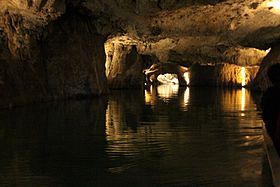
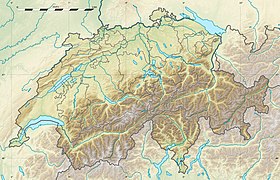
Underground Lake Saint-Leonard ( Fr. Lac souterrain de Saint-Léonard ) - the largest natural underground lake in Europe . Located in the commune of Saint-Leonard , in the Swiss canton of Valais . Surface area - 6000 m². Altitude - 509 m.
| Lake | |
| Saint Leonard | |
|---|---|
| fr Lac souterrain de saint-leonard | |
 | |
| Morphometry | |
| Absolute height | 509 m |
| Dimensions | 0.26 × 0.014 - 0.029 km |
| Square | 0.006 km² |
| Deepest | 13 m |
| Average depth | 4 m |
| Location | |
| A country |
|
| Canton | Valais |
| District | Saint Leonard |


The total length of the cave in which the lake is located is 300 m, the lake itself is 260 m, the average width is 14 m, the maximum is 29 m. The water temperature is constant and equal to 11 °, air - 15 °. The vault thickness increases from 30 m near the entrance to 70 m deep in the grotto [1] .
Content
History
Although written sources testifying to this do not exist, the locals had long known a mountain cave filled with water. Winemakers used cold underground water to cool their drinks. The lake was first explored by cavers under the leadership of Jean-Jacques Pittard ( Fr. Jean-Jacques Pittard ) in 1943. They crossed it in an inflatable boat and landed on the opposite shore from the entrance. The following year, a complete topographic survey of the cave was made [2] .
Until 1946, the water level was significantly higher than at present, the distance from the surface of the water to the arch of the cave was only 50 cm [3] . During an earthquake on January 25, 1946 with a magnitude of 5.6, new cracks appeared in the cave, through which part of the water left the lake, which led to a decrease in the level. Over time, cracks were plugged with clay and gypsum particles dissolved in water [2] .
Since 1949, the lake is open to visitors from mid-March to late October. Half-hour excursion is conducted in English , French , German and Italian [4] .
In 2000, a boulder weighing about 2 tons fell from the ceiling of the cave. A geological survey showed that the cave arches are unstable and there is a risk of collapse. The lake was closed to the public. At this time, work was carried out to strengthen the arches. The lake was drained, a special elevator was built, with the help of which construction equipment sank to the bottom of the cave. The walls were reinforced with special bolts and on June 16, 2003, the underground lake was reopened to visitors [3] .
Geology
The mountains in which the cave is located consist of rocks of the Carboniferous period - shales , graphite , quartzite . The cave was formed in a gypsum bed in the Triassic period , that is, about 240 million years ago.
- Central part: gypsum and anhydrite with a large number of inclusions of other minerals and impurities: sedimentary tuff , travertine , cellular limestone , gneiss , granite , anthracite , iron , limestone , dolomite , quartzite , quartz and salt .
- Northern wall: mica graphitized schists of the Carboniferous period.
- South wall: marble [5] .
Flora and fauna
The flora and fauna of the grotto of Saint-Leonard are extremely scarce.
Fauna
A small colony of bats lives in the cave, which increases during the winter hibernation - from November to March. Presumably, these are dwarf bat . To monitor the state of the water, a trout population was released into the lake, numbering about a hundred fish of various species, including rainbow trout and lake trout (subspecies fario ). The population depends on human feeding and, population growth is difficult due to cannibalism . The average lifespan of fish is 8 years, during which time they reach a length of 70 cm and a weight of 4 kg. Near the entrance, various insects live, which gradually penetrate deep into the cave.
The original inhabitants of the grotto:
- Pulmonary snails - Clausilia plicatula ,
- Collemboles - Folsomia candida var. distincta ; Heteromurus nitidus ; Sinella coeca ,
- Coleoptera - Atheta subcavicola ,
- Bats - Rhinolophus f. ferrumequinum [6] .
Flora
Around the illuminators you can see several strips of green and copper moss [6] .
Notes
- ↑ Underground Lake in numbers (inaccessible link) . Date of treatment June 7, 2019. Archived June 15, 2009. (fr.)
- ↑ 1 2 History of Lake Saint-Leonard (Unavailable link) . Date of treatment December 9, 2009. Archived September 10, 2009. (fr.)
- ↑ 1 2 Subterranean lake comes back from the dead , swissinfo.ch (June 16, 2003). Date of treatment December 7, 2009.
- ↑ Visit to the underground lake (inaccessible link) . Date of treatment December 9, 2009. Archived December 6, 2009. (fr.)
- ↑ Geology of the underground lake (Inaccessible link) . Date accessed June 7, 2019. Archived September 12, 2010. (fr.)
- ↑ 1 2 Biology of an underground lake (Inaccessible link - history ) . (fr.)
Links
- Site of Lake Saint-Leonard (English) (French) (German)