



The cubic equation is an algebraic equation of the third degree, the general form of which is as follows:

For a graphical analysis of the cubic equation in a Cartesian coordinate system , a cubic parabola is used .
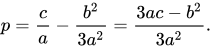
A cubic equation of general form can be reduced to canonical form by dividing by and variable replacements bringing the equation to the form:



Where

History
Cubic equations were known in ancient Babylon, the ancient Greeks, Chinese, Indians and Egyptians [1] [2] [3] . Cuneiform tablets of the Old Babylonian period (20–16 century BC) were found containing tables for calculating cubes and cubic roots [4] [5] . The Babylonians could use these tables to solve cubic equations, but there is no evidence that they did this [6] .
The problem of doubling a cube uses the simplest and oldest of the cubic equations, and the ancient Egyptians did not believe that its solution exists [7] . In the fifth century BC, Hippocrates reduced this problem to finding two means proportional between one segment and another twice its size, but could not solve it with a compass and a ruler [8] , which, as is now known, cannot be done.
In the III century AD, the ancient Greek mathematician Diophantus found complete and rational solutions for some cubic equations with two unknowns ( Diophantine equations ) [3] [9] . It is believed that Hippocrates , Menehm, and Archimedes came closer to solving the problem of doubling a cube using conic sections [8] , although some historians, such as Reviel Netz, say that it is not known whether the Greeks thought about cubic equations , or just about tasks that can lead to cubic equations. Others, such as Thomas Heath , translator and commentator of all the works of Archimedes who have survived, disagree, pointing to evidence that Archimedes did solve cubic equations by intersecting two cones [10] .
Methods for solving cubic equations appear in the Chinese mathematical text Mathematics in nine books , compiled around the second century BC and commented on by the Chinese mathematician Liu Hui in the third century [2] .
In the 7th century, during the Tang Dynasty, the astronomer and mathematician Wang Xiaotong, in his mathematical treatise entitled Jigu Suanjing, outlined and solved 25 cubic equations of the form , in 23 of which , and in two equations [11] .
In the 11th century, the Persian poet and mathematician Omar Khayyam (1048–1131) made significant progress in the theory of cubic equations. In his early work on cubic equations, he discovered that a cubic equation could have more than one solution, and argued that the equation could not be solved with a compass and a ruler. He also found a geometric solution [12] [13] . In his later work, A Treatise on the Demonstration of the Problems of Algebra , he described the complete classification of cubic equations with their general geometric solutions using intersections of conic sections [14] [15] .
In the twelfth century, the Indian mathematician Bhaskara II tried to solve cubic equations without much success. However, he gave one example of a solution to the cubic equation [16] :
In the same century, another Persian mathematician, Sharaf ad-Din (1135-1213), wrote Al-Mu'adalat ( Treatise on Equations ), which refers to eight types of cubic equations with positive solutions and five types that do not have positive decisions. He used the approach that later became known as the Ruffini - Horner method for numerically approximating the root of the cubic equation. He also developed the concept of the derivative of the function and the extrema of the curve to solve cubic equations that may not have positive values [17] . He understood the importance of the discriminant of the cubic equation for finding an algebraic solution of some special types of cubic equations [18] .
Leonardo of Pisa, also known as Fibonacci (1170-1250), was able to find positive solutions of the cubic equation x 3 + 2 x 2 + 10 x = 20 using the Babylonian numbers . He indicated a solution of 1.22,7,42,33,4,40 (which is equivalent to 1 + 22/60 + 7/60 2 + 42/60 3 + 33/60 4 + 4/60 5 + 40/60 6 ) [19] , which differs from the exact solution only by three trillion.
At the beginning of the 16th century, the Italian mathematician Scipio del Ferro (1465-1526) found a general method for solving an important class of cubic equations, namely, equations of the form with non-negative n and m . In fact, all cubic equations can be reduced to this form, assuming the possibility for and be negative, but negative numbers at that time were not yet known. Del Ferro kept his discovery a secret until he told his student Antonio Fiore about it before his death.
In 1530, Niccolo Tartaglia (1500-1557) received two tasks in the form of cubic equations from Zuanne da Coi and announced that he could solve them. He soon received a call from Fiore for a mathematical competition, which, after its completion, became famous. Each of them had to offer a certain number of tasks to the opponent to solve. It turned out that all the problems obtained by Tartaglia were reduced to cubic equations of the type . Shortly before the deadline, Tartaglia managed to develop a general method for solving cubic equations of this type (rediscovering the del Ferro method), and also generalize it to two other types ( and ) After that, he quickly solved all the tasks proposed to him. Fiore received from Tartaglia tasks from various branches of mathematics, many of which were beyond his power; as a result, Tartaglia won the competition.
Later, Gerolamo Cardano (1501-1576) repeatedly tried to convince Tartaglia to reveal the secret of solving cubic equations. In 1539 he succeeded: Tartaglia informed his method, but on condition that Cardano would not open it to anyone until the release of Tartaglia’s book on cubic equations, on which he worked and where he was going to publish the method. Six years later, Tartaglia never published his book, and Cardano, by then learning about Ferro’s work, considered it possible to publish the method of Ferro (with the name of Tartaglia, who discovered it independently) in his book in 1545 . Cardano justified himself by promising not to tell anyone the results of Tartaglia, and not del Ferro. However, Tartaglia believed that Cardano had broken his promise and sent a challenge to the competition, which Cardano did not accept. The challenge, in the end, was accepted by the student of Cardano Lodovico Ferrari (1522-1565), and was the winner [20] .
Cardano noted that the Tartaglia method sometimes (namely, in the presence of three real roots) requires extracting the square root from a negative number. He even included calculations with these complex numbers in Ars Magna , but, in fact, he did not understand the problem to the end. Rafael Bombelli studied this problem in detail, and therefore is considered the discoverer of complex numbers.
Francois Viet (1540-1603) independently derived a solution to the cubic equation with three real roots. His decision was based on the trigonometric formula
In particular, the substitution leads the equation
to mind
Later, Rene Descartes (1596-1650) deepened the work of Vieta [21] .
The roots of the equation
Number that turns an equation into an identity is called the root or solution of the equation . It is also the root of a third-degree polynomial on the left side of the canonical notation.
Over the field of complex numbers , according to the main theorem of algebra , the cubic equation
always has 3 roots (taking into account the multiplicity).
Since each real polynomial of odd degree has at least one real root, all possible cases of the composition of the roots of the cubic equation are exhausted by the three described below. These cases are easily distinguished by discriminant.
So, only three cases are possible:
- If Δ> 0, then the equation has three different real roots.
- If Δ <0, then the equation has one real and a pair of complex conjugate roots.
- If Δ = 0, then at least two roots coincide. This can be when the equation has a double real root and another material root different from them; or all three roots coincide, forming a root of multiplicity 3. The resultant of the cubic equation and its second derivative helps to separate these two cases: a polynomial has a root of multiplicity 3 if and only if the specified resultant is also equal to zero.
By Vieta's theorem, the roots of the cubic equation related to coefficients the following relations [22] :
By dividing the indicated identities into each other, several more fair relations can be obtained:
- ,
- ,
- .
- ,
Solution Methods
General exact solution methods:
- Formula Cardano
- The trigonometric formula of Vieta
- Chirnhaus Conversion
For some special types of cubic equations, there are special solution methods. See for example:
- Return equation
- Bezou theorem
You can also apply numerical methods for solving equations .
Substitution Vieta
As indicated above, any cubic equation can be reduced to the form:
Let's do the substitution known as Vieta substitution:
As a result, we obtain the equation:
Multiplying by , we obtain the sixth degree equation from which, in fact, is a quadratic equation from :
Solving this equation, we obtain . If a , and are three cubic roots , then the roots of the original equation can be obtained by the formulas
- and
Omar Khayyam's decision
As shown in the graph, to solve the equation of the third degree where Omar Khayyam built a parabola circle whose diameter is a segment positive axis , and a vertical line passing through the intersection of a parabola and a circle. The solution is determined by the length of the horizontal segment from the origin to the intersection of the vertical line with the axis .
Simple modern proof of construction: multiply by equation and group the terms
The left side is the value on a parabola. Circle equation coincides with the right side of the equation and gives the value on the circumference.
See also
- Bring Root
- Cube
Notes
- ↑ British Museum BM 85200
- ↑ 1 2 John Crossley, Anthony W.-C. Lun. The Nine Chapters on the Mathematical Art: Companion and Commentary. - Oxford University Press, 1999. - S. 176. - ISBN 978-0-19-853936-0 .
- ↑ 1 2 Van der Waerden. Geometry and Algebra of Ancient Civilizations. - Zurich, 1983. - S. chapter 4. - ISBN 0-387-12159-5 .
- ↑ Roger Cooke. The History of Mathematics. - John Wiley & Sons, 2012 .-- P. 63. - ISBN 978-1-118-46029-0 .
- ↑ Karen Rhea Nemet-Nejat. Daily Life in Ancient Mesopotamia. - Greenwood Publishing Group, 1998. - P. 306. - ISBN 978-0-313-29497-6 .
- ↑ Roger Cooke. Classical Algebra: Its Nature, Origins, and Uses. - John Wiley & Sons, 2008. - P. 64. - ISBN 978-0-470-27797-3 .
- ↑ Guilbeau, 1930 states that "the Egyptians believed that a solution was impossible, but the Greeks came closer to a solution."
- ↑ 1 2 Guilbeau, 1930
- ↑ Thomas L. Heath. Diophantus of Alexandria: A Study in the History of Greek Algebra. - Martino Pub, 2009 .-- ISBN 978-1578987542 .
- ↑ Archimedes (translation by TL Heath). The works of Archimedes. - Rough Draft Printing, 2007 .-- ISBN 978-1603860512 .
- ↑ Yoshio Mikami. The Development of Mathematics in China and Japan. - 2nd ed. - New York: Chelsea Publishing Co., 1974. - S. 53-56. - ISBN 978-0-8284-0149-4 .
- ↑ Work by Omar Khayyam, Scripta Math. 26 (1963), pp. 323–337
- ↑ in O'Connor and Robertson’s book “Omar Khayyam”, MacTutor History of Mathematics archive, University of St Andrews, you can read. This problem led Hiam to the cubic equation x 3 + 200 x = 20 x 2 + 2000 and he found a positive root for this equations as the intersection of an equilateral hyperbola and a circle. An approximate numerical solution was then found by interpolating the trigonometric tables .
- ↑ JJ O'Connor and EF Robertson (1999), Omar Khayyam , in , state, “Khayyam seemed to be the first to think about a general theory of cubic equations.”
- ↑ Guilbeau, 1930 states, “Omar Al Hey Khorasan, around 1079, did a lot along the path of advancing methods for solving algebraic equations using intersecting conic sections.”
- ↑ Datta, Singh. History of Hindu Mathematics. - Delhi, India, 2004 .-- S. 76 ,. - ISBN 81-86050-86-8 . p. 76, Equation of Higher Degree; Bharattya kala prakashan
- ↑ O'Connor, John J .; Robertson, Edmund F., “Sharaf al-Din al-Muzaffar al-Tusi,” MacTutor History of Mathematics archive, University of St Andrews.
- ↑ JL Berggren. Innovation and Tradition in Sharaf al-Din al-Tusi's Muadalat // Journal of the American Oriental Society. - 1990. - Vol. 110. - Vol. 2 . - P. 304-309. - DOI : 10.2307 / 604533 .
- ↑ RN Knott and the Plus Team. The life and numbers of Fibonacci // Plus Magazine. - 2013.
- ↑ Victor Katz. A History of Mathematics. - Boston: Addison Wesley, 2004 .-- S. 220. - ISBN 9780321016188 .
- ↑ RWD Nickalls. Viète, Descartes and the cubic equation // Mathematical Gazette. - July 2006.- T. 90 . - P. 203-208.
- ↑ Bronstein I.N. , Semendyaev K.A. Math reference book. - Ed. 7th, stereotyped. - M .: State Publishing House of technical and theoretical literature, 1967. - S. 139.
Literature
- Bronstein I.N. , Semendyaev K.A. Handbook of Mathematics. - Ed. 7th, stereotyped. - M .: State Publishing House of technical and theoretical literature, 1967. - S. 138-139.
- Lecture 4 in Tabachnikov S.L. Fuchs, DB Mathematical divertissement . - ICMMO, 2011 .-- 512 s. - 2000 copies. - ISBN 978-5-94057-731-7 .
- Guilbeau, Lucye (1930), " The History of the Solution of the Cubic Equation ", Mathematics News Letter T. 5 (4): 8–12 , DOI 10.2307 / 3027812