Steam tank (tracked) ( eng. Steam Tank (tracked) ) - a combat vehicle, driven by a steam engine. The most famous American tank during the First World War , equipped with a steam engine.
| Steam tank | |
|---|---|
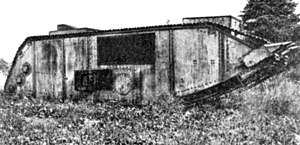 Steam Tank (Crawler) US Engineering Corps; sponsons not mounted or removed | |
| Steam Tank (tracked) | |
| Classification | flamethrower tank heavy by weight |
| Combat weight, t | 50.8 |
| Layout diagram | Diamond-shaped, with a sponsored arrangement of weapons |
| Crew | eight |
| Story | |
| The number of issued, pcs. | one |
| Key Operators |  |
| Dimensions | |
| Body length mm | 10600 |
| Width mm | 3800 |
| Height mm | 3200 |
| Clearance mm | 420 |
| Reservation | |
| Type of armor | steel bulletproof |
| Armament | |
| Gun type | Flamethrower |
| Firing range, km | 0,027 |
| Machine guns | 4 × 7.62 machine guns (two in sponsons from each side) |
| Other weapons | Bow ram |
| Mobility | |
| Engine type | 2 × Stanley Motor Carriage Company Steam Engines |
| Engine power, l with. | 50 |
| Speed on the highway, km / h | 6 |
| Specific Power, l s / t | 9.8 |
| Suspension type | hard |
Content
Creation History
The initial tank design was developed by an officer from the United States Engineering Corps (United States Arms of Enginesers , USACE ), after which the development was initiated by General John A. Johnson with support from the Endicott-Johnson Shoe Company and funding from the Boston Bank Phelan and Ratchesky (the cost of creating the machine was approximately $ 60,000). The engines were commissioned by the Stanley Motor Carriage Company , which produced steam cars .
At the beginning of 1918 the only copy of the car was completed, after which in April of that year, it was shown to the general public in several parades.
Design Description
The car had a diamond-shaped layout, very similar to the layout of British tanks of the same period.
Armament
The tank was armed with a flamethrower, which was located in the frontal sheet of the armor. Additional weapons were ram.
Engine
The power plant was unusual - instead of internal combustion engines , the tank used two steam engines with a kerosene heating boiler, with a total capacity of 500 liters. with. . In addition, the tank was additionally equipped with a 35 liter kerosene engine. pp., necessary for the flamethrower to operate efficiently (the kerosene engine gave a pressure of 1600 psi , while steam engines gave only 700).
Combat use
In 1918, the tank was sent to France for combat tests, however, the First World War ended before the tank could take part in combat clashes.
Other types of steam tanks
In Vladimir Dobrovolsky’s book, Modern Steam Cars and Tractors, issued in 1936, with reference to the Technological News magazine, he mentions the “light tank of the Kingdom of Illyria” equipped with a steam engine.
The development of the tank with a steam engine was carried out in the USSR. There are archival documents indicating that on March 14, 1936, the ABTU RKKA concluded a contract with the Kolomensky Machine-Building Plant for the manufacture of a prototype steam-powered installation with a capacity of 600 liters. with. (in the documents it passes as a PT) for installation in a heavy T-35 tank. One T-35 tank was transferred to the Kolomna plant. Kuibyshev for working off a steam power plant on it. The tank in correspondence was called PT-35 (Steam Tank). However, no more documents were found on this subject, and it was not possible to establish whether the tank was switched to steam draft.
The military’s interest in installing a steam engine on a tank is understandable: a steam engine can run on any solid-state solid fuel and does not depend on centralized deliveries of motor fuel, thereby achieving high tactical mobility and independence from the supply bases of this type of combat vehicles. However, this idea was never embodied in an effective technique.
Photo Gallery
Links
- United States heavy tanks - Tanks! (eng.)
- Weapons of War - Tanks - First world war.com