Khiva campaign of 1873 - military expedition of the Russian Empire with the aim of conquering the Khiva Khanate in 1873 .
| Khiva campaign in 1873 | |||
|---|---|---|---|
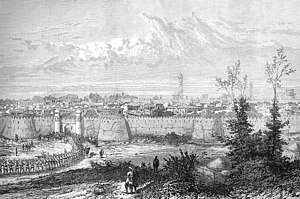 Russian troops enter Khiva in 1873. | |||
| date | 1873 | ||
| A place | Khiva Khanate , Bukhara Khanate , Turkestan Governor-General , Central Asian possessions of the Russian Empire | ||
| Total | victory of Russia, Gendemian peace treaty | ||
| Changes | The Khiva Khanate falls into political and economic dependence on Russia and loses a significant territory on the right bank of the Amu Darya . | ||
| Opponents | |||
| |||
| Commanders | |||
| |||
| Forces of the parties | |||
| |||
| Losses | |||
| |||


Content
Background
By the 70th. XIX century. The Russian Empire conquered the two largest states in Central Asia - the Bukhara and Kokand khanates . Significant territories of these states were annexed. The Khiva khanate remained the last independent state in Central Asia. It was surrounded on all sides by the Russian territories and the territories of the vassal Russia of the Bukhara Khanate.
Fighting
The conquest of Khiva Khanate was carried out by four detachments that came out in late February and early March 1873 from Tashkent (General Kaufman ), Orenburg (General Verevkin ), Mangyshlak (Colonel Lomakin ) and Krasnovodsk (Colonel Markozov ) (2–5 thousand people) 12-13 thousand people and 56 guns, 4600 horses and 20 thousand camels. The command of all the detachments was entrusted to the Turkestan Governor-General General Kaufman K. P.
Speaking on February 26 from the Embin post , the Orenburg detachment of General Verevkin across the steppes, covered with deep snow, headed for Khiva . The hike was extremely difficult: started in a harsh winter, it ended in the scorching heat in the sands. During the journey, clashes with the enemy occurred almost daily and the Khiva cities of Khodjeyli , Mangit and others were taken. On May 14, the vanguard of the Orenburg detachment joined up with the Mangyshlak detachment of Colonel Lomakin . On May 26, the combined Orenburg and Mangyshlak detachments approached Khiva from the north and on May 28 both detachments settled in a position opposite the Shah-Abad gates of Khiva; On May 28, the detachments stormed the gates, General Verevkin was wounded in the head during the assault and command was transferred to Colonel Saranchov . [1] On May 29, the Turkestan detachment of Adjutant General Kaufman approached Khiva from the south-east and entered Khiva from the southern side, a truce was announced and the Khivans capitulated. However, due to the prevailing powerlessness in the city, the northern part of the city did not know about the surrender and did not open the gate, which caused an assault on the northern part of the wall. Mikhail Skobelev with two companies stormed the Shahabat Gate, first made his way inside the fortress and although he was attacked by the enemy, he kept the gate and the shaft behind him. The assault was stopped by order of General KP Kaufman, who at that time peacefully entered the city from the opposite side.
Krasnovodsk detachment of Colonel Markozov, due to lack of water, was forced to return to Krasnovodsk and did not participate in the capture of Khiva.
Implications
The medal "For the Khiva campaign", established in 1873 by Emperor Alexander II in honor of the successful end of the military campaign, for awarding military officials, civilians and clergy, militias and volunteers as part of the Russian army. | ||
Between Russia and the Khiva Khanate a Gendemian peace treaty was concluded . The Khiva Khanate recognized the protectorate of the Russian Empire over itself.
On July 22, 1873, Emperor Alexander II, specifically for the participants in the described military events, established a state award — the medal “For the Khiva campaign” .
General Kaufman was awarded the Order of St. George , 2nd degree, and in 1874 promoted to engineer-general .
Colonel Lomakin , who commanded the Mangyshlak detachment, received the rank of major general (seniority of July 22, 1873) for distinction, a golden saber with the inscription “For Bravery” and was awarded the Order of St. Vladimir 3rd degree with swords, German Red Eagle 2nd degree with swords and a star, Persian Leo and Sun 1st degree.
Colonel Markozov was removed from command and accused of the disaster of the Krasnovodsk detachment; as a result, he retired, but after the results of the reconnaissance of the Skobelev wells in the Karakum Desert became known, all charges were dropped and on August 14, 1874, Markozov returned to service.
See also
- Khiva campaign of 1839-1840
- Gendemic Peace Treaty 1873
- Medal "For the Khiva campaign"
- Central Asian possessions of the Russian Empire
- Kaufman, Konstantin Petrovich
- Khiva Khanate
Notes
Literature
- Grodekov N.I. Khiva campaign of 1873. The actions of the Caucasian troops. SPb. ed. magazine "Russian antiquity" 1883. . Eastern literature . The appeal date is February 11, 2011. Archived April 12, 2012.
- Markozov V. Krasnovodsk detachment. His life and service from the date of landing on the eastern shore of the Caspian Sea to 1873 inclusive. SPb. 1898. . Eastern literature . The appeal date is February 11, 2011. Archived on August 23, 2011.
- McGahan J.A. The military actions on the Oxus and the fall of Khiva. M. 1875. . Eastern literature . The appeal date is February 11, 2011. Archived on August 23, 2011.
- We have become a firm foot on Amu-Darya. Khiva campaign in 1873 in the description of Grand Duke Nicholas Konstantinovich // Source. Documents of Russian history, № 4 (58). 2002. . Eastern literature . The date of circulation is February 11, 2011. Archived February 21, 2012.
- Nujevskiy M. Recollection of the commander of the 2nd Turkestan rifle battalion L. G. Veymarne. Tashkent. 1874. . Eastern literature . The appeal date is February 11, 2011. Archived April 12, 2012.
- Saranchov E. Khiva expedition in 1873 Notes of an eyewitness, sapper E. Saranchova. SPb. 1874. . Eastern literature . The appeal date is February 11, 2011. Archived on August 23, 2011.
- Sadykov A.S. Economic ties between Khiva and Russia in the second half of the XIX - early XX centuries, Tash., 1965.
- Khrebtov A.N. Khivinsky campaign: Four readings for the troops and the people. - SPb .: Type. A.M. Kotomina, 1875. - 122 p.
- Khivinsk campaign in 1873: (According to official sources). - SPb. : Printed in Type. Department, 1873. - 166 p.
- Lobysevich F, I. Description of the Khiva campaign in 1873, St. Petersburg, 1898.
- Alikhanov-Avarsky Maksud Hiking in Khiva (Caucasian troops). 1873. Steppe and oasis. - SPb .: Y. Lieberman Steam Raptor, 1899. - 314 p.