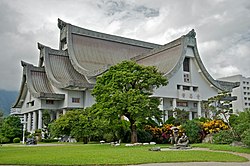

Buddhism is the main religion on the island of Taiwan. 90 percent of Taiwan's population follows a Chinese tradition that combines the principles of Confucianism , Taoism, and Buddhism . [1] . At the same time, according to various estimates, from 7 to 15 percent of the population is quite strict about Buddhism. [2] A distinctive feature of Taiwanese Buddhists is vegetarianism .
According to official figures, about 8 million people belong to Buddhism, but some of them profess syncretic religions, which cannot be considered strict Buddhism.
Buddhism in Taiwan is currently concentrated in four main schools, which are headed by the so-called “ Four Heavenly Kings of Taiwanese Buddhism”:
- North ( Jinshan, Taipei ): Shenyang Teacher (聖 嚴, d. 2009), Dharma Drum Monastery (法鼓山)
- South ( Dashu , near Kaohsiung ): Teacher Xingyun (星雲), Fo Guang Shan Monastery (佛光 山)
- East ( Hualien ): Teacher Zhenyian (證 嚴) Tsi Ji Foundation (慈濟 基金會)
- West ( Nantou ): Teacher Wei Jue (惟 覺), Zhong Tai Shan Monastery (中 台山)
All four schools represent Chan Buddhism . Some of these schools are influenced by humanistic Buddhism (人間 佛教) by the Yin Shun teacher (印順). The missions of the four main Taiwanese schools operate around the world, with centers in many countries. Taiwanese Buddhists also play an important role in restoring Buddhism in China
Content
History
Buddhism was introduced to Taiwan during the Ming Dynasty by settlers from Fujian and Guangdong . After Kosingha expelled the Dutch from Taiwan, his son founded the first Buddhist temple.
After Taiwan joined the main China of the Ming Dynasty , after 1683 a large number of monks arrived from Fujian and Guangdong provinces , many temples of different schools were built. However, monastic Buddhism did not arise until the 19th century .
During Japanese colonization (1895-1945), the Buddhist temples of Taiwan were streamlined and subordinated to the central temples:
- North ( Keelong ): Mount Yumei (月 眉山), a monastery founded by a teacher of Shanhui (善慧)
- Center ( Miaoli ): Fayun Temple (法 雲 寺), founded by teacher Jueli (覺 立)
- South ( Tainan ): Kaiyuan Temple (開元 寺), also founded by teacher Jueli
At this time, Buddhist temples fell under the influence of Japanese Buddhist schools, in particular, rectors who were married were widespread. On the contrary, those temples that adhered to the celibacy and vegetarianism of the priests opposed Japanese schools.
With the coming of Kuomintang to Taiwan, a large number of monks fled from the mainland, who received privileges from the new government. At this time, the Chinese Buddhist Association (中國 佛教 會) was formed, taking control of Buddhist temples and monasteries. This association arose in 1947 (in Nanjing ) and moved to Taiwan. Only in the 1960s did independent Buddhist organizations become permitted, which became especially widespread after 1987; The influence of the Chinese Buddhist Association has fallen.
The first large independent organization was founded by Xingyun , it was popular among believers after a series of radio programs in the fifties.
Later, Nun Zhenyang , who received initiation from Yin Shun , founded the Tsi Ji School, which also became an influential charitable organization. Several hospitals operate under the auspices of Tzu Ji in Taiwan. In 1999, Tzu Ji School provided tremendous assistance to the victims of the Puli earthquake.
In the eighties, under the influence of the leaders of Buddhist organizations, the Ministry of Education of Taiwan relaxed the requirements for educational institutions, allowing the creation of Buddhist universities. Almost every school has created its own universities and colleges.
In 2001, teacher Xin Tao (心 道) opened the Museum of World Religions (世界 宗教 博物館) in Taipei. This museum exhibits materials on ten world religions and demonstrates the structure of the universe according to the Avatamsaka Sutra .
In 2009, one of the most influential Shenyang teachers, the abbot of the Dharma Drum Monastery, passed away.
The popularity of Vajrayana Buddhism has greatly increased in recent years, the island was visited by Tibetan lamas, leaders of all four Tibetan Buddhist schools, and the Dalai Lama XIV was also in Taiwan in 1997, 2001 and 2009.
Recent Growth
According to statistics from the Taiwan Ministry of the Interior, the number of Buddhists in Taiwan increased from 800 thousand in 1983 to 4.9 million in 1995. The number of registered temples increased from 1,157 to 4,020, and the number of monks and nuns increased from 3,470 to 9,300 [3] . This trend is explained by the vigorous activity of Buddhist organizations and teachers.
Sources
- Chandler, Stuart. Establishing a Pure Land on Earth: The Foguang Buddhist Perspective on Modernization and Globalization. University of Hawaii Press, 2004.
- Government Information Office (Taiwan), Republic of China Yearbook , 2002.
- Hsing, Lawrence Fu-Ch'uan. Taiwanese Buddhism & Buddhist Temples / Pacific Cultural Foundation: Taipei, 1983.
- Ho Erling, “ Buddha Business ” (article 2002.
- Jones, Charles Brewer. Buddhism in Taiwan: Religion and the State, 1660-1990. University of Hawaii Press, 1999.
- Madsen, Richard. Democracy's Dharma: Religious Renaissance and Political Development in Taiwan. University of California Press, 2007.
Literature
- Azarenko Yu.A. Buddhist organizations of modern Taiwan // Religious Studies (journal) . - 2002. - No. 4 . - S. 145-149 . - ISSN 2072-8662 . Archived on August 28, 2014.
Notes
- ↑ Major Religions Ranked by Size
- ↑ NIRC homepage has moved Archived May 11, 2004 on Wayback Machine
- ↑ Lin, Diana. "As Buddhism Grows, So Grows Its Impact," Free China Review , 9.