Shoktsy ( Croatian šokci , Serb. Shocki ) is a Croat subethnos living in Croatia , Serbia , Hungary and Romania , mainly in the historical area of Backa . The Croats themselves are perceived as “ Serb Catholic ”.
| Shocky | |
|---|---|
| Abundance and area | |
| Total: about 10,000 people. | |
 Hungary ( Baranya ): Hungary ( Baranya ): | |
| Tongue | Serbian , Croatian |
| Religion | Catholicism |
| Related peoples | Serbs , Croats |


The historian of the 18th century, Jovan Raic, argued that “shoktsy” is a contemptuous name given to South Slavic Catholics by South Slavic Orthodox [1] .
Content
History
The earliest known mentions in the Ottoman Empire about Shockahs date back to 1615 (1024 in accordance with the Islamic calendar). Ferman Sultan Ahmed I in one of the documents called them a population belonging to the "Latin faith", whose "religion is completely different from the faith of the Serbs, Greeks and Vlachs." They are also mentioned in the documents of the Roman Catholic Church, where they asked Jerome Lucic to appoint Bishop of Bosnia and Slavonia in 1635.
The actual origin of the shockers is not entirely clear, although they may be descendants of the original Slavic population, who came to Slavonia and the surrounding areas during the Slavic resettlement period.
Regardless of when exactly they settled there, the shockers are considered descendants of the indigenous Croatian population in Slavonia and Vojvodina, while the majority of the modern population of these regions are descendants of the last settlers. It is worth noting that the invasion of the Ottoman Empire led to a large deportation of the Christian population from Bosnia and Herzegovina, as well as other neighboring regions, so that according to one version, the population again moved from the more southern areas (Bosnia) to the north.
Culture
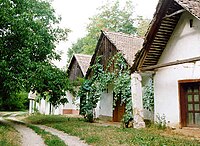
Many of the traditions of the Shocki people depend on their environment - they live in the fertile lowlands, where they grow grain and corn in large fields. Villages often have one main street (šor), where each subsequent family house is an ancillary building * with a spacious yard, as well as a well. The central street is surrounded on both sides by canals with water, which have small passages so that one person can get to the house.
Families often keep poultry, especially ducks and geese, although pigs are the main source of meat. They use pork products such as ham, sausages (especially Kulen) and bacon. These products are usually obtained by traditional fall in the fall. The most common fruits are plums, not least because they are used to make traditional home-brewed moonshine - plum brandy .
Shoktsy pay much attention to folklore. Each village is a whole cultural society where they sing folk songs and perform national dances. They also hold an annual celebration called Šokačko sijelo.
The most recognizable feature of the shock culture is their music, which is played mainly on the vestibule . Many tambour groups have achieved nationwide fame in Croatia. Tambour is traditionally made from maple, poplar or plum wood, but today it is mostly made from fir. Another instrument used in the past is bagpipes . Traditionally, wedding celebrations pay much attention, and sometimes even invite entire villages.
The traditional costume of the Shockians is made of white fabric with lace decoration. Women generally wear such clothing only in summer, replacing it with wool clothing in winter. The most revered decoration of the clothes of the Shockians are gold coins, called “ducats” (dukati). The rich girl of Shok had to wear a large number of ducats woven on her chest, not only as a decoration, but as a clear sign that she came from a wealthy family.
Shoktsev annually arranges bushoyaras . Bushoyaros is an annual celebration of the shokis living in the town of Mohacs (Hungary), starting at the end of the carnival season (“Farsang”) and ending the day before Ash Wednesday . Features of the celebration are Bouchards (people wearing traditional masks), folk music, disguises, parades and dances. Bushuarash lasts six days, usually during February.
Notes
- “ The history of different Slavonic peoples, especially Bulgarian, Croatian and Serbian, seized obscurations izyataya ... - Vienna, 1794. - Part 1, Book I, Chapter XIX, paragraph 4.
Links
- (Serb.) Lazo M. Kostić: Srpska Vojvodina i njene manjine , Novi Sad, 1999.
- (Serb.) Mile Nedeljković: Leksikon naroda sveta , Beograd, 2001.
- (Croatian) Tko su Šokci? (Who are the Šokci?)
- (Croatian) O porijeklu Šokaca, iz knjige "On the origin of Šokci, from the book" Šokadija of Zagreb ")
- (Serb.) "KOLIKO SE POZNAJEMO?" - brochure of the Vojvodina project "AFIRMACIJA MULTIKULTURALIZMA I TOLERANCIJE U VOJVODINI"